A Trip in Java

5%

Review and Herald Publishing Assn. · Takoma Park Station, Washington, D. C. · Oct 10, 1916

FromThe Youth’s Instructor, Vol. 64, No. 41.

Read the full edition

A Trip in Java

K. M. ADAMS
At five o’clock in the afternoon our boat, the “Melchior Treub,” slowly drew away from the wharf at Singapore. Our friends and loved ones waved their good-bys, and our hearts thrilled with the realization that we were at last on the journey to Java. Just at the moment of departure, some luggage was thrown from the boat to the wharf, and it appeared that a family was too late to catch the boat. But when the last piece was on the wharf, a Chinese ran up and with chattering gesticulations ordered the things to be replaced on the boat. It was interesting to see whether all the goods could be returned before the boat was too far away from the dock. The lines had been cast off, but the coolies who were transferring the baggage did not hasten. Fortunately, all was safely returned to the ship, although the last trunk was passed over four feet of water.
As soon as the boat moved away from the ship, several skiffs, made from hollowed logs, darted out from under the dock, and their occupants called for money to be thrown into the water. They were Malays, and they were as much at home in the water as on land. No sooner was a coin tossed overboard than there were half a dozen splashes in the water, and a tangle of legs and feet would then appear. A short pause, and first one head would bob up, and then another. An agile leap, and they were back in their canoes. They bail out the water that is shipped when they get in, by a forward kick of the leg from the bottom of the boat up the side and so over the edge. To see them handle their canoes, one would think that it was very easy, but to try it is a different matter.
Some skiffs had two and even three occupants. In one was a father and two sons. These boats followed the ship for some little distance, until the speed of the ship was too great for them to keep up with.
The wharf grew fainter and fainter in the distance, and was soon lost to view as the boat made a turn in its course. A sleek-looking man-of-war was at rest near by. Its dull gray paint reminded us of the war that is raging in Europe, and for the moment it seemed that even we, so far away, were not entirely free from its influence. Another reminder of hostilities was the line of buoys that lazily floated in the harbor. These buoys warned of unseen danger beneath—the mines that are placed to protect one of the most important coaling stations and fortresses in the Far East.
The “Melchior Treub” is the finest boat in the local East Indian passenger service. Decks, dining-room, and social-hall are roomy, and the staterooms are very comfortable. The berths are not one over the other as in most boats, one being in the end of the room, and the other at the side. There are no cockroaches to be seen, and that is the greatest recommendation that can be given to one who has traveled in the tropics. In some boats a person cannot sleep at night because these large insects, some of them three inches long, run over the berth, and even across one’s face.
The passengers, as ordinarily, represented many nationalities. The Dutch predominated, as this is a Dutch boat. There were several English, a few Americans, and some Chinese, together with the usual collection of business men, tourists, and missionaries. In the fourth class were hundreds of Malays and Chinese. They slept on the after deck on mats of their own providing. They were served rice and vegetables for food. The boat was loaded to its capacity, as nearly all ships are now, for the war has caused a great shortage of boats, and all ports are choked with freight. The rates of carriage have trebled, as have the prices of ships. One ship in Singapore was sold at so great a price that, if the ship were weighed and sold by the pound, the owner would have received twenty-five cents a pound for it. A man bought a ship, and a few months later sold it for just twice what he paid for it.
The servants on the boat are all from the Netherlands Indies. Some are Javanese, others Sundanese, and many are probably from Borneo, Celebes, or even Sumatra. Their faces have that passive immobile look which is natural only to the Malay. They look very neat in their white uniforms. Their headdress is a large gaudy kerchief, which is tied about and over their heads. Underneath their coats are to be seen glimpses of their sarongs, sort of skirts that are worn by most Malay tribes. The boys are not allowed to wear them about their legs while on the smooth decks.
There was a circus on board, bound for Java. The menagerie was on the rear deck. Lions, tigers, hyenas, and other animals were there, and one wondered what would happen should one of these beasts break through the frail-looking cages, and spring among the natives below. There are several circuses and shows that travel about the Orient. They are necessarily small, but they are a never-ending source of delight to the natives. The children of the East are ever happy, and anything that will amuse never fails to attract. No matter about the future; take all the money there is and enjoy the present.
At the southernmost point of Banka, a large island of the Dutch East Indies, is a lighthouse. There are many lighthouses scattered about these waters, for the islands are innumerable, and many reefs lie hidden under the surface. The whole sea from the Malay Peninsula to Java and from Sumatra to Borneo has scarcely a spot more than one hundred and fifty feet beneath the surface. A ship can be a hundred miles from land, and yet drop anchor. But on the south side of Java and Sumatra, the depth at a few miles from the coast is thousands of feet. It seems as if there was a huge crack in the earth’s crust along the southern coast of Java; and that along this crack numerous volcanoes had sprung up, forming the islands of Java and Sumatra. Indeed, there are now many active volcanoes in Java and Sumatra. The greatest volcanic eruption known to man was the explosion of Krakatua not fifty years ago. The remains of the crater may still be seen to the south of Sumatra.
About a mile from Banka is the low-lying black line of an ugly-looking reef. Our ship passed between this and the island. The steward told us that a boat on which he was traveling, had, not long before, run onto that very reef. The buoy that marked the channel had broken loose and drifted three hundred yards from its moorings. The captain, thinking that the buoy was in its usual place, steered the proper distance from it, but the ship struck the reef. The weather was calm, so the boat was saved, but it had to undergo extensive repairs in dock. The reefs and islands of these waters make navigation difficult and dangerous.
The coast of Sumatra soon came into sight. It lies to the west like a huge, long sea serpent. There is not a mountain to be seen. On the island of Banka to the east, are many hills and mountains. The water at the bow of the ship froths into a peculiar orange color, instead of the usual white foam. No doubt it is a different kind of water brought by a current. We passed one current whose edge was marked by a strip of yellow foam. On one side of the line the water was a muddy green. On the other side it was the purplish black of the deep sea. There were not twelve inches between those two shades of water.
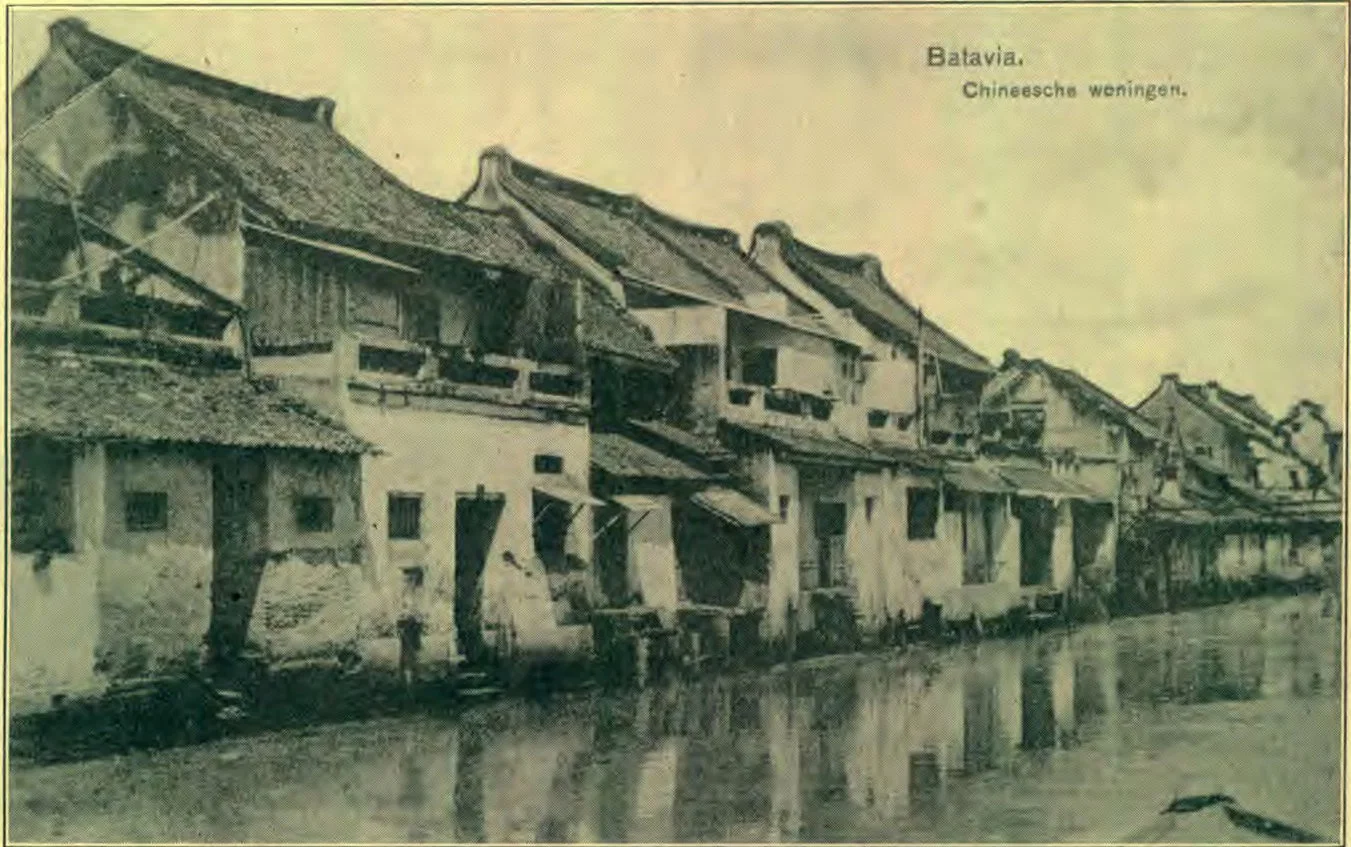
CHINESE HOMES IN BATAVIA, JAVA
One evening while we were sitting at dinner, the lights of a boat passing very close by, were seen. Suddenly a searchlight was thrown onto the boat we were on, and our engines slowed down and stopped. Some one said, “Kapal prang” (warship), and the excitement became intense. We lay to for half an hour while the British torpedo boat destroyer, for such it proved to be, hovered near at hand. “Had England declared war on Holland, and was our boat captured?” was the query in every mind. A cutter rowed by, sturdy sailors came bringing two officers. In a short time they returned, while the Britishers on our vessel sang “Tipperary” as a serenade. The news filtered through finally, that the latest war news was all that was wanted. Our ship started on its journey again, and we settled into the customary routine of boat life.
Early next morning the islands near the harbor of Batavia came into view. We steamed on and were soon inside the breakwater. To our right were three little gray Dutch warships, speedy and shallow of draft. They are used mainly for coasting about the islands of the archipelago, and putting down small rebellions, and capturing pirates, of which there are not a few in these waters. The pirates do not attack large steamers, but small boats, especially those owned and plied by the natives, are always in more or less danger. The sides of the island facing into the shallow sea are especially favorable for pirates, for the land is flat, there are enormous swamps, and the estuaries and river mouths are numberless, giving them unlimited opportunities of escaping from the warships.
The harbor of Tandjong Priok is about eight hundred feet wide and a mile long. Our boat had to turn around in this narrow space, but did so carefully, and before long was alongside the dock. Passengers who have round-trip tickets are not required to have passports to enter the Netherlands Indies, but those who do not must pay an entrance fee of ten dollars. If they leave before six months, this money is refunded. After paying their fee of ten dollars, they must get a passport, which they must use when traveling about on the island. Java has a population of more than thirty million, and the Dutch are not anxious that more people shall come there. They do not care to have Europeans settle in Java. It is said they want all the business and money-making for the Dutch; so they make the living hard for foreigners by taxes and formalities. These same hindrances used to be placed on tourists, but the Hollanders are waking up to the fact that a tourist trade means more money brought into the island, so they are encouraging tourists to come.
As we went down the gangplank, there was a horde of coolies who seized our hand baggage. These coolies are Javanese. There were many other kinds of people on the wharf: Dutch, English, Chinese, and Arabs. Java has very few people from India, but they are numerous in all the English colonies. Our baggage was taken to the customhouse. There is a duty on practically everything except personal clothing. Cameras, typewriters, bicycles, books, and kindred things are enlarged with duty. All tobacco has a heavy duty. Firearms of any description are not allowed to be brought into the Netherlands Indies without a special license. The authorities fear that the natives will get possession of them and start a rebellion. After being questioned closely about the contents of our baggage, we were allowed to proceed without having to open it.
We made our way to the railway station near by, and climbed on board the train. Here we had an altercation with the coolies about prices. They misstated the number of pieces carried, said we could cut their throats if they were not telling the truth, and threatened never to carry another piece of baggage if we did not pay them what they wanted. At last the train left, and we were at peace.
Tandjong Priok is about five miles from the city of Batavia. Weltevreden, the new Batavia, is about three miles farther away. We were to stay in the latter place. The train took us through low-lying land, principally given over to grazing. After a time we came to gardens, then houses, and in a short time we were at the station in Weltevreden.
On the railroad there are three classes of carriages. The first-class is really better in equipment than the average coach in America. The seats are upholstered with leather, and are soft and roomy. The second-class seats are made of wicker, and have springs. The third-class have only board seats with backs. The tourists and government officials use the first-class; the fare is three cents a mile. The second-class is used by the ordinary business men and planters, and the best class of Chinese. The third-class is used by the natives. The second-class fare is two cents a mile; the third-class, two thirds of a cent a mile.
  • (To be continued)*