SWIMMING is one of the most helpful and effective of exercises, bringing almost every muscle of the body into wholesome play. Some go so far as to say that the teaching of swimming should be made compulsory in every school. As a life-saving device and disease preventive, it challenges wide attention.
The season for outdoor swimming is past, except for those fortunate enough to be living in the Southland; but some of our readers may have access to indoor swimming pools, and since the instructions may be preserved for future use, some rules for aiding one to acquire most readily the art of swimming are herewith given. Future issues of the paper may contain further lessons. Mr. J. H. P. Brown, in his book, “Modern Swimming,” gives the following suggestions and rules:—
“First learn how to float, and ascertain the buoyancy of your body. This knowledge will give you confidence to start the different strokes, for these are all taken from one or the other of the three floating positions.
“Breathe properly. The nose, not the mouth, is made to breathe with.
“Relax thoroughly. This is the whole secret of healthy, competent, and pleasant natatorial pastime. Tension tires, arrests progress, and injures the system.
“You cannot float unless you relax. Relaxation may be termed the keynote to all forms of buoyancy and propulsion in the water.
“Back-floating. This is the easiest form of floating, and will be the subject of our first lesson.
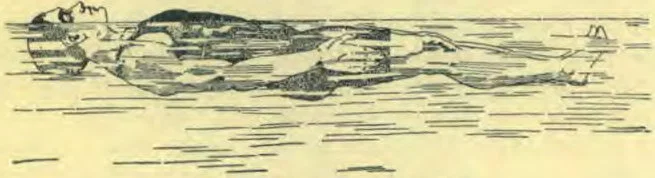
“Do not hesitate, go right at it. Walk out into the water up to the waistline, squat down slightly upon the legs, and facing the open, fall backward so as to lie upon the water. The head must hang loosely and sink to the opening of the ears; the arms should lie by the sides. Do not bother about the legs; if they are kept relaxed, they will take care of themselves. If upon the first impact with the water the head should sink so as to submerge the face, keep relaxed and remain perfectly quiet, and the body will balance itself so as to make you feel at ease.
“Fill the lungs as you drop to the surface; exhale when you are comfortably positioned upon it, after which you should breathe naturally. By practicing deep breathing in this manner you will dispel much of the nervousness the first attempt to float generally causes.
“As soon as you feel perfectly at ease in the back-floating position, alternate the positions of the arms as follows: First, extend them to right angles with the sides; second, clasp the hands together, fingers interlaced, and place them under the head, with the elbows flat upon the water; third, fold the arms over the chest; fourth, lay the hands across the abdomen; fifth, cross the arms under the back; sixth, bring the forearms to right angles with the upper; seventh, hold the arms straight above you.
Synopsis
Lie upon the back in the water.
Relax thoroughly.
Allow the head to drop so as to cover the ears.
Breathe slowly and through the nose.
Inhale as you fall upon the back, and exhale as soon as you are comfortably positioned.
Keep the arms by the sides and under the surface.
The legs will take care of themselves, if relaxed.
The top of the head should point to the shore.
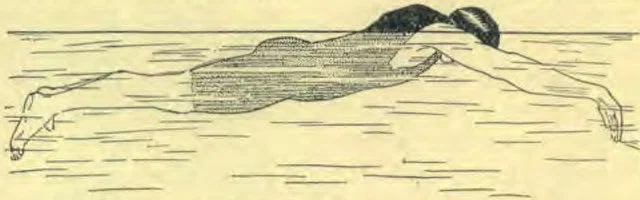
“Stomach-floating. Step out into the water up to the waistline, and fall forward onto the stomach, facing the shore. The face should be submerged up to the backs of the ears. Breathe in deeply as you fall forward, and exhale under the water. Keep all parts thoroughly relaxed. As soon as you feel obliged to breathe in, raise the head to do so, when it should again be immediately dropped so as to exhale as before.
Synopsis
Face the shore and fall forward.
Breathe in as you drop to position.
Exhale under the water.
Keep well relaxed.
Raise the head to inhale, and drop it back quickly to exhale.
“Side-floating. This is the most difficult manner of sustaining oneself above the surface and in correct position because of the difficulty experienced in keeping the body balanced.
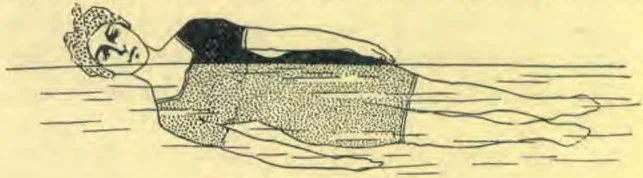
“Take the back-floating position. Turn the head so as to have either side of the face on the water. Bring the arm and leg of the opposite side to which it lies upon, over in front of the body. As soon as you have turned sufficiently, balance by moving the arm or leg backward or forward. When you have the proper position, straighten out the upper leg so as to lie directly over the under one and the upper arm to repose upon the side. Be sure to avoid tension. The lower corner of the mouth should be laved by the water, and no tension of the neck muscles permitted. Breathe in as you turn; exhale when you are properly positioned.
Synopsis
Start to turn from the back-floating position by first turning the head.
Bring the arm and leg over.
Balance by either the forward or backward movement of either the upper leg or arm.
“As the various positions in floating are the initial steps to all forms of propulsion in the water, they should be thoroughly mastered. A disregard for proper poise and relaxation will cause much annoyance in your efforts to become graceful and efficient in the different strokes.
“To rise from either the back- or the stomach-floating position it should always be borne in mind that thep. 9 head leads the body. If you are upon the back, raise the head and allow the knees to flex so as to be able to kick backward under the body and thus assist it to an upright position. If you are in the stomach-floating position, simply allow the legs to sink; at the same time draw them toward the abdomen so as to be able to kick downward as the head is raised from the water and stretched back between the shoulders.”