The Need of a Nation
THE first necessity in pioneer work is to awaken public opinion to the need of a reformation, and this was accomplished in Montevideo, the capital city of the republic of Uruguay, by means of a lecture given by Dr. Joaquin De Salterain, for twenty-five years official statistician in charge of the national archives.
According to the report presented in the Academy of Medicine in Paris, February, 1915, by Prof. Gilbert Ballet, France alone surpasses Uruguay in the number of saloons in proportion to the inhabitants, having one saloon for each 82 inhabitants.
Uruguay stands next, with one saloon for each 246 inhabitants; the United States has one for each 380 inhabitants; England has one for each 430 inhabitants; and Sweden has one for each 5,000 inhabitants.
The total number of drunkards in Montevideo reaches the maximum, especially among those in the period of adolescence. The number of licenses amounts to 10,000: 3,000 in Montevideo, and 7,000 in the departments of the interior. During the year 1913, 10,240 persons passed through the police courts of Montevideo for drunkenness, more than two and one-half per cent of the entire population, or 9,769 men and 471 women.
The director of the national asylum demonstrated that alcohol was the cause of twenty per cent of our lunacy. The latest figures available, those for 1911, give an increase in proportion of insane persons on December 31, as 1,506, in 361 of whom the insanity was entirely due to alcohol.
Added to these sad victims, the judge of crime of the second grade states that from 1900 to 1911 he had pronounced 653 sentences, of which 184 were for drunkenness. The judge of correction states that fifty per cent, or exactly half of his definite sentences, were caused by alcohol.
The judge of instruction of the third grade estimated that ninety per cent, almost the total number of cases of homicide, wounding, and attacks of personal violence, were due to alcohol.
The judge of crime of the first grade shows that for three years in succession the proportion of alcoholic delinquents rose from 24 to 32 and 36 per cent respectively.
More of these convincing figures might be added, but sufficient had been placed before the highly intelligent and patriotic people of Uruguay to awaken their determination to enforce a revolution in these matters in their cherished capital.p. 5
Revolutionary Measures
At the close of the lecture given by Dr. Joaquin de Salterain, and attended by the Ministers of the Interior and of Public Education, by the doctors and professors of the university, and many gentlemen holding high positions in the public service and bearing the highest recommendations in private life, together with their wives and daughters, more than 300 names were inscribed as members of the Anti-Alcoholic League.
A few days later, on the tenth of June, 1915, a meeting was called by the Señora Manuela de H. de Salterain, one of the most distinguished ladies of the capital, to hear a lecture by Miss Hardynia K. Norville, delegate of the World’s W. C. T. U., entitled, “Our World-wide Work.”
In the beginning of July, 1915, the president called a meeting in the Atheneum, in which the constitution and regulations were read and accepted, forming the committee of the National Anti-Alcoholic League of Uruguay. At this meeting Dr. Baltasar Brum, the Minister of the Interior, gave the opening address, “assuring the women and children that he was sure of the success of the association, since they were at the head of it.”
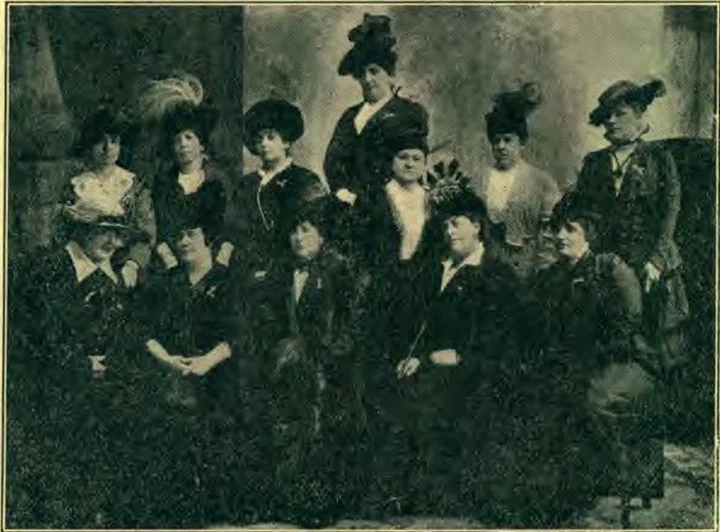
The constitution consisted of nine articles, with the object, according to Article II, “of educating public opinion in favor of total abstinence, especially for the children, saving the drunkard, and endeavoring to arrive at the legal prohibition and complete destruction of the sale of alcoholic liquors.”
The pledge employed is the following: “I promise to abstain from the use of all intoxicating liquor, and to use every possible means to prevent its sale and use.” This pledge conveys all the privileges of active membership and confers the right to vote in all official meetings.
The organization of the society was further defined in twenty-one departments, beginning with the Cradle Section for babies and children under seven years of age. In this section all the mothers are total abstainers for the period of lactation, an immense gain over popular opinion and practice. Each baby is decorated with a tiny white ribbon bracelet, and each mother receives a certificate.
Of the Loyal Temperance Legion for children from seven to sixteen years of age, Dr. Jose Espalter, Minister of Public Education, is the honorary president. The Señorita Enriqueta Compte y Riqué, active president, enlisted the aid of twenty-five of the most prominent teachers of the public schools, organized temperance fêtes in the largest halls and theaters of the city, and prepared programs for the Gold Medal Contest, in which one pupil from each school took part.
The Young Women’s Department under the able presidency of the Señora Berta de Maria de Pratt, organized the young people of the city to take an active part in the struggle against alcohol throughout the whole country.
A Food Reform Department was included in one branch of the work, with the object of recommending a diet based on cereals, fresh and preserved fruits, and fresh vegetables, with a view to allaying thirst and proving that alcoholic liquors are unnecessary.
The department that attracted the most enthusiastic support was that of the mothers, presided over by the Señora Carmen Cuestas de Nery, the daughter of the ex-president of the republic. This devoted lady gathered round her a circle of sixty ladies, divided into five committees, and meetings for mothers were held in the largest theaters and halls of the city, for scientific instruction and social intercourse. The greatest triumph of all was when, in the public banquets and social gatherings, at which ladies of the highest rank were present, it became the fashion to turn down the wine glasses and decline champagne and wine of all kinds. To gain this vantage ground required the greatest tact, but inch by inch the idea of sacrifice for the sake of others grew and strengthened in the minds and lives of these noble women.
Liberty to the Captive
For the first time in the annals of this republic, prison doors were opened by special concession of the council of penitentiaries, jails, and correctional schools. The doors of the state prison opened to the messengers of good tidings, to admit as bearers of the good news the little children of the city. The young and innocent were admitted to bear witness by their bright young lives and happy faces as harbingers of hope to the captives of sin. A Christmas tree was decorated and lighted, and a program was given by the children, after which the six hundred inmates marched past to receive from the hands of little children their gifts of fruit and candies. Many tears were shed, and the pledge of total abstinence for life was taken by nearly all present. The director of the prison gave a short address, and aided in securing signatures to the pledge cards.
All the ministers of the government and their wives gladly gave their names as honorary members of this department.
The wife of the minister of war, the Señora Margarita de S. de Sanchez, one of the most active members of the central committee, is president of the Department for Work in the Army and Navy, and is untiring in her effort on behalf of the soldiers and sailors of the republic.
Temperance and the Produce of the Country
The government has already taken measures to convert the produce of the vineyards of the country from their present use to a more wholesome purpose. Ten years is allotted to the task of converting the winep. 6 industry into a temperance industry, such as the producing of dried grapes or raisins, and canning or preserving the grape juice. Generous concessions are made by the government to bring about this industrial reformation.
Meetings continue to be held in all these departments, with medal contests, which are greatly appreciated, and the influence of the Anti-Alcoholic League of Uruguay is already making an impression on all classes of society in the republic, demonstrating the fact that when the national government of a country awakes to its responsibilities, and unitedly combats this immeasurable evil of drink, a loyal and willing people will gladly follow its lead. It is our hope and aim that the larger republic of Argentina will soon follow the footsteps of her younger sister republic, and raise the flag of temperance in her vast domain.
Dear boys and girls, do not forget your brothers and sisters of the republics of the great southern continent,—the dark-eyed boys and girls whose hearts beat high with hope and patriotism for a brighter future for their well-loved land. Through many centuries of despotism and depression these people have fought their way to a recognition of their individual rights, and now they are fighting the harder battle of the right to refuse to accept the despotism and despoiling of the ruthless foe—alcohol. Send us your sympathy, remember us in your prayers, and let us feel, as we rejoice over each addition to the dry States of North America, that the goal of dry republics is not an unattainable ambition, but may soon be a glorious reality.
May the Stars and Stripes point the way for the Blue and White to wave over many a gallant band of loyal legions, loyal to God and home and native land.
HELEN M. STEWART.