In early August we took a trip to Nikko, about eighty miles north of Tokio, to see something of the wonders of that place. There is a proverb current among the Japanese that “one should call nothing magnificent until one has seen Nikko.” In their language there is a pun on the words “Nikko” and “gekko.” The latter word means magnificent or wonderful. Whatever the proverb may say about the place, I will say that it is about the best thing that I have ever seen in all my little trips. It would take a week to describe the place, and then it would not have had fair treatment.
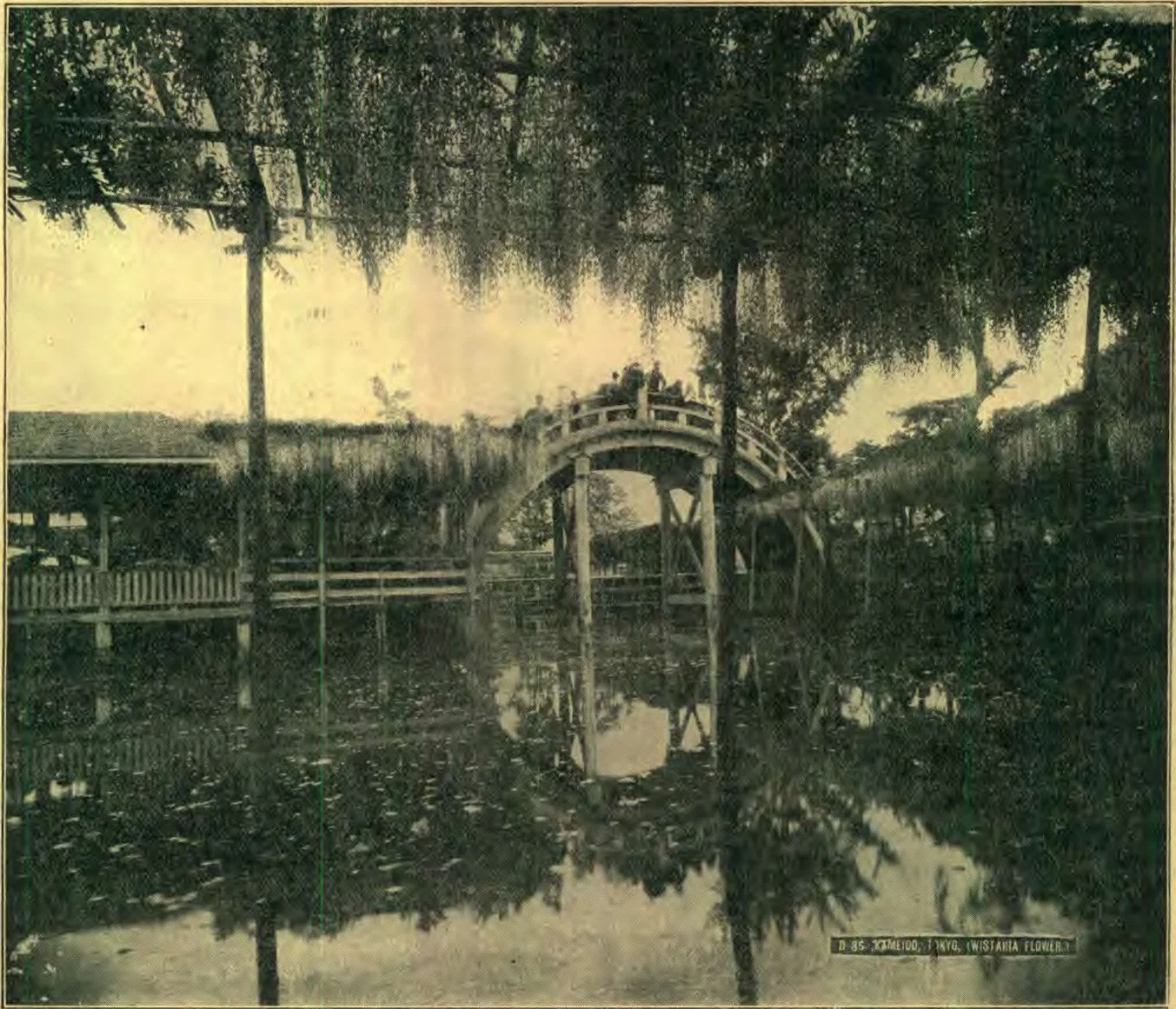
A SCENE IN TOKIO, WHERE THE WISTARIA ABOUNDS
The first thing that we discovered about it was that we were not perspiring as we had been doing in Tokio. Coming from the city in August was like coming out of a Russian bath into a cool breeze. Nikko is cool most of the time, even in the very hottest weather. Immediately after this discovery we were able to limber up and look around. First and foremost of the wonderful things one can see in Nikko are the trees. These are called cryptomerias and are gigantic things. They are somewhat like cedars in appearance, and grow straight and tall. It is queer that they should be able to grow so close together as they do; in places they simply crowd together. They are the property of the temples, and for this reason are considered sacred.
Water Seen and Heard Everywhere
Nikko is high in the hills and built on the hillsides, so that water runs down each side of the streets. A regular torrent of water runs in what corresponds to our gutters, only these are deeper. These streams make a pleasant sound all the time. They help to keep the place cool and clean, for the people just slop water around all day long. There is no need to be afraid of a wetting here, for it becomes second nature to paddle around in water.
We saw some of the hydroelectric plants that are numerous in this section of the country. It is a pretty sight to see the water running along so fast and yet so quietly until it takes the tumble down the long flumes. There are many streams from the mountains, and about every one is turned into an electric plant for power and light. The only way in which this has marred the natural beauty of the place is in the numerous power lines that are strung everywhere. However, these lines are to be preferred to a lot of smoking chimneys scattered over the otherwise fair landscape.
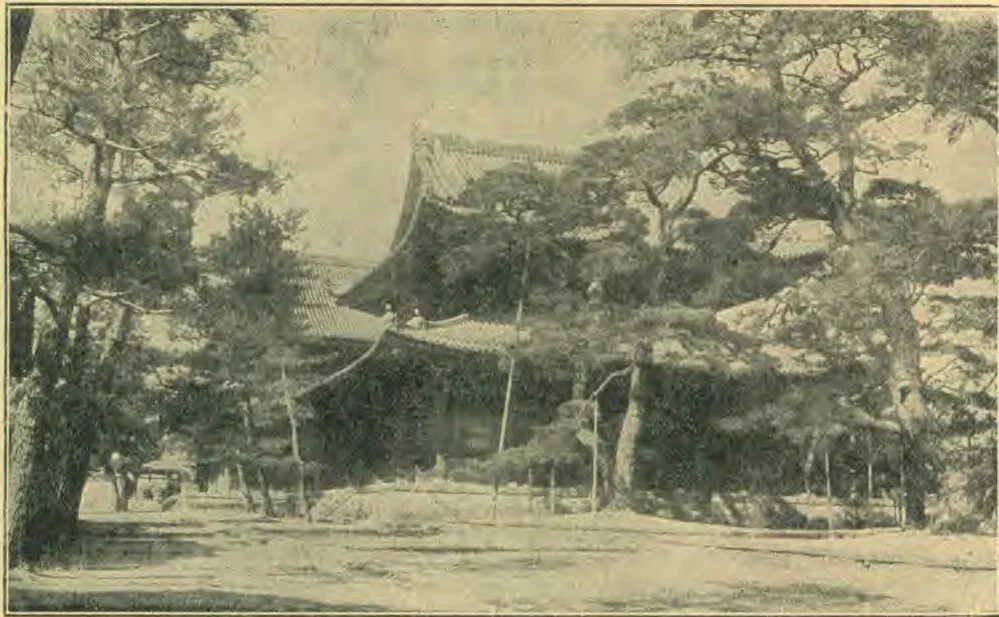
A BUDDHIST TEMPLE IN JAPAN
In the evening of the day of our arrival we took a6walk around the place where some of the most famous temples are located. It was restful to be able to walk about and not be bothered by mosquitoes. Although there are plenty of electric lights around, there is no glare. The trees are so thick that the light is largely confined to the ground. The effect is pleasing and much to be desired to the white lights of Broadway. There is something very soothing in the mellow light and in the sound of the water running along the side of the roads.
When it came to sleeping we had a jolly time. Three men occupied the front balcony of the house where we were staying. It was exactly 6 x 12 feet in size. We had separate beds of futones on the mats, and had to square ourselves around so that our heads did not break down the doors. One man was more than six feet tall, and he had to lie diagonally to avoid serious discomfort to his neck. Well, the sleeping was excellent. It got pretty cold before morning, but this was something one could stand after having had such warm weather in Tokio.
Lake Chuzenzi Our Goal
About nine o’clock we started for the real object of our visit to Nikko. This was a place named Lake Chuzenzi, situated away up in the mountains about 5,500 feet. A street car runs part of the way, but the major part of the trip has to be made on foot or in a jinrikisha. We carried our own food, as we are not too fond of the Japanese food that is offered at hotels and lunch houses along the way. We soon decided that the walking looked good, and so took a jinrikisha only for the children.
There is a splendid road up the mountain, but it cannot be used by any kind of carriage except the jinrikisha, as the turns are too sudden. The whole road climbs the face of the mountain by a series of zigzags. At many places one can take a peep over a sheer fall of several hundred feet or more. Naturally there are many picturesque views to be obtained along the way. The number of waterfalls is surprising. Some are small, while others have a tremendous drop.
After about four hours we reached the last fall of the series. This is called the Suicide Fall on account of its being a favorite spot for unfortunate people to make an end of things. It is said that it takes months for their bodies to come to the top of the water at the base of the fall. One could well imagine that they would make a deep dive, for the fall is three hundred fifty feet or more. The water breaks up into a mist before it strikes the bottom; that is, the outer part of the water does. It is possible to get a front view of this fall if one will take the trouble to climb down and up the path provided for viewing it. Recently the officials have erected a fence some distance from the fall so that one cannot get to the top of it without deliberately doing some fence climbing. This is done in the hope of stopping the deadly jumping over the fall.
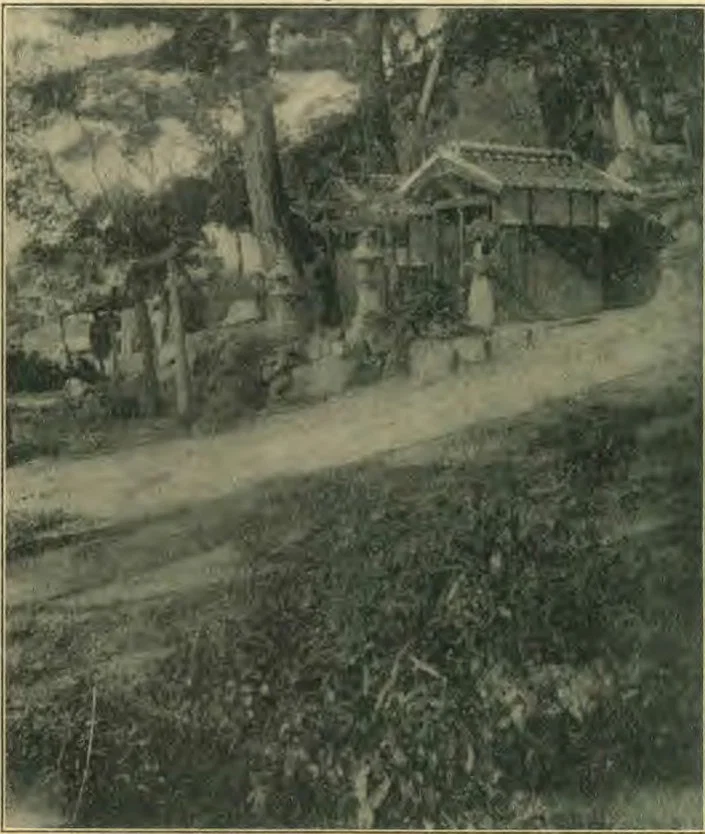
SHINTO SHRINES OF JAPAN
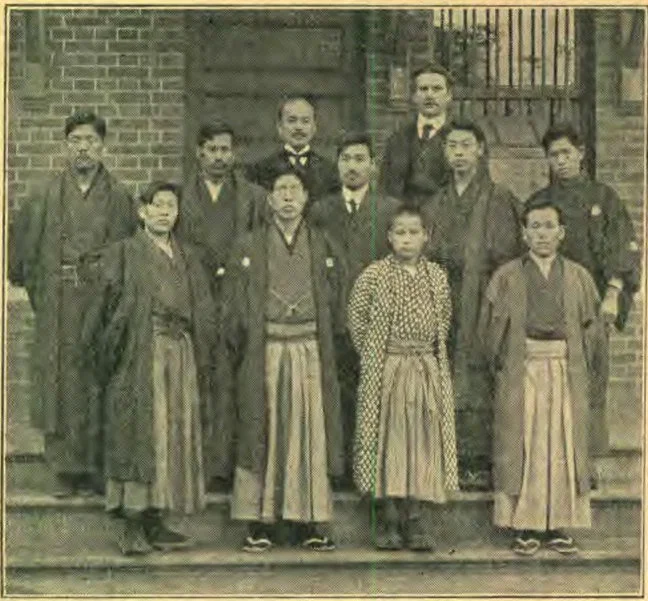
MR. A. B. COLE AND THE OFFICE FORCE
Mr. Cole Has Charge of the Publishing Work in Japan.
About a mile from this fall one gets the first view of the lake. This is a beautiful sheet of water from which all the power plants get their supply. It is possibly seven miles long and runs very cold. It is said to be well stocked with fish, and makes a good place on which to practice sailing and motor boating. There are many boats for hire, and a trip around the lake would doubtless be a very pleasant experience. On account of fatigue, however, we made no trips of this nature. All we did was to sit around and rest during the afternoon until the sun went down and the temperature dropped like a ball. Then we went to the hotel and got into the bath. This bath was made of wood, and was about 9 x 5 feet in size. It was heated from outside the building, and was so hot that it made the room very warm. When it came time for us to get into it, after sundry washings and scourings outside, we found that it was hot. Here I learned a secret. If one can control one’s emotions when entering very hot water it is possible to get in and stay in7as long as one wishes. The secret is to keep as still as a log and think of something that will give you cold chills. After some time we all three got in and had a good bath. If you want a treat, take a bath as hot as this was. By the time we were ready to get out we were warmed for the rest of the day and night. Such things have to be experienced to be believed and enjoyed.
In the morning, after a short look around we started to walk back over the road we had come up the day before. It is a question in my mind as to which part of this trip is the better. Coming down one has no work to do and has more time to see the beauties of nature. Going up one has to work, and gets the exercise that we all need.
Visiting the Temples
After dinner we started out to visit the wonderful temples of Nikko. These have some beautiful work in the way of decoration. Though I should rather see the beauties of nature than any number of heathen temples, at the same time one can hardly go through the world and keep one’s eyes shut to these things.
The better part of this morning trip was the walk through the grounds of the temples. Everything was so very fresh and cool that it reminded me of England in the springtime. The grass was in good condition, and there were plenty of flowers and bushes. Japanese gardens are always pretty, no matter what season of the year one may see them. The only thing that spoiled these beautiful things was the presence of the serpent in two forms. Real snakes were there, as we saw two dead ones. The footprint of the serpent is discernible in all the multitudinous forms of idolatry. A strange thing about these places is that the Buddhists and Shintoists seem to get along well together. The Buddhists worship Buddha and many forms of idols. The Shintoists do not worship idols, and have no form of such in their temples. They have a large disk of bright metal, sometimes silver and other times plated brass or even plain brass. They worship their ancestral spirits and, through the mirror, themselves. After all, they are not alone in self-worship, for many of us often do that very thing.
Our visit over, we came back to the heat and steam of Tokio, a charming city nevertheless. We felt the good effects of even three days in Nikko, and wished for a longer stay.