DURING our Christmas vacation another medical student at Loma Linda, California, and I felt the need of diversion from our studies. We decided that a trip to the mountains was the surest and pleasantest way of getting a great deal of recreation out of a short time, so we planned to ride our bicycles as far as possible, then push them until the roads got too bad, and finally, discard them, and carry our packs on our backs.
Accordingly 6:45 A. M., Wednesday, Dec. 26, 1917, found us starting on our journey, pedaling bicycles loaded to the limit. Behind our seats we tied our blankets, and to the handlebars secured supposedly enough food for nine meals, a complete repair outfit for our bicycles, and various camp accessories.
Having a good road, although much of the time a steep one, by ten o’clock we had made fifteen miles. Having eaten an early breakfast, we decided to lunch. As enjoyment and recuperation were the primary objects of our trip, after having eaten, we took a nap. Waking much refreshed, we pushed on, getting to a large mountain resort about sundown. Starting for the place where we wished to camp, we were forced, after going only about a mile, to leave our bicycles, carrying our luggage the rest of the way. Of all the roads I have ever seen, the last three miles to camp seemed the longest. The moon was kind enough to shine brightly, but under the tall trees our toes disturbed many a rock from its cozy bed in the middle of the road. Great was our rejoicing when we saw a signpost pointing the way to “Vivian Trail to Summit of Gray Back,” and knew that the place for our camp was only a few rods across the bed of a stream.
It was not long before we were enjoying a savory warm supper by a glowing camp fire. And again it was not long before we had spread our blankets upon a pile of pine needles, put a hot stone to our feet, and were fast going to sleep to the music of Mill Creek as it tumbled over the rocks below. By the way, let me emphasize the value of the stone to our feet: on our return twenty-four hours later it was still warm.
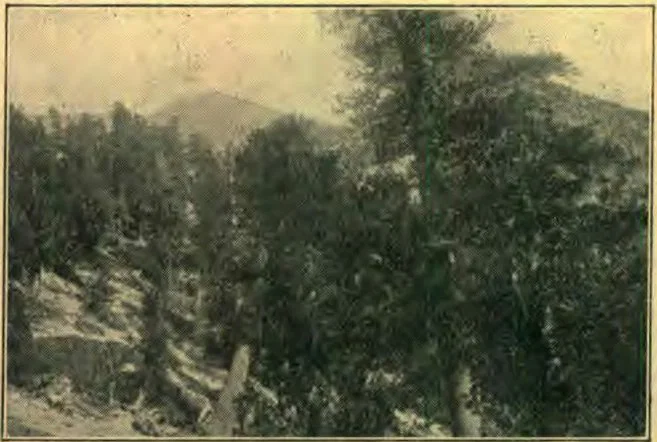
GRAY BACK AS SEEN FROM WHERE WE ATE DINNER
Our bed was in a deep valley with a high range of mountains, the Galenas, to the south, and the lesser hills on the way to Gray Back to the north. After breakfast the next morning we started up these hills, working up what are called “switchbacks.”
The path was exceedingly rocky. We were glad more than once that we had profited by previous experience and had our shoes “hobbed,” for on a previous trip to this same mountain my shoes gave out and I had to walk about twelve miles with a piece of canvas around one shoe.8
Up the path the scenery was always changing. At first the pines and spruce towered high in the air, but they soon got shorter and shorter. The creek along which we traveled for some distance would occasionally disappear and then reappear as it flowed over and under the ground. The most beautiful of views would appear when we rounded a point and saw the valley stretching out for miles and miles before us.
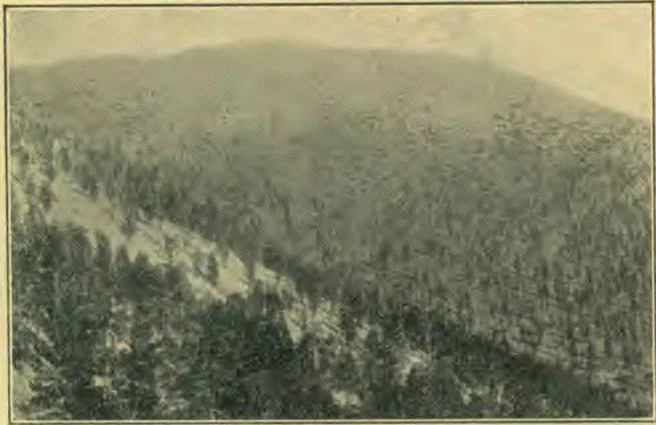
GRAY BACK TIMBER LINE
By eleven o’clock we were so high that our heads began to ache. Notwithstanding this we were hungry; so we stopped and had lunch, and then finding a sunny spot, took a short nap. After this we were able, by resting at brief intervals to get our breath, to reach the summit, where we found a pile of rocks with this sign, “Mount San Gorgonio [that is the geographical name of Gray Back, but the mountain is always called Gray Back], 11,485 feet.” We had climbed up approximately two miles since starting on our journey.
Standing there by that pile of stones, the view over the mountains and valleys was something grand. We could look down on Mt. San Jacinto, San Bernardino, and Baldy, each of which is more than 10,000 feet high, for we were on the highest mountain in Southern California. Away to the west was the Pacific Ocean, and the Santa Catalina Island, probably one hundred twenty-five miles away. To the south was Salton Sea and Imperial Valley. To the east was the desert glistening in the sunshine, and to the north a large lake with range upon range of mountains. And there in the midst of all this grandeur were just we two. Surely there is nothing like this kind of view to reveal one’s insignificance and the grandeur of God’s creation.
But it was afternoon, and as we were twelve miles from camp, we could not tarry. Do the best we could, the sun set when we were only about halfway down; but we had a good moon, and when it would not show the path to advantage, our flash light did good service. Indeed, one of the best views of the day was in store for us. When we were about 1,000 feet above camp, the moon shining on the range south of us brought it into relief as the sun had failed to do. Standing there, a sheer, steep slope probably three to four thousand feet high in the moonlight, it made an indescribably impressive scene.
We reached camp tired, hungry, and sleepy, but happy nevertheless. Our food for nine meals having lasted only six, we had to wait until our early return on the next day to satisfy our hunger; but we proceeded at once to dissipate our other ills by a refreshing sleep of eleven hours. Surely there is nothing better than a mountain hike to make one appreciate the God-given blessings of food, water, and rest.