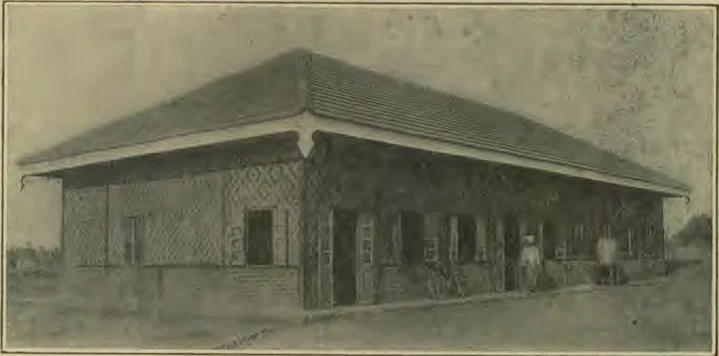
Houses
R. B. THURBER
SOON after coming to Burma, we received a letter from a small boy acquaintance in America, asking if we lived in a tree. Perhaps this idea is akin to the notion that the sun never shines in darkest Africa, or that all the vegetation in China is yellow. However, it may be our young friend did see a picture of a house in a tree, purporting to be a reflection of life in this country. After six years’ going about I have not yet seen the reality, so I suppose the Burmese houses are just about as ordinary as American houses.
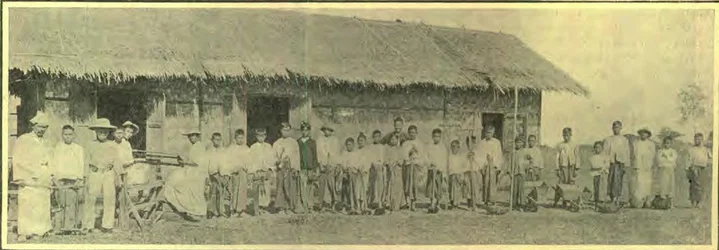
But the Burman is fond of living “up in the air,” at least in the low-lying parts of the country. Paddy (rice) is the most general crop, and it must be kept flooded. The ground is covered with water during the rainy season; and even if it were possible, it would be very uncomfortable and unhealthful to live in a house with a dirt floor. So the people usually perch their houses high up on posts.
The typical Burmese house is made entirely of bamboo, that inestimable boon to the poor man in the tropics. Its firm structure, light weight, and straight-splitting tendency make it very valuable for building purposes. With it he makes all parts of his house, his linoleum, candlestick, drinking cup, savings bank, cowbell, wrapping paper, horoscope, water pipe, furniture, baskets, handles for tools, and a hundred other articles too common to mention. I judge the least use he makes of it is for fishing poles.
The primitive and only tool needed for the building is the dah, a long knife just about the size and shape of a straight corn-cutting knife. It is also the general weapon. It is wonderful in how many ways the Burman can use it. It is said that a skilled jungle man in the olden days could go into the forest with nothing but a dah, and emerge in a day or two with a complete and well-made bullock cart.
In a typical Burmese house large enough to have two stories, the upper story is never above the lower, but is placed at the back, so that the two are like steps. If he can help it, no Burman will live or sleep beneath the room in which another lives or sleeps. When we started our school several years ago, we did not have room enough in the dormitory; and in my ignorance I suggested that we make “double-decker” beds. We were warned before it was too late.
Below the upper or back story of the house is the stable for the bullocks and carts. The floor of the bedroom above is made of split bamboo, and has cracks about an inch wide. So the air in the sleeping apartments cannot be very fresh and clean; and it would be almost unbearable if the walls were not made of bamboo matting and the windows kept open so that the breeze can have free course.
The roof is usually made of short pieces of stripped bamboo, which are lapped like shingles. From within, it is possible to study the heavenly bodies through the roof; but it is surprising how little of even the heaviest rains comes through when once the wood is wet.
Every year a careful house owner daubs the walls and posts of his house with a coat of crude petroleum, and this preserves the light material for several years. The average life of the roof and walls is three years, when it must be entirely renewed.
There is a little corner or room at one side of the front of the house which is set aside as a cooking place. The “stove” is a low, wide box filled with earth. On it are large stones on which the cooking utensils are placed, and among which the fire is built. The rice is cooked in an earthen pot; but the most common utensil is a large, shallow iron bowl in which many foods are boiled in grease. The Burman is very fond of fatty foods.
Burmese beds are usually made up on the floor, but some have a low wooden bed with bamboo strips for springs. A double mat or thin mattress is placed on top of the bamboo strips. The pillow is round and high and hard. There are no chairs, and a mat on the floor or a low platform serves as a table.
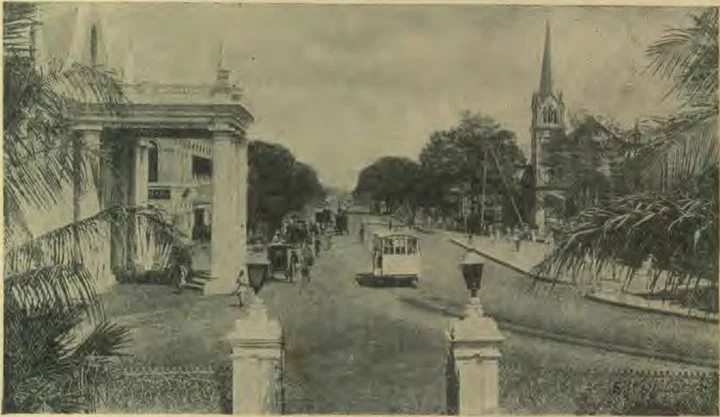
Except in the larger towns, where there are sanitaryp. 4 laws, the surroundings of a Burmese house are kept indescribably filthy. All refuse and rubbish goes through the floor, or is dumped near the house, and left. During most of the year the ground underneath the house is covered with puddles of stagnant water. If it were not for the animal and insect scavengers, conditions would indeed be deplorable. But chickens, ducks, crows, vultures, dogs, pigs, and ants attack the waste, and thus save the lives of the people from many epidemics. Is it any wonder that these filth consumers have the freedom of the house, and are never killed? There are very few flies; but mosquitoes abound, and make fevers very prevalent.