Our pioneer missionary in the Sunrise Kingdom was Pastor W. C. Grainger, principal of our school at Healdsburg, California. His interest in Japan was aroused by his acquaintance with a young Japanese brother who had accepted the truth at a tent meeting in Southern California, and had come to this school for further preparation for service.
In harmony with the law that those who are really called to work in distant fields will not be unmindful of the opportunities to sow the gospel seed in the homeland, Brother Grainger laid aside his school duties, and associated himself for some time with a mission conducted by the church in Oakland for the Japanese in San Francisco. When, in 1896, he sailed for Japan, he was accompanied by T. H. Okohira, the young Japanese convert already mentioned.
From the first, the work in Japan has developed slowly. “We were of the very last of the Christian denominations to enter the field,” says Brother F. H. De Vinney, “and had to encounter all the opposition found at home from the established churches, in addition to the self-satisfied indifference of a heathen people. Elder Grainger, who was well along in years, and other foreign laborers who followed, did not acquire the language, which, by the way, is admitted by the best authorities to be one of the most difficult in the world to learn.”
Recruits
But in spite of almost insurmountable difficulties, the work was begun. The Shiba Bible School was opened in a rented house, in which daily classes for the study of the English Bible were held at various hours. A year later, Brother Grainger’s wife and daughter arrived, and in another year Brother and Sister B. O. Wade and W. D. Burden came to assist in the work. Another Bible school was opened, and was filled with students. By the earnest efforts of those pioneers, some were led to accept the truth. Several of these have developed into earnest workers.
Our Mission Paper
The need of a Japanese paper was soon felt, and in July, 1899, the first number of the Owari No Fukuin (Gospel for the Last Days) was issued. This paper has been of great value to the work in Japan. Nearly all other denominations give away their literature, but all ours is sold. To give it away makes it of less value in the eyes of the people, and is not a good training for them. Though the price is very small, still its purchase entails some sacrifice, and therefore enhances its value in the eyes of the purchaser. Moreover, in this way we are enabled to give the truth to more people, by producing more literature. In 1914 the circulation of the Owari No Fukuin averaged about five thousand copies a month, most of which were sold by canvassers. Over three million pages of tracts and other periodicals were also sold during this period.
Medical Missionary Work Begun
In 1902 the medical missionary work was begun, under the supervision of Dr. S. A. Lockwood, and his wife, Dr. Myrtle S. Lockwood. No suitable opening being found for this work in Tokio or Yokohama, it was started in Kobe, a thriving port city three hundred and seventy miles southwest of Tokio. Nurses and other helpers came from the United States, and for a time this work prospered. Two Japanese physicians also opened a small institution in Kobe, and this continued some time with good success. One of the physicians, however, was obliged to retire, owing to ill health, and the work was taken over by Dr. Noma and a group of earnest nurses, and so continues to the present time. This sanitarium, known as the Eisei-in, is doing a good work for the Japanese, a work that foreigners could not hope to do. Dr. Noma is a very hard worker; and in addition to the oversight and management of her large family, the burdens falling to the lot of the head of a sanitarium, and the faithful performance of her church duties, she has opened up and successfully carried forward treatment rooms in Osaka, a suburb of Kobe.
Tent Meetings
The use of tents for holding series of meetings has been found a successful means of reaching the people. The first tent used for this purpose in Japan was secured in 1905,—a gift from friends in the homeland,—and has been in constant use ever since. In 1910 a second tent, in 1911 a third, and in 1913 a fourth were secured. Brother De Vinney says: “Our tent experiences are not remarkable, except for the number of children who gather. We always have to hold a children’s meeting in the hour previous to the regular meeting, and then dismiss them from the tent, or we should not have room for any adults. After two evenings the children will sing our good Christian hymns as if they had been accustomed to them all their lives.”
Progress
The last few years have witnessed great progress in the development of our work in Japan. An office building of brick for the printing plant, a school building, and a number of homes for the foreign and native workers have been erected, and a permanent headquarters established.
“One more foreign building, for the manager of the printing plant, who will also act as the secretary and treasurer of the mission, a small church building, and a dormitory for the young women attending the training school, will be needed to complete the headquarters plant.
“The mission’s compound and its buildings give it a standing with the government and the people that it has not had in the past. It has been urged upon those under conviction, that we had nothing permanent, and were liable to get discouraged, give up our work, and leave the country at any time; and if they cast their lot with us, they would be left alone, without help, advice, or sympathy—a laughingstock. But now they see that we have come to remain, and that in dealing with us they are dealing with responsible persons.”
Many of the lessons learned during the early years have brought a knowledge and confidence that will be a great help in carrying forward the work from this time. Perhaps one of the greatest blessings that has come is the recognition that the situation is a difficult one and the language very hard to learn, and the resolution to overcome the obstacles in the way. Young men are studying the language with a determination to conquer it, and they are having good success.
The Japanese learn English very readily, and many of the schools require it; therefore it is not to bep. 7 greatly wondered at that they should feel more or less contempt for foreigners who come to teach them, yet who do not attain some degree of proficiency in their language. However, some recognize the difficulties in the way. A Japanese lady who speaks several modern languages, said to the writer, on one occasion, that in her home they were always very careful to use only the most correct forms of speech; it was so easy, she said, to forget them, and that would never do; it would be a disgrace.
Some idea of the difficulties of the language may be gained from the following from Brother H. F. Benson, head of our training school: “We do have a difficult language. There is not a foreigner, perhaps, who has ever fully mastered it. We have three languages to deal with,—the ordinary colloquial, the original language, and the public-speaking language. The latter is about halfway between the literary and the colloquial. In order to read the Japanese, we must learn all the Chinese characters, in addition to a set of explanatory symbols. But all our students who have attended the language school in Tokio have done well, and have received good grades. What the other missionaries have done we can do, and they have been able to get enough of the language so that they can do acceptable work.”
The Work Extending
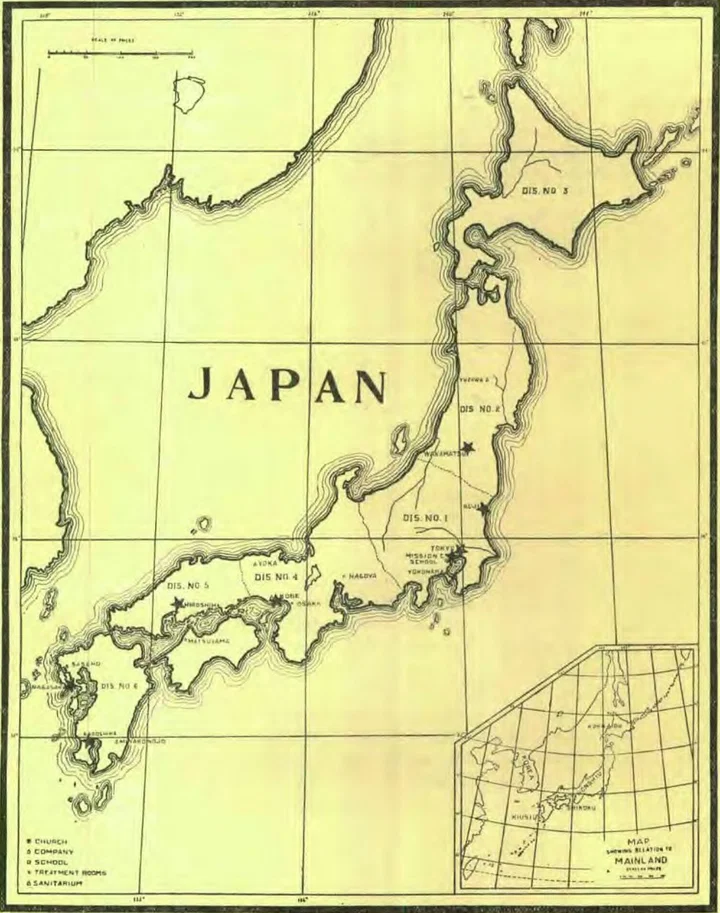
At the present time the Japanese Mission operates in three of the four main islands of Japan—Honshiu, Kiusiu, Shikoku—and in a smaller island off the western coast of Kiusiu—Hirado. The three main islands are divided into districts, with principal stations in Tokio, Kobe, Wakamatsu, Hiroshima, Nagoya, Nagasaki, and Kagoshima.
Jan. 1, 1915, the statistical report showed a total of three hundred and nineteen Sabbath keepers. Of these, seventy-six are workers, receiving their support either in whole or in part from the mission. The tithes and offerings last year showed a material increase, and the Sabbath school offerings have more than doubled.
Four tents were in the field during 1914, and good results were seen from their work. Special attention was given to instructing the women and children. In Wakamatsu a new church building was dedicated free from debt, and the debt remaining on the Kobe church was also paid. The mission now has sufficient money in hand to build a house of worship for the church in Tokio.
The Training School
Twenty students were enrolled in the training school during 1914-15, and these went into the canvassing work at the close of the school period. Our school in Japan occupies a peculiar position. In that field, when young men and young women from heathen families accept Christianity, they are in nearly all cases cast out of the home empty-handed, and not allowed to return unless they repudiate their faith and do penance to the gods and to the family. Brother De Vinney says:—
“To accept Christianity is to refuse to honor the family authority, deny the faith of the family, and insult the spirits of the dead. If the head of the family is the one thus to offend, the family is called together, and the headship and property are given to another, unless the family is already Christian. If it is a young wife who accepts the Sabbath or Christianity, in most cases the husband will divorce her, take away her children, and cast her out with nothing for her support. The condition of a wife or young woman under these conditions is truly pitiable.
“After a child passes the sixth grade, he cannot attend any public school and keep the Sabbath. A few have been admitted in denominational schools which were established before the public school system was adopted, and which are recognized by the government, but in most cases no student can go beyond the sixth grade unless he can attend our training school.
“Students who attend the government normal schools are obliged to teach for a term of years in the public schools. If such a one accepts the Sabbath, he can neither attend the normal nor teach, and must return to the state the whole cost of his normal training. There is no escape from this tax. We have one laborer who has been paying his tax for seven or eight years, and it will take him as much longer before he can be free. This year there will be two or three more in the same situation.
“Nearly all our present force of workers, and all the students of the training school have come to us under one or more of these conditions. In order to test the stability of those who enter the school, they are required to canvass for a time, that we may determine whether they are true-hearted, loyal to theirp. 8 profession, and in earnest in their desire to be trained in the Lord’s work. Often, when cast out of their homes, they are left with very little, if anything; and at present the canvassing work will give little more than a living of the plainest kind. When they are ready for school, nearly all are reduced to the clothing on their backs, and in many cases only summer clothing at that. The mission must furnish them with everything during the school year, except what they can earn out of school hours and on Sundays. They are required to work each day, but we have only a limited amount to give them that will aid in their support. All the rest must come from loyal friends at home.”
As the force of laborers must be constantly increased, to meet the increasing calls, it can be seen that the training school has an important work to do. School is held for six months, then the students go into the field for six months; those who are loyal take another six months, and a few have a third school year. Careful oversight is had of these young people when they enter the field to work, and frequent institutes are held with them.
Out of Heathenism
It has often been charged that we gain our converts from other denominations. Recently a careful inquiry was made into the history of every church member and baptized believer, and it was found that eighty per cent of these had come direct from heathenism, and had not previously been interested in Christianity.
Surely our hearts should be full of courage as we study the map of Japan (shown on page five of this issue), and see what has been accomplished so far. The believers in that field have much to contend with, and yet they are faithful, loyal, and earnest. In order to accept this truth, they must often suffer persecution and sever the dearest earthly ties. Let us do all we can to hasten the proclamation of the message in “Dai Nippon,” and not forget to pray that the Lord will bless the believers and workers in that distant land. A. B. E.