III
The Rogue River and Ager Routes
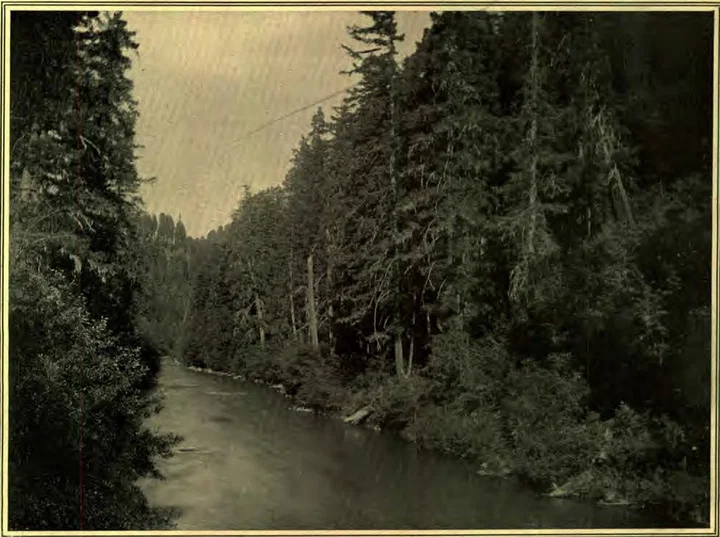
There are three routes by which one may go to Crater Lake from the railroad. The shortest and most picturesque is the Rogue River route. Another leads from Ashland, Ore., along what is called “the Dead Indian road,” through a rough and rugged country. This road is often chosen because of its famous hunting and fishing reserves. By the third route one leaves the railroad at Ager, Cal. This is the longest road of the three, but it is the easiest to travel,—though that is not saying much.
By the Rogue River route the traveler leaves Central Point, a little flag-station near Medford, Ore., and for a few miles passes through a fertile farming country. Then the road crosses mile after mile of sandy chaparral desert, until Big Butte Creek is crossed, some thirty-five miles from the starting-point. Here the mountains are entered, and the scenery rapidly becomes picturesque.
For five or six miles the road leads through open forests, then down into a deep cañon, at the bottom of which the Rogue River flows silently and peacefully,—deep enough to float a steamboat, and wide enough for one to turn around in. In this cañon the white pumice dust was so deep that it came up over my shoe-tops, and I had hard work pushing my wheel through it up the long, steep grade to the divide on the other side. From there to Prospect, another ten miles, the road climbs a gentle grade through a forest where madroña, oak, fir, and pine struggle for the ascendancy.
At Prospect the road again crosses the river,—not here a peaceful, sluggish stream, but a succession of foaming rapids and roaring cascades, which carry the water down hundreds of feet in a distance of less than half a mile. These rapids are called the Lower Falls of Rogue River. Just below the rapids, Mill Creek, a fair-sized stream, tumbles over the rocky wall of the cañon in a sheer fall of nearly two hundred feet. A short distance below is still another fall of equal height, but smaller in volume.
Beyond Prospect the road passes through a magnificent forest of sugar pines (Pinus Lambertiana), the most beautiful tree of the pine family. Specimens of this tree often measure ten feet in diameter, and two hundred feet in height. There is little undergrowth in these forests; and where the fires have not swept them clean, the ground is thickly carpeted with fallen needles, and strewn with giant cones, that often measure more than a foot in length.
Another ten miles, and the road passes near the Natural Bridge, where the river rushes under a natural arch of basalt to reappear at several openings a few hundred feet below. A few miles beyond, the road again passes close to the river, which here flows through a deep, narrow gorge, to plunge over an abrupt precipice one hundred and eighty feet high.
Beyond that point the road is steep and sandy. It leads through a forest of young fir-trees that struggle bravely on, though the half-burned remains of their predecessors constantly point to the fate in store for them.
The Rogue River road is the old military road, which in early days connected Jacksonville with Fort Klamath. Just at the foot of the last steep grade leading to the divide, the summit of the Cascade Range, a dim and little-traveled road branches off to the north. Nailed to a tree near by is a weather-beaten sign-board, on which are painted the words, TO CRATER LAKE.
When I visited the lake last summer, I chose the Ager route, and went back to the railroad by the Rogue River. But whether one goes to Crater Lake, or from it, along this road, he will see the same noble forests, the same rushing, plunging waters, the same rugged mountains, that I saw; and he would be well repaid for his journey, even though he never saw Crater Lake.
Ager, Cal., is not a city nor even a village; but it is a stopping-place on the railroad, and a starting-place for those who go by stage or wagon to Klamath, Hot Springs, or Klamath Falls. The distance from Ager to Crater Lake is one hundred and twenty miles; but I chose that route because I had been told that it was the only practical one for a wheelman to travel. That was a bit of misleading information, for there is no road to Crater Lake that is practical for a wheelman. But of three evils, I undoubtedly chose the least.
On my wheel I carried a load that weighed more than half as much as myself, and I found the roads so steep, rocky, and dusty that I was compelled to walk nearly all of the way.
The first ten miles of the road led across a desert, where only sage-brush and scrubby cedar-trees grow. Then I followed up the banks of quite a large creek, past its principal source,—a great spring bursting from a mountain rock,—and soon entered the heavy timber of the Klamath River Valley. The remainder of that day, and half the next, I trudged along the sandy road, seldom more than a stone’s throw from the turbid, rushing river, which seemed to be waging constant and noisy warfare against its rockbound, boulder-strewn channel. Often I would pass a farmhouse standing in a clearing in the narrow valley between the river and the mountains; and sometimes a small irrigating ditch, which carried water from some springp. 146 or stream on the mountain-side to an orchard, garden, or hay-field near by.
About noon on the second day I passed Klamath Hot Springs, a well-known summer resort, beyond which the road left the river-bank, and led up the steep mountain-side to the divide above. It was a long, steep climb, and I was four hours in traveling three miles. But when I reached the summit, I was rewarded with a magnificent view of the river cañon at my feet, the valley through which I had come, and the mountains, with a glorious sunset beyond. But it was still five miles to a camping-place, so I did not dare stop long to admire the view.
That five miles of the road was good, and I would have ridden the distance in short order, but an accident had left me with a flat tire, which resisted my best efforts at repair. I walked rapidly, but it soon grew dark in the dense pine forest through which the road led, and I was beginning to think I should have to camp without water, when I came to the cabin near which I had been told I would find a spring.
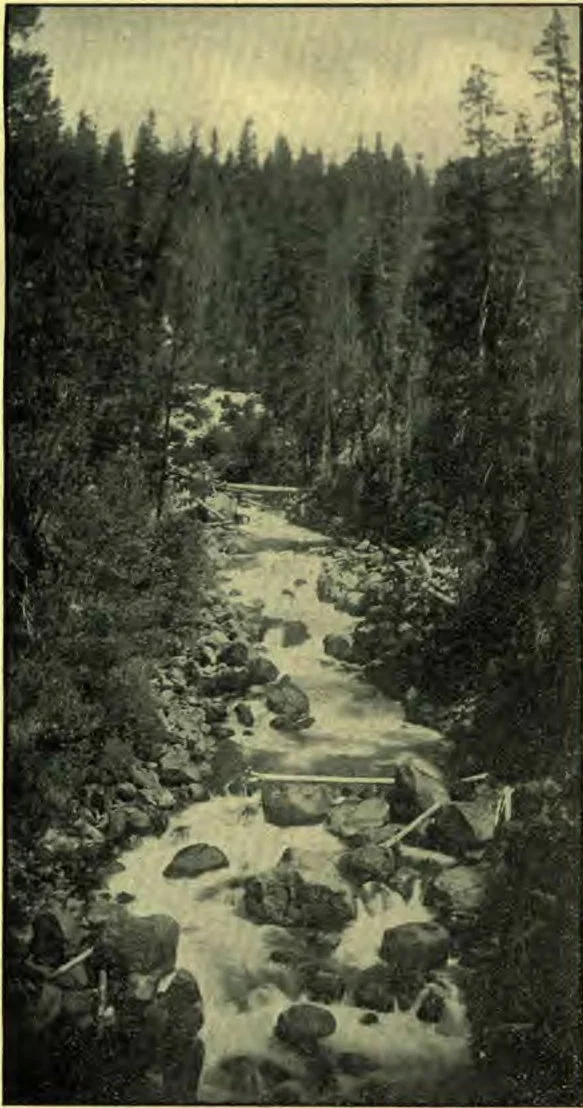
I camped that night in the deserted cabin, but it gave me the blues. I never like to see a home, upon which some one has expended thought, care, and patient labor, deserted and going to ruin. I can not help but sympathize with the disappointment some one must have felt when he found that his labor was wasted. Then I think of the bitter disappointments and heart-aches that go to make up this life, and long for the time when there shall be no more sorrow, neither crying nor pain,—the time when “they shall build houses, and inhabit them; and they shall plant vineyards, and eat the fruit of them.”
Early next morning I crossed the line that separates Oregon and California, and at noon I left the pine forest at the little village of Keno, which lies just at the edge of the broad plateau called Klamath Plains. There I crossed the river. It was hard to believe that it was the same stream up whose banks I had been trudging for two days. Below, it was a roaring, tumbling mountain stream; here, I found a river, wide, deep, and sluggish, with rank tule growing along its banks, and half hiding an old scow and small steamboat that lay there idle.
I reached Klamath Falls that night, having walked fifty-six miles in two and one-half days. There I secured another tire for my wheel, and next day I rode, and walked, forty-five miles farther,—through another stretch of pine forest; along the shore of the beautiful Klamath Lake; and across the scorched plains of the Indian reservation to old Fort Klamath, where many substantial buildings, that cost the people of the United States much good coin, have been slowly going to ruin since 1890, when the fort was abandoned.
I did very little riding next day. Mile after mile I waded through the deep sand along the brink of the wild, romantic Anna Creek cañon. I could hear, and sometimes see, the water at the bottom; but it was impossible to reach it, and I nearly famished for want of a drink before I reached the head of the cañon, near the summit of the range, where the water of Anna Creek flows from a mammoth spring.
From there to the summit was only a short, though very steep, climb; and just at dark I came to the road that branches off for Crater Lake. I was too tired to climb Mount Mazama that night, so I camped by the roadside, having been four and one-half days in traversing the one hundred and seventeen miles that lay between me and my starting-point.
J. EDGAR ROSS.