(Concluded from last week)
BERTHA SHANKS CHANEY
NOT so long ago it was thought that skill in the making and using of weapons was a standard of culture to be applied only to savage races. Public opinion has apparently changed during the last fourteen months, and this test of culture is now being applied to highly civilized nations.
Judged by their weapons and their skill in using them, the Australian aborigines are not the lowest peoples of the earth. For purposes of offense they use a formidable reed spear, and to make it go farther and more violently, it is propelled by a curious “throwing stick.” This womera, or wommerah, to use the widely known native term, acts as does the cord of a sling in flinging a stone. The well-known boomerang is peculiar to Australia. Having found a piece of root of the proper curve, the black fellow laboriously chars and scrapes it to the desired thickness, sometimes ornamenting it with rude carvings. It is skillfully flung from the hand, and will rise in the air as high as a hundred and fifty feet, in circular courses, and return to the owner if it does not strike any object in its course. The natives are adept in hitting an emu or a wallaby with it.
There is a variety of clubs, some fairly light, to be used in the chase; others heavy and carved with prominences to increase the severity of the blow, for hand-to-hand fighting.
All these weapons were used as much in bringing down game as in warring with hostile tribes, but the defensive wooden shield was for war only. Shields, light and heavy, broad and narrow, may be found, all held by a handle scooped out of the wood at the back.
Three remarkable defects have been found universal among the blacks of Australia: they nowhere cultivated the soil for any food crop; they never built any kind of permanent dwelling; and they raised no cattle, nor kept any domestic animal except the dog. When the white man first came into contact with them, he found the dingo, a wild, savage kind of dog, domesticated; but now the introduced dog has supplanted the dingo, and in all their camps scores of mongrels lie about, living on a par with the children, and snapping and snarling at the intruder.
Perhaps in no other part of the world do the natives build poorer shelters for themselves than do these nomadic children of the bush. Their wurleys, miamias, or gunyahs, as they are diversely called by different tribes, are mere lean-tos, built of strips of bark or of branches daubed over with earth or clay to keep out the wettest of the rain. So low are the walls, and so narrow and small the entrance, that the owner must drop onto his hands and knees to creep in. Their glorious land of purple hills and sunlit plains furnishes an ideal climate for living out of doors, the main protection being made against a long, heavy downpour. Their huts, which are grouped together in camps or villages, are five or six yards from one another, and each family occupies its own quarters. Usually there is a separate wurley for the young men not yet initiated into manhood, or unmarried. In front of each, burns ever a small fire, which serves the double purpose of being ready for the cooking and of keeping away the dreaded evil spirits.
Nothing that creeps or walks or crawls or flies is scorned as food. Luscious grubs found in green trees, cicadas dug from the soil, bandicoots, snakes, porcupines, emus, all kinds of wallabies and kangaroos, fish and eels from the rivers and lagoons, all help to stock the family larder; and in the golden romantic past, men were also included in the list. In their netted bags the women gather seeds from grasses, tubers, fern roots, edible plants, and wild fruits, and clean them in their pichis, or wooden troughs. The men are expert in catching and spearing fish, often diving silently and transfixing them under water.
A change in fashion is the least trouble a black gin [a native woman] ever has to worry over. Blacks who live near or mingle with white people, have perforce to wear European clothes (after their own fashion), but there are still places where primitive styles prevail. About the only garment worn by men or women is an opossum rug. Sometimes a covering is made of a kangaroo’s hide. These are particularly needed and used in severe winter weather, and they make a fine receptacle in which the mother may carry her infant.p. 11
The gins prepare the pelts by thoroughly cleaning them of the flesh, and after rubbing them with free-stone to make them pliable, the small skins of the opossums are neatly sewed together with sinews to make a garment of suitable size. Girdles with fringes are worn, too, more especially by the girls and women. Ornaments that are purely for vanity’s show are not many; strings of bright-yellow reed beads or of dog’s teeth, or a piece of polished shell,—these, and feathers for the hair on certain occasions, are all their simple natures have invented. But they love European beads and trinkets. A safety pin or a watch wheel makes a beautiful ear ornament.
We vision the untrammeled life of the black—his days spent in basking in the sunshine of the warm and fertile southland; his nights in dreamless sleep as he and his family lie curled around the smoldering camp fire. In our imagination he is a free child of nature, unfettered by creed or custom, with no memory of the past to oppress, no thought of the future to dread.
But our vision is false. Nature does not provide bountifully in Australia without a great deal of sweating and hard work and heart-breaking failure, as the white settler knows to his cost. To provide game for a precarious living takes weary miles of travel and hours of stalking before it can be struck with spear or club. The black gin’s life is a toilsome quest for nardoo and fern roots, or of gathering wood for the fire, or catching lizards, rats, and other small creatures for the roasting oven. But beyond any hardship of work or endurance is the slavish chain of sorcery which binds him in every thought and act. No native, unless he may have come under the strong influence of a white man, was ever strong-minded enough to disbelieve or disregard its power. It is the bane of his life, waking or sleeping.
The mysterious, horror-filled art of sorcery may be practiced to a limited extent by any one, but to a few in every community was given in a dream extraordinary skill in its practice. These are the medicine men, or koradjis, who have power as they wish, to become invisible or invulnerable, to fly through space, to kill or cure, to bring thunder and lightning. Sickness or death is always laid at the sorcerer’s door. Death is caused by pointing a bone in the direction of the victim, and he dies. The koradji may cure by sucking a pebble or a piece of glass or a plug of tobacco or a half brick out of one’s leg or face or back.
Although the blacks live in a wretchedly low state of nomadic savagery, yet they have a remarkably complex social organization. There are laws or rules which govern a great many things—their relationship to one another, crude property rights, burial, and so forth. Marriage regulations prevent the union of near relatives, and these are rigidly kept. A man guilty of running off with a woman who is not his by tribal right, is killed, or else he must be strong enough to outclub those who try to put the law into execution.
The initiation ceremonies are positively forbidden to women, and a woman caught spying on the excited party of men who are going through them would be killed on the spot. Hints are thrown out to the women that something is to take place at which their presence is not wanted. Then the men from the different tribes, taking their young men with them, go off to a spot previously decided upon by the head men, and here long and intricate ceremonies are gone through, which last for days. During this time the bull-roarer is frequently sounded, warning the women and children off. The bull-roarer and some other sacred objects—pebbles, etc.—are never seen by the women, on pain of death. Years of study and inquiry have been given by men in government official positions, or otherwise closely connected with the native tribes, into the strange customs which hold these people. Long they held their tribal secrets very tenaciously.
When the English first began to occupy Australia, using the colony as a dumping ground for the overflowing jails and correction houses of England, the blacks looked doubtfully on their arrival, and it was not long before the fatal clash began which ended in the white man possessing the land. Even when Cook, one of the wisest of heads in dealing with natives, was cruising up the eastern coast, the natives became hateful toward a party of his men who were obliged to spend a few days ashore, and set fire to the grass and partially destroyed the camp and stores.
The black man was, however, a very different antagonist from the red man of America, or the Maori of New Zealand. He was never the serious problem that either of the others was, as he was not of the fighting stamp, nor did he possess formidable weapons. Not only were the Australian natives too few and too scattered to start a general uprising, but they were incapable of organizing against a common foe. They could not successfully attack and destroy the first settlements, but there was continuous hostility between the two races.
If a small batch of convicts cleared off into the bush, they were killed. Any white person who heedlessly wandered from the settlement was overpowered and promptly dispatched. Cattle, brought from South Africa and raised with much difficulty by the starving, incompetent settlers, were driven away and killed. Hateful, petty deeds were constantly committed. Ceaseless retaliations were made, and blacks were abused, tortured, and killed at every chance. The treatment of the Australian aborigines is neither ap. 12 bright nor an honorable chapter in the history of English colonization.
But if in those early days they endured some unspeakable cruelties, we must not forget that the age itself was partially responsible. If in England itself the hangman’s noose was adjusted for the man who stole forty shillings, and a pickpocket was sentenced to death, we could not look for tender mercies to be extended in that unknown savage land at the ends of the earth, to miserable, naked, degraded savages who possessed not an attractive quality.
At the present day there are government reserves in some places for them; in other more or less inaccessible parts of the continent, where the climatic conditions have so far prevented white settlement, they roam at will, not far removed from their primitive state.
For many years blacks have been connected with the police force as trackers, their powers in this respect being positively uncanny. Not even the American Indian can equal them. A few are employed as shepherds and stockmen on the cattle runs, but they are too indolent naturally to be easily trained into habits of industry.
Since the European war started, the question has been discussed of training mounted regiments of half-castes, or even of aborigines. Half-castes are, according to reputation the best cattlemen and the best shots in the territory. Some think that the forming of strictly native military camps would help to solve the question of how to preserve this fast-dying race of the southern continent.
There are several admirably conducted organizations which watch over the welfare of the natives, but the problem of preserving a colored race when it comes in contact with a white race, is one that remains unsolved.
For many years attempts have been made by several religious bodies to establish and carry on missions among these dark people of the island continent. The Anglicans, the Presbyterians, the Catholics, and other denominations have missions among them. In these the natives are taught useful trades as well as the principles of the gospel, and a certain degree of success has crowned these noble efforts. But too often it has been found that the civilization with which they come in contact while being Christianized proves their undoing. It is not that the principles or the teachers of Christianity are at fault.
Our own denomination—the Seventh-day Adventist—has been interested for some time in this people, and an attempt was first made about four years ago, in the southern part of Queensland, to work for them. At first, two of our workers, as they could find time, visited and taught among them, on the government settlement at Barambah. Later, Brother and Sister P. B. Rudge were sent to spend their whole time and effort at Barambah. But, as Brother Branford in his report at the 1914 union conference, says, “it was soon found that the conditions prevailing on a government settlement hindered the progress of our work.
“Time after time, as Brother and Sister Rudge labored hard and long, and obtained a few interested ones, these would immediately be sent away, and the work would seem to be in vain. The difficulty with which the work was carried on, soon showed the great need of establishing a mission entirely under the control of our own denomination. Finally, it was decided by the union conference that the Queensland government be approached with the object of securing suitable land for mission purposes. This was done, and our request was very favorably received by the home secretary. Two brethren were sent to north Queensland to inspect blocks of land that were available for the purpose. In due time, a grant of a piece of land comprising four thousand acres was received. This land consists of grassy forest ridges, and abounds with permanent creeks. There are about seven or eight hundred acres of jungle scrub.
“The property is now known as the Monamona Mission, and is situated thirty-six miles from Cairns, and eight miles from the railway.”
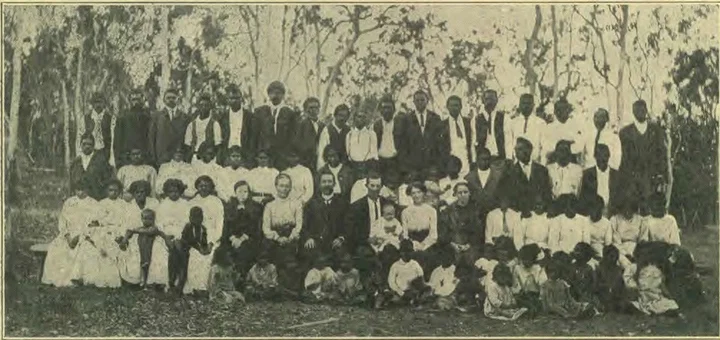
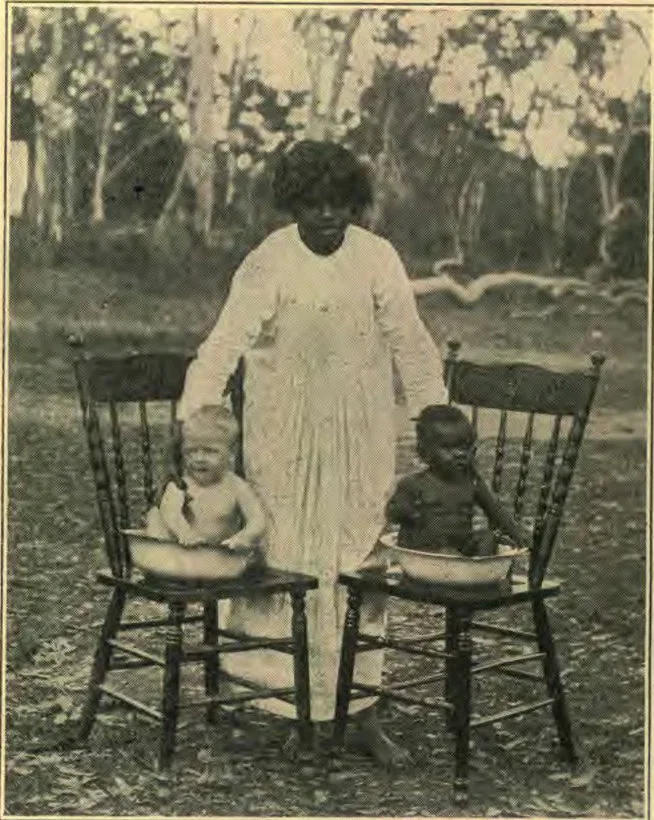
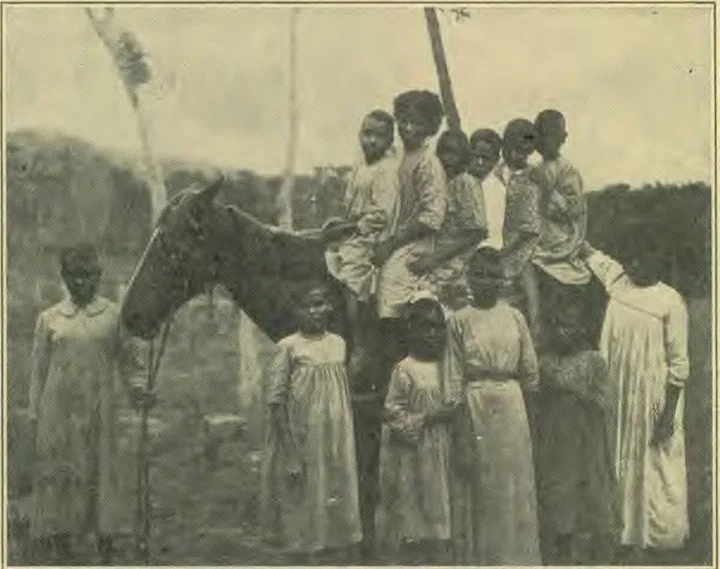
The photos which accompany these articles were made by Brother Branford on the Queensland mission, and show some of those now connected with the mission.
A patriarchal system of control must be followed in dealing with so primitive a people. All the natives on the station are fed and clothed by the whites in charge. The cooking is supervised very carefully by the white women, as the natives are so wasteful. Brother and Sister Branford have others now to help them in their work.
Since the Queensland mission was established, another attempt has been made to interest the aborigines in the gospel message for the closing days, at Kempsey, in the state of New South Wales. Here it is not a mission station that has been established, but a tent effort that is being held, and some very interesting reports have been sent in. The natives at this place have long been in contact with civilization, and know the ways and language of the English people, so that different ones of our workers go and preach to them. Unstable in character, they sometimes respond to the preaching and teaching, and run well for a little season, and then fall away.
“The restless heathen wait That light whose dawning maketh all things new; Christ also waits, but men are slow and late. Have we done what we could? Have I? Have you?”