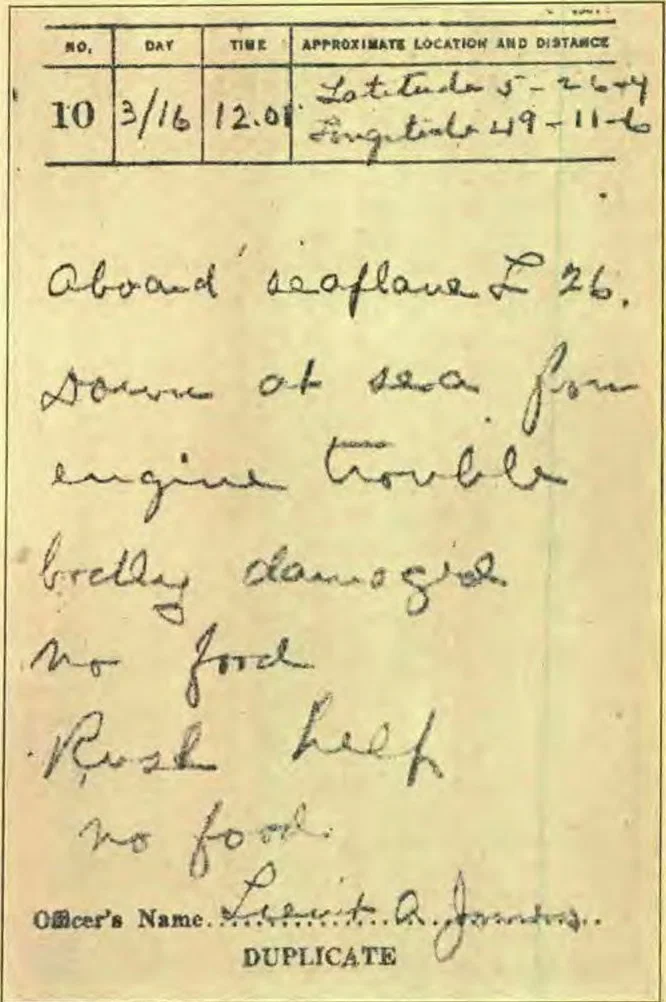
IN the Great War the carrier pigeons of the United States Navy proved themselves one of the most efficient arms of the service. In the thousands of flights which they made over the enemy country and the battle fronts, the plucky little birds could be counted on ninety-eight per cent of the time. The missing birds probably lost their way in the smoke of battle, or were brought down by shock of exploding shells, so close were their journeys to the firing lines.
In a single year our navy birds at the front made 778 flights, covering a total of 10,995 miles. They carried messages, which meant life or death to our boys, in incredibly short time, often under the direct fire of the enemy. The birds were taken into the front-line trenches or carried with the advancing troops. Their most important work, however, was probably in the aeronautic service. Carried aloft on aeroplanes, they sped back to their homes over sea and land, carrying priceless information. Some 219 flights were made from seaplanes “down at sea.” When an aeroplane is forced to come down at sea, its position is especially dangerous. The frail craft is at the mercy of every wave, there are no lifeboats, and scarcely a spar to hold to. No matter how remote the aeroplane wreck may be, the pigeons, with unerring instinct, soon find their way home, carrying news from the wreck. An American air pilot, Lieutenant Stone, found himself in such a plight off the coast of France. He released his birds and watched them disappear. His message reached his naval base in short order, and scouting seaplanes and motor boats were quickly sent out to his relief. He was not found for seventy hours, but his life, like that of many others, could have been saved only by the faithful pigeons.
One of the English carrier pigeons, “Red Cloud,” flew 535 miles in the incredibly short time of 643 minutes. The longest flight on record, by the way, is 1,680 miles, covered in less than three days. No boats which sail the seas, and scarcely any aircraft, can rival these birds. As one of the sailors in charge of the carrier pigeons explained, “they have no engine troubles.” The British bird “Peerless Pilot” averaged three flights a day for eleven months. It is not generally known that the Germans had some 60,000 carrier pigeons in service, so important did they consider their work. The Allies had 30,000 birds. When the German armies marched through Belgium, they confiscated every pigeon, and announced that any citizen found with a carrier pigeon in his possession would be instantly shot.
A Carrier-Pigeon Dispatch
In dispatching pigeons at the front, the messages are always sent in duplicate. The officer in charge carries a little pad made up of sets of three sheets of paper, two thin sheets for carbons, and a third, heavier sheet for the record. The sheet, which measures three by five inches, is ruled with columns for the date, the number of the message, the time, the officer’s name, and the position from which the bird is set free. The message itself is usually written in cipher. By using two carbon sheets, the three leaves are filled in with one writing. The two thin sheets are then detached, rolled up, and each inserted into a water-tight aluminum tube, which is fastened to the leg of a pigeon. The two birds are then released, carrying duplicate copies of the message, which gives two chances that the message will be delivered. The birds object at first to the little cartridges and try to peck them loose, but soon grow accustomed to them.
The carrier pigeons used by our navy abroad have been British or French birds. The champions have been brought to America, and will be used for breeding birds for American flights. Special attention will be paid to this work in future at all naval stations.
The British and French birds would, of course, be useless if liberated in America, since their homes lie so far away, and in trying to find them they would be lost at sea. The American aircraft starting on their trip across the Atlantic, in order to keep in touch with both continents carried both American and European birds.— F. A. Collins, in St. Nicholas.