Pond Scum

10%

Review and Herald Publishing Assn. · Takoma Park Station, Washington, D. C. · May 1, 1917

FromThe Youth’s Instructor, Vol. 65, No. 18.

Read the full edition

Pond Scum

How often a person has been walking abroad on a hot summer’s day, and when thirsty has come, much to his disappointment, to a pool of clear water filled with green scum or slime, and has turned away from the pool with disgust, unaware of the fact that he was turning away from a marvelous and lovely sight, unlovely and common only because of coarse eyes, and because of ignorance of what he was really seeing.
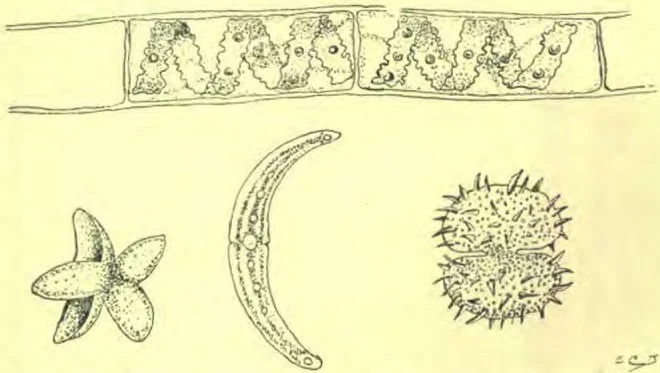
Spirogyra (at top) and some of its near relatives found in pools.
That scum or slime is a network of beautiful plant filaments, which when viewed with an ordinary high-power microscope, becomes of intense interest. These slime plants belong to an order of plants known as algæ. Algæ colored green are known as green algæ. Our common seaweeds are algæ too, but belong to other kinds known as the red and brown algæ.
Our “pond scum” is quite likely to be a plant individually known among the green algæ as Spirogyra. If we lift a portion of it from the water, we see that the mat is made up of a tangle of green silky threads. Inasmuch as each thread is a single plant, the number of plants is very great.
Place a thread or two of Spirogyra upon a glass slide and examine it with a microscope; it will be observed that the filaments are made of many cells or cylinders placed end to end, and that in each of these cells is found a beautiful irregularly notched green band.
If we have a lens of high power of magnification, we may see the true beauties of our scum. The spiral bands noted now look like marvelous green fluted ribbons set with beautiful jewels. These bands contain the green coloring matter of the plant, known as chlorophyll. The jewel-like disks set like pearls in the band are called pyrenoids, and are the centers of starch manufacture for the plant.
By careful search, a rather dense granular body is seen with delicate threads of shiny granular substance radiating out in starlike manner to the sides of the cell. The dense body in the center is the nucleus, the most important part of the cell. The shining, radiating bands are composed of a substance called protoplasm, which is found to be the basis of all physical life in this or any other living plant.
So is not “pond scum” interesting after all? If we would only examine many other common so-called “ugly” things, we should find them equally fascinating. The most marvelously interesting beauties are often hidden from the natural eye, under forbidding exteriors.
EDMUND C. JAEGER.