Not all the passengers of the “Sierra” return to the ship. When we reassemble on deck, some of our former mates are missing. One of these, a Greek woman named Anastasia Erokommoupoulos, was detained unwillingly for theft committed in San Francisco. Thus retribution follows even across the sea.
A tall young man remained at Honolulu to spend five or six months in perfecting the various wireless stations on the islands; for Hawaii gets the world’s news simultaneously with the cities of the mainland. He seemed extremely young for such a task, but is apparently qualified, as his father is one of the chief directors and instructors in this science.
One family of three discontinued their voyage here. This left Ivanilla the only girl on board the ship. They brought with them their automobile, and were to spend a delightful time touring on and among the islands. We almost envied them.
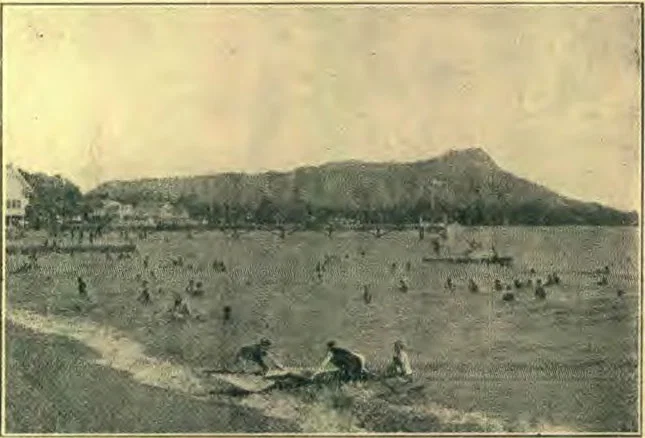
WAIKIKI BEACH
Others from our number are on shore to wave farewell. Among these, to our regret, stands one of our special party of five, a young man from Australia. While en route to America, he formed the acquaintance of Elder Fulton and his family. Through them he first learned of the truth, and was baptized in America. On this voyage, with Elder Fulton as cabin mate, he was diligently studying the truth, to teach it to the folks at home.
Through him we were learning, too, of our new home by object lesson,—the different names applied to articles, of their customs and their monetary systems, so that when we reached there we might seem to the manner born, and escape the perplexed looks of others and our own chagrin when we or they talked of things of which the other had never heard. For instance, before we enjoyed the dining-room very well, he offered to bring on deck a plate of biscuit. We anticipated the light, crispy food so tempting to the capricious appetite. When we saw the sweetened crackers, the desire uppermost was to pitch them overboard. In Australia, crackers are firecrackers only, and these are never demanded—on the Fourth of July. Our biscuit are their scones. A pie with no upper crust is a tart; a little tin pail is a billy; a spool of thread, a reel of cotton; a chemise, a singlet; yarn is wool; a davenport, an ottoman; a cart or gig, a jinker; a field or pasture, a paddock; a merchant, a draper; and a store, a shop.
We looked forward to continuing these lessons during the weeks to come. But at Honolulu word was received that caused our tutor to hasten on board just before the gangplank was withdrawn, remove his luggage, and bid us an indefinite good-by, as he was to take the next boat back to America.
At the last moment the jolly chief kitchenman is seen coming up the plank. Round and merry, with a circumference about equaling his height, and almost no neck or other figure lines, he is bedecked with innumerable wreaths and laises of every kind, length, and color. One encircles his hat. Some are of fluted yellow paper, and many are made of flowers, one being a beautiful combination of white pond lilies, maidenhair fern, and rosebuds. Arrayed thus, he makes a fantastic picture of merriment and good nature. A halt is called, kodaks are leveled, and many pictures are made of this striking figure.
The anchor is hoisted, and out we sail from the deep-water lagoon, through the natural coral piers. Young swimmers are again in evidence, clad in the briefest of trunks and chattering like magpies. Their rivalry for possession of the coins tossed overboard is energetic and accompanied by shrieks of laughter. The winner rises to the surface with the money in his mouth for safe-keeping. It is surprising how many pieces the champion’s mouth can hold.
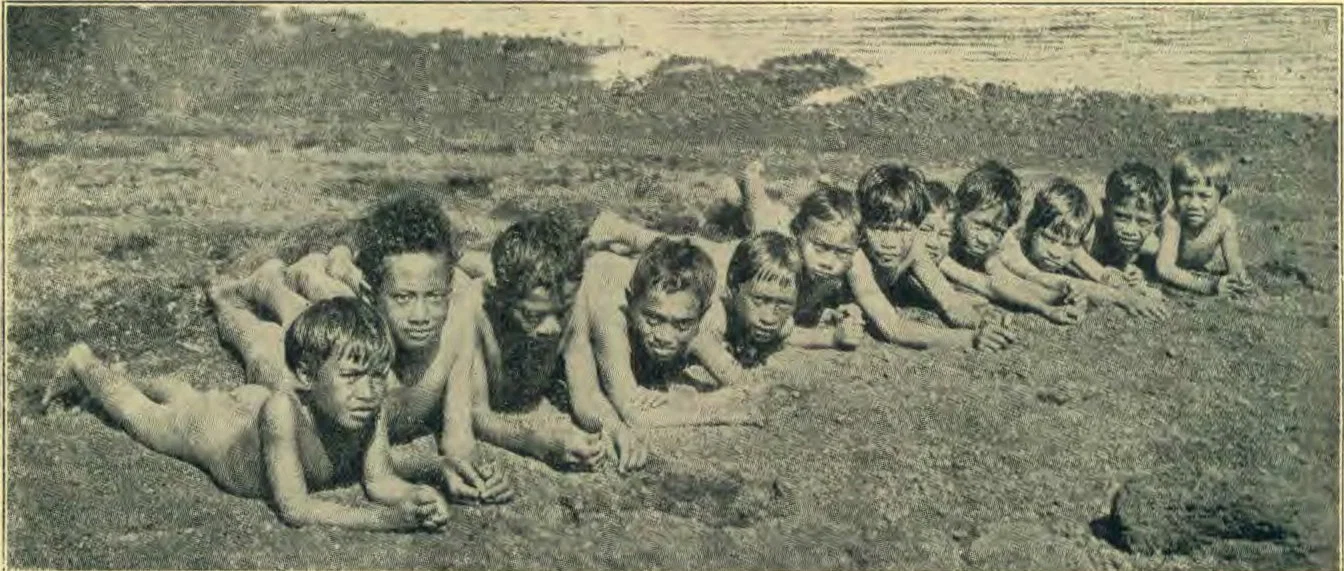
We see again the famous Waikiki Beach, with its magnificent ocean front stretching in graceful curves for miles, until stopped by the bold crags of Diamond Head. Waikiki Beach is a safe place for bathers—no undertow, sea puss, or sharks. The outer coral reef protects from these dangers. It is said that in no other country in the world can such delightful surf4bathing be enjoyed, and both sexes become exceedingly expert in the water. As swimmers they are noted, and count in their ranks the champion swimmers of the world. Even the wee toddlers play in the surf, and then run about on the sand while old Sol dries their few dripping garments. They are not overburdened with raiment at any time.
On entering port we had scarcely noticed, amid the many things to be seen, the forest of masts that crowd the harbor. Almost every variety of craft lies at anchor here. The beautiful Stars and Stripes floats out to the breeze from an armored cruiser. The Union Jack waves proudly; and the kaiser’s flag also is seen, as two German ships are interned here. There are the full-rigged ship and the barkentine, and among these larger vessels, puffing launches make a great deal of apparently unnecessary noise. White-sailed yachts skim the water noiselessly, like overgrown swans, and the swift-going picturesque native boats with their curved outriggers flit here and there.
READY FOR A PLUNGE IN THE SURF
We remain at the rail, looking backward, until Honolulu, beautifully kneeling at the feet of its hills and mountains, is lost to view, when some one in the group exclaims, “Adieu, Honolulu, one of the happiest-appearing cities in the world.”
Passengers on the “Sierra”
At no time is dirt noticeable anywhere on the ship. Every morning witnesses a grand cleaning up, and boys are about all day scrubbing the paint and shining the metal work. There are no cinders or smoke,—except tobacco smoke,—and there is no dust flying, even when the wind blows. But when we return from our six hours on shore, it can be noted with more senses than one that there has been an entire freshening up of staterooms, dining-rooms, every part of the good ship. Everything is spotless.
This morning the whole crew, from captain down to the careful and tidy man who sets one’s cabin to rights, doffed their blue uniforms and appeared in immaculate white, which they will continue to wear until an appointed day during the last week of the voyage.
The regular motion of the ship no longer nauseates one, although it persisted in accompanying us on land, and proved very uncomfortable there, materially decreasing the enjoyment of our trip. We now drop into the pleasant routine of ship life.
Acquaintance is made easily and with little ceremony where a number of people are compelled to associate together for several weeks—acquaintance that often develops into lifelong friendship. We have a quiet and respectable company of fellow travelers.
Any formality or restraint that might otherwise exist is dissipated by the occasional appearance on deck of nine or ten merrymaking passengers. They generally remain in the lower part of the ship, and come up only one or two at a time. When they do favor us with their presence, their vivacious conversation, singing, whistling, and laughter are infectious and mirth-provoking.
One of them was unable to speak or understand a word in any other language than Spanish when he embarked on this voyage. He learned our little daughter’s middle name in the first lesson. When she tries to teach him to say Ivanilla, he will say, soft and low, “Jaunita.” When she persists, he will shriek out the same word, and break into a peal of laughter and song. He betrays himself, too, by his changeable moods and volatile temper. Sometimes he responds to love words and caresses with winsome coos and cuddles and dainty pecks with his bill. But beware! he is as fickle as Warburton weather. Notwithstanding, he is the favorite one of his party, and oftenest in demand by the audience.
American loyalty prompts us to mention first, and as most distinguished of the interesting people we meet on the “Sierra,” the nephew of our honored President. We understand now that nationality is a stronger link to Americans away from home than is social rank. This brings to mind one amusing incident. When a table mate heard some one say that President Wilson’s nephew was on board, he straightened himself with pride, and with wondrous dignity responded, “I am my father’s son.” He himself is a street fiddler. His companion is a thin-chested, sallow-faced lad, destroying himself as fast as possible by constant use of the cigarette and frequent trips to the bar. I think he must get up in the night to smoke. However early in the morning or late at night we see him, he is accompanied by the despicable cigarette.
Finally my desire to help him could not longer be silenced. Leading him to talk about himself, I learned that he has no ideals and no ambitions. Then, overcoming my scruples and fear of wounding his pride, I warned him of the deadening effects of the habit to which he is so addicted. Its dangers were pointed out as convincingly as I knew how. His response was that nothing could ever separate him from the cigarette5as long as he could get one to smoke—even if he knew that death would follow the next one. And, although apparently once a bright boy, he is getting to look the part of a cigarette fiend. I often think of the future of these two boys, so far from home and its influence—if they have any home. We chanced to be near when their trunk was examined by the inspector, and it was almost empty.
How I wished for copies of the TEMPERANCE INSTRUCTOR. When at sea, people will read anything, and printed words are so much more effective, sink so much deeper, than those spoken. They cannot be answered back.
Never could there be greater need of anti-tobacco lessons than in this assemblage. Two men, one a Scotchman, proud of his Gordon name and blood and of his position in the ranks, and the other a young Englishman, are never seen, except at the table, without their pipes. In fact, one can scarcely find a corner to escape cigar and cigarette smoke. The men think nothing of puffing the smoke into the ladies’ faces. Lieutenant Gordon is very friendly with all, and some one asked him one day if he slept with his pipe in his mouth. He understands the entire mechanism of the ship, and is today taking all who dare venture, on a tour of inspection below.
One poor little mother draws on my sympathy. She left her home in Brisbane when but fourteen years old. The next year she married. Now at the age of twenty-four she is returning home with four boys. All but one are sickly, and she leaves in San Francisco the little graves of a son and her only daughter. Although the baby is five months old, it is so thin as almost to seem inhuman. The young mother knows less about the proper care of her children than does many a little girl who has tended only her dollies.
The father, who seems fond of his boys, smokes cigarettes all the time, and in play oftentimes blows the smoke directly into their faces and mouths. It makes my heart ache to see such ignorant cruelty. I talked with her about it, and she said she did wish he would give up smoking, it was such an expensive habit, and maybe, as I said, bad for her and the children. He had tried to give it up, she said, but couldn’t.
The stewardess is much interested in present truth, and also in the temperance question. She is a well-informed woman, and asks many questions, and desires literature. We give her what we have, and promise more, praying that the Lord of the harvest will nourish the seed sown, and that it may bring forth an abundant fruitage.