The Spade as Teacher — No. 1
THOUSANDS of books in our libraries are there through the knowledge given to the world by the spade. A hundred years ago there was no authoritative history of Assyria, Babylon, or ancient Egypt. People talked freely of Nineveh, Babylon, Ur of the Chaldees, of the Hittites, and of ancient Egypt; but they were dependent upon the Bible for their knowledge, together with “several ancient compilations of uncertain value.” But the Bible was the only authoritative book in the world that gave historical data concerning these peoples and kingdoms.
At this time the oldest authentic profane history known was the history of Greece and Rome, dating back to four or five centuries before Christ. Mythological history ran back of this time by several centuries but it was not reliable. The Bible, therefore, stood alone in offering to the world bona fide information reaching back thousands of years before there was authentic profane history. Its statements could not be proved to be true or untrue by the statements of other reliable writers. None such were known to the world a hundred years ago.
Arguments Against the Bible as History
This state of affairs made the Bible to be regarded by the worldly wise as a mere creation of the Jews to praise those of their own race or ancestry. As examples of their boastful reasoning we quote from Dr. Ira Price, in his interesting work “The Monuments and the Old Testament:”
“In Genesis, chapter fourteen, we find that, in some distant age, four kings of the East had conquered, and held in subjection for twelve years, the five kings of the cities of the plain. In the thirteenth year these kings of the West rebelled against their Eastern masters. In the fourteenth year these Eastern lords planned and executed a great campaign against the West land rebels, conquering and capturing and plundering their former subjects. Now, this is a most unlikely story. There is no evidence outside of the Old Testament that any such great kings of the East ever lived, no evidence that the West ever suffered such a disastrous defeat at the hands of any rulers at that distant day. In fact, the whole story seems to be the invention of some enthusiastic Jew to laud the military ability of Abraham, and to explain the origin of the tithe and of Melchizedek.
“‘Another case also should be mentioned,’ says the critic. ‘Who were the Hittites? They are frequently mentioned in the Old Testament, and sometimes as being a powerful people; but is there any extra-Biblical evidence that they ever existed? Not one scrap. They are simply one of the mythical peoples with which the Old Testament is filled, and are introduced merely to magnify the vast administrative ability of David and Solomon in commanding and using foreign peoples in their armies and in their service.’
“‘There is one name in Isaiah (chapter 20:1) which well illustrates my point. Sargon is mentioned as king of Assyria. Other kings of Assyria are given in other passages, but the writers have been extremely consistent and very shrewd in their introduction of these mythical monarchs. This case in Isaiah is unique. The name is not mentioned again in the Old Testament, neither is it found in any other literature. Now, it is manifestly absurd to say that such a name is anything but a myth, or a scribal error.’”
But the author of the Bible made no answer. He just waited. He knew the proofs for the vindication of his Word that some day would be given to the world through spade and monument; and he knew, too, that the Spirit of God demonstrated its truthfulness all the way along to every true believer. “If any man will do His will, he shall know of the doctrine.”
The Bible Vindicated
Finally, after long waiting, the Lord, as it were, said to the world, Now take your spades and go to work. For centuries you have questioned the reliability of my Word; now unearth the proofs of your own shortsightedness and unreliability and of the truthfulness of my Word. In response to the decree the archeologist began his work. Men had often noted that the great monuments, temples, and other ruins of Egypt carried on them peculiar ornamentation. They wondered whether this might not be a kind of picture writing, giving information in a language to which the world had lost the key. But why wonder? There was no key to the dark millenniums of the past. Yes, there was, and in God’s providence the time had come for it to be found.
The Finding of the Key
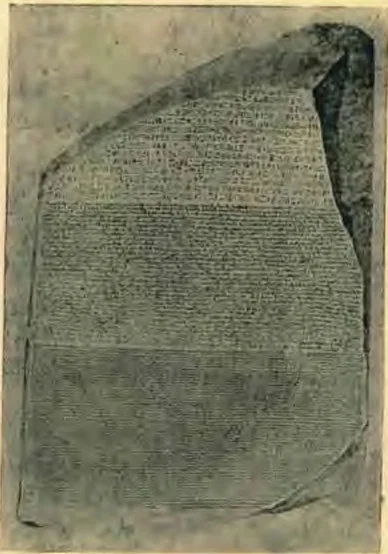
Indirectly the world is indebted to Napoleon Bonaparte for the finding of this key. Napoleon coveted Egypt. Therefore in 1798 he invaded the Nile country with an army. Among the strong corps of eminent scholars and artists which accompanied the expedition was Boussard, a French engineer. It was he who found the lost key to Egypt’s past, in 1799, while digging near Rosetta, at the mouth of the Nile, near Alexandria. It was a black granite stone, 3 feet 9 inches by 2 feet 4½ inches, and 11 inches in thickness, containing inscriptions in three languages, one of which was Greek. This was easily read by Greek scholars, but the other two no man could read. However, the stone was carefully cherished; and when terms were made with the defeated French army, it, with other important archeological treasures, was turned over to the British.
The two unread inscriptions on the Rosetta stone aroused the curiosity and interest of scholars, and for twenty years men tried heroically but vainly to decipher them. In 1818 a French scholar, who understood the Coptic language, began the study of the Rosetta stone. “No one at that time realized that the Coptic was descended from the ancient Egyptian,p. 6 and was still preserved as the sacred language of the Egyptian church, as Latin is the ecclesiastical language of Roman Catholics.”
By most painstaking effort this eminent scholar finally succeeded in deciphering the long-forgotten writing of ancient Egypt. He published his discovery in 1822, less than one hundred years ago. “Thus the door to the historical and literary treasures of ancient Egypt was unlocked, and from that time to this the study of Egyptian inscriptions and documents has gone steadily forward.” Universities now offer courses in Egyptology, their knowledge going far back of the first mention of Egypt in the Old Testament.
The critics were astonished, and said, “Well, if Egypt existed so long ago, perhaps the Hebrews really did exist, for they are represented as living in a much younger age.” The Bible was coming into its own. The information of spade and imperishable monument could not be refuted. As concrete illustrations in this connection of the way infidels have been answered and the accuracy of the Bible has been emphasized by the findings of archeology, I quote from “All About the Bible,” by Sidney Collett:
Biblical and Assyrian Records Harmonize
“For many years there were great questionings as to the accuracy of 2 Kings 18:14, where the Holy Spirit records that the king of Assyria made Hezekiah, king of Judah, pay a tribute of ‘three hundred talents of silver and thirty talents of gold.’ When the Assyrian records of this transaction were discovered,—the accuracy of which no one questioned, being Sennacherib’s own account,—the amount of tribute was there stated as eight hundred talents of silver, not three hundred as in 2 Kings 18:14; while the number of talents of gold was the same as the Scripture record, thirty. For some time it was felt that there was no way of reconciling the different figures, and therefore one or other of them must be wrong; and of course, as usual, the inspired record was condemned. Nothing but a little patience was, however, needed, for we now know by more recent discoveries that the difference in those figures, far from proving the existence of a mistake in either record, constitutes a most remarkable testimony to the accuracy of both; for while the standard for calculating talents of gold was the same in Judea and Assyria, that for the talent of silver was quite different. In fact, it took exactly eight hundred Assyrian talents of silver to equal three hundred Hebrew talents—just as it takes twenty shillings to make an English pound, while a Turkish pound only represents about eighteen shillings. And thus, in what was supposed to be a mistake, the minute accuracy of the Word of God was demonstrated. . . .”
Whence Came the Gold the Israelites Borrowed?
“The question has often arisen in many minds as to how the Israelites became possessed of so much gold and silver, as was required for the furniture and appointments of the tabernacle. (See Exodus 25.) Was it likely that the Egyptians either could, or would, allow the Hebrews to carry away the immense quantity of treasure which was required for such purposes? to say nothing of the immorality on the part of the Hebrews in ‘borrowing’ that which they never intended to repay! “As to this latter question the Revised Version shows that the word is not ‘borrow’ at all, but simply ‘ask.’ “‘Every woman shall ask of her neighbors.’ Ex. 3:22. “‘Let them ask every man of his neighbor.’ Ex. 11:2. “‘And the children of Israel did according to the word of Moses; and they asked of the Egyptians jewels of silver, and jewels of gold, and raiment: . . . so that they [not ‘lent’ them, but] let them have what they asked.’ Ex. 12:35, 36. “So that there was no immorality at all; it was a perfectly straightforward transaction.”
“As to their willingness to part with such wealth, we must remember that there were those even among the servants of Pharaoh who ‘feared the word of the Lord.’ Ex. 9:20. It is, therefore, most natural to assume that many of them would sympathize with the Hebrews in the merciless treatment to which they had so long been subjected at the hands of the Egyptian authorities. Indeed, we are distinctly told twice over that ‘the Lord gave the people favor in the sight of the Egyptians’ (Ex. 11:3; 12:36); while many more, after the terrible experiences of the plagues which had devastated their land and darkened their homes, would be only too anxious to offer some substantial gifts in the superstitious hope that the God of the Hebrews might be thereby propitiated, his wrath appeased, and their land saved from further plagues.”
“All this, however, seems reasonable enough to an impartial mind; but there still remains the far more practical question. Was gold and silver really so plentiful at that time in Egypt as to make such a thing probable or even possible? For it must be acknowledged that the quantities of these precious metals carried away by the Hebrews must have been enormous. The gold used in the construction of the candlestick alone (Ex. 25:31, etc.) represented in our money over $25,000.”
“This difficult question has, however, at length been answered, in the providence of God, in a way which leaves no possible room for doubt, by a discovery made by Mr. Theodore M. Davis as recently as February, 1905, which the Times describes as ‘the most important discovery ever made in Egypt!’”
“On Sunday, February 12, Mr. Davis, in his excavations, came upon a royal tomb of the eighteenth dynasty,—the time of the Exodus,—which, when entered, was found to be full of treasures of priceless value. The contents were examined in the presence of the Duke of Connaught and Professor Maspero, the chief feature of which was the lavish quantity of gold and silver—‘gilded masks,’ ‘a chariot broad enough to hold two persons . . . encrusted with gold,’ plaster heads coated with gold, ‘a box stool resplendent with gold and blue enamel,’ ‘gilded handle of a mirror,’ a figure of a female slave offering a princess a golden collar; while an inscription tells us that the gold had been brought from ‘the lands of the south.’”
“The Times article then goes on to say that this discovery ‘has revealed one striking fact—the ostentatious, not to say vulgar, display of wealth which distinguished Egyptian society in the later days of the eighteenth dynasty.’ We had learned from the Tel-el-Amarna tablets that Egypt was at that time the California of the civilized world—a land where, as the correspondents of Pharaoh reiterate, ‘gold is as plentiful as dust,’ and in the profusion with which the precious metal has been lavished on the contents of the newly discovered tomb their words receive a striking illustration. There was nothing, however mean or insignificant, which was not literally plated with the gold of the desert mines.”
“In the light of this new discovery, how easy it is to understand the Egyptians giving to the Hebrews great quantities of gold, etc., at a time when that precious metal was ‘as plentiful’ in their land ‘as dust’!”
Further Findings Silence the Critic
The archeologist has also found abundant evidence of the existence of the Hittites, to which fuller reference will be made later. He has found the royal palace of Sargon, whose existence critics scouted; and it is now conceded that the kings mentioned as taking part in the great Elamite campaign spoken of in Genesis 14, have been identified. Amraphel, king of Shinar, being Hammurabi, king of centralp. 7 Babylonia; Arioch, king of Ellasar, being Rim-Sin, king of Larsa of Lower Babylonia. Dr. Price says: “We have more than a dozen dedicatory inscriptions of Rim-Sin. Chedorlaomer, king of Elam, is identified as Judur-Lagamar, the Elamite prince.” Tidal, king of nations, has not been definitely identified, but he is regarded by some authorities as the king of Gutium or of Kurdistan.
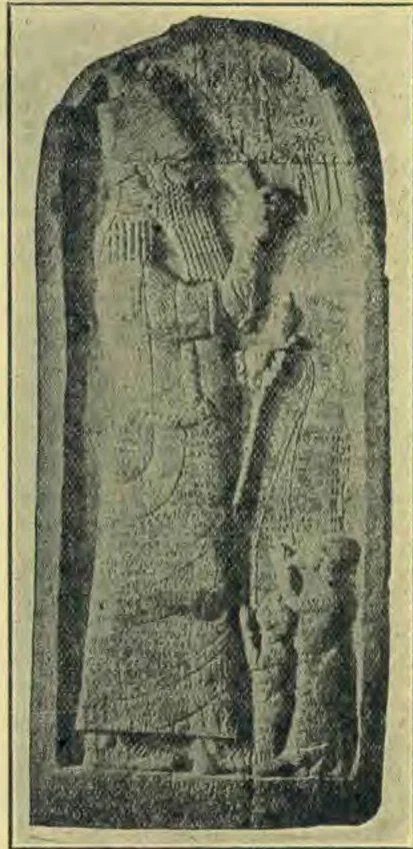
So late as 1916 a research expedition sent out by Harvard University found the burial place of Tirhakah, king of Ethiopia, mentioned in 2 Kings 19:9. So far as the history of Egypt and Ethiopia is concerned this name had been lost to view; but the Bible record is thus confirmed by the recent excavation. He it was who was ruling in Egypt when Esarhaddon, the Assyrian, marched into Egypt with his army about 600 B. C., and made the land of the Pharaohs an Assyrian province. An Assyrian tablet represents Esarhaddon as holding the thongs which are passed through the lips of Tirhakah and of Baal, king of Tyre, as they kneel before him, signifying their submission to his rule. (See cut on preceding page.)
Any good history of Egypt will reveal the wealth of knowledge that has been given to the world by the archeologist, who has found that the Egyptians wrote an extensive history on temple walls, tombs, tablets, and monuments. F. D. C.