J. E. FULTON
THERE are many things to interest one as he labors among the people in the Fijian villages, even though there are privations and inconveniences to be met. The people are uniformly kind, and do their best to please their visitors.
Sometimes when it has been announced that visitors are coming, as in the case of our recent tour through the mountains, flowers are gathered and placed in vases in the house to be occupied by the visitors. Often on our trips the houses we occupied had an arbor of flowers and greenery at the entrance.
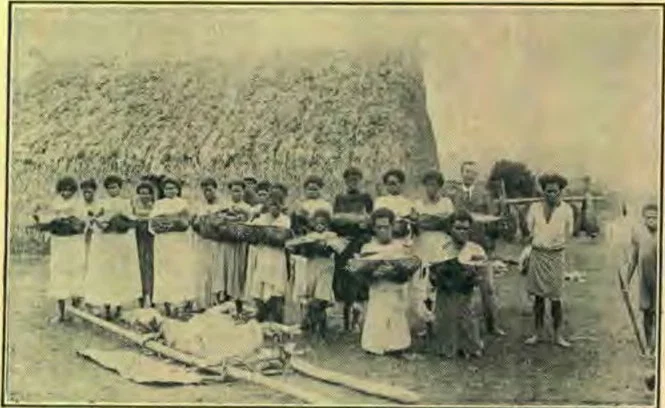
Food was brought to us in great abundance. It is always customary to have a feast to greet visitors. Sometimes a good deal of expense was incurred by their slaying the “fatted calf” and buying what they thought we might like. With this would be great quantities of vegetables and sometimes fruit. Then follow the customary speeches in presenting the food, and the replies from the visitors,—the first telling how little and poor the gift is, and the other telling how much and how good it is. After the food is prepared, it is brought in and laid on large, fresh leaves which are placed on a special mat laid on the floor. Fijians never use an elevated table, but sit Turkish fashion, with the food on the special mat spread on the ordinary floor mats, with which every Fijian house is covered. Many foreigners have difficulty to maintain this attitude long; but as ordinarily there are no tables and chairs in a Fijian home, one must accustom himself to sit so and to have both hands free; it seems the only way.
Generally speaking, the natives are clean in their habits, bathe frequently, and have ideas of cleanliness in respect to the preparation of food. Yet there are some things they do which severely try those long accustomed to better ways. It is bad Fijian etiquette to pass behind any one. In olden days such an offense was punishable by death. So the boys who wait upon the table must walk upon the mat upon which the food is spread. No forks are used in placing the food before one, so the hands are freely used by those preparing the meal and in handling the food.
The houses are rather dark inside, there being, as a rule, but few doors or windows. In the evening a single small kerosene lamp or lantern provides all the light furnished. With this it is quite impossible to distinguish the dark figures sitting here and there, gazing upon the visitor who has the light shining full on his body. Sometimes there is no kerosene in the home, and stores are often far away. The host may then go to his neighbors to borrow a little oil. If successful, he is likely to come back with the kerosene in the most unheard-of kind of oil receptacle. You look for a bottle or a tin or a cup, but he seems to have nothing. Then he takes the lamp or lantern, andp. 4 ejects the great mouthful of kerosene he has borrowed, and it dawns upon you that the Fijian mouth is used as a combined suction pump and kerosene container.
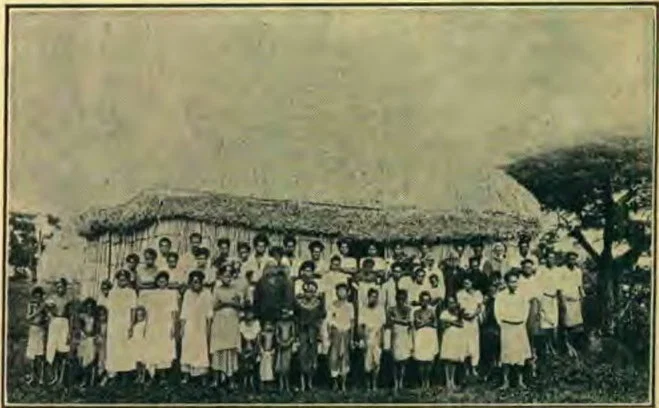
At a number of places, on arriving at the boat’s landing we were met by our brethren with singing. At one place an arbor was built down to the water’s edge, and under this we walked while the brethren sang. Then with singing they accompanied us to the house we were to occupy. It was very good of them, but the writer felt they made altogether too much of the occasion.
On our tour there were two or three sermons a day, besides baptisms and many visits, picture taking, and then at night, after all our work, and perhaps a long journey through the day; anxious questioners would perhaps keep us busy till midnight expounding Scripture. But all was interesting and thoroughly enjoyable.
On our trip we saw the descendants of those who took part in the killing of Mr. Baker, a Wesleyan missionary. We visited the town of Nabutatau, where this took place, and found nearly one hundred Sabbath keepers. The grandson of the old chief who was responsible for the death of Mr. Baker, is now the reigning chief and a fine man, a zealous Bible student, and an ardent advocate of the message. We also saw two old men who had part in that terrible cannibal feast. These men also are nominal Adventists. Many here who have recently accepted the Sabbath truth need much instruction, but wonderful opportunities are presented to teach them the full message.