“MRS. SMIDCHT, will you give me a paper sack to put this sugar in?”
“Why don’t you go to the man of whom you bought the sugar?” the lady asked somewhat severely.
“We did go back, but the store was closed,” said one of the trio.
“Closed! that’s queer!” but the subterfuge saved the children from retracing their steps and gained for them the paper sack.
Mrs. Laon, in relating the foregoing dialogue, said: “I knew there were but two places in town where the sugar could have been bought, so I took pains to see if under some extraordinary circumstance either store could be closed; but I found that people were coming and going as usual from both. The cold-blooded falsehood told so easily by the little girl seemed a terrible thing. I could not forget it. So on my return home, as I kissed my own lassie and laddie, I sent heavenward an earnest prayer for wisdom to guide my children far from deception’s shoals, that wreck and despoil character.”
“I knew that Heaven required me to have a part in answering my own petition; so I determined to strike while the iron was hot, by immediately preparing for our evening lesson something that might aid in instilling a deeper love for truth in my children.”
“As the story hour drew near, Lucile asked, ‘What are we to have tonight, mother?’
‘Can’t we have something more about war heroes?’ suggested Carroll.
‘I have in mind another kind of hero for tonight, my son.’
‘All right, mother; we are ready for anything.’
‘Bring your chairs near to mine, then. Which do you like better, this beautiful tea rose or this very good imitation of one?’
‘I’ll take the real rose every time,’ declared Lucile, as she took the rose from my hand, ‘for it smells so sweet, and is so very delicate and pretty.’
‘Mother, you couldn’t find anybody in the wide world,’ answered Carroll, ‘who would choose the made rose instead of the real one.’
‘Perhaps not, but people often prefer artificial things to the real. The real tea roses are to be preferred, of course, to their best imitation; but how about peaches and oranges, Carroll?’
‘Don’t speak of peaches, mother. My mouth waters now for a real Alberta. No imitation peach for me! How about you, sister?’
‘None for me, either.’
‘Look at this picture of King George’s scepter, and notice this immense diamond. It is a part of the great Cullinan diamond found twelve or thirteen years ago in one of the South African mines. Though the original stone was no larger than your hand, the Transvaal government paid the mine owners $1,000,000 for it, and presented it to King Edward of England, King George’s father.’
‘There are imitation diamonds, too, aren’t there, mother?’ inquired Carroll.
‘Yes, but would any one pay $180,000 for a very small imitation stone, as did Mrs. McLean, of Washington, D. C., for the little blue Hope diamond? No; fancy prices are paid for the real, not for the imitation.’
‘Now tell me, please, what is the most interesting thing the Lord ever made?’
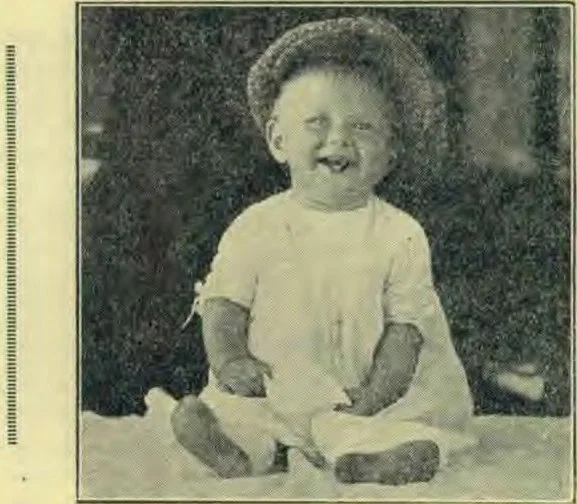
‘Lucile, catching a glimpse of a picture that lay in her mother’s lap, shouted gleefully, “I know. It’s a baby!”’
‘Do you agree, Carroll?’
‘I think so, mother, if it is as sweet as our own little Pearl.’
‘But a baby is a man or woman in the making. The Lord began the work well and he expects the boy and girl, the parents, teachers, and friends to help in the finishing process. He stands ready, however, to advise, and to help whenever needed. In fact, he wants to have a hand continually in the molding, fashioning process, and has given explicit instruction for the character-developing work. What is one trait of character the Lord expects every boy and girl to possess?’
‘He expects them to obey their parents,’ volunteered Lucile.
‘Yes, but what does he expect them to speak?’
‘Speak the truth, be the matter what it may,’ answered Carroll.
‘A Spanish proverb says, “Truth is God’s daughter,” and a lie is the child of Satan. The Lord loves his own daughter, but loathes untruthfulness and deception. A boy who does not tell the truth is not a genuine boy, just a poor imitation, a sham. People very soon learn that he is a counterfeit, and so do not put a high value on him.’
‘If imitation roses, peaches, and diamonds, are poor substitutes for the real, much more is a lying boy or girl a poor substitute for the upright and truthful one. Truthfulness is the solid foundation rock upon which good character is built, and no worthy character can be built upon any other foundation.’
‘True men detest a liar. There is an interesting story told of Wu Ting Fang, at one time China’s ambassador to this country. Like most Chinese, Mr. Wu liked to ask questions, so he said to a young reporter who was interviewing him, “What is your weekly salary?” The young man, wishing to make a favorable impression, answered glibly, “One hundred fifty dollars, sir.” Mr. Wu did not hesitate to say he thought that was too much.’
‘Another day the reporter called at the embassy to get some important information for his paper, but Mr. Wu would give him none, saying, “You lied to me about your salary, as I later learned. If youp. 9 will falsify about such a thing as that, you will lie about anything. I do not trust you. I have nothing to say to you. And I want to revise my former estimate of your value. Instead of your being worth twenty-five dollars a week, as I then suggested, you are not worth anything, sir,” and with this he curtly dismissed the young man. Some time was required for the reporter to recover from the shock of this unexpected confession, but he never forgot the lesson.’
‘He was just an imitation man, wasn’t he, mother, and Mr. Wu was genuine,’ suggested Lucile.
‘Yes, the reporter was a human sham, because he loved not the truth.’
‘One day an eagle was seen gracefully soaring over our beautiful Chautauqua Lake, when it suddenly darted toward the water, catching in its claws a large fish. “There was a clash, and a splashing of fins and feathers,” said an observer of the incident, but slowly the bird rose in the air with its captive dangling and wriggling below. When at a height of about one thousand feet, the bird, still clinging to the fish, began to sink slowly toward the lake, gaining speed as it descended, and finally fell with a splash into the water. Later both fish and bird were found together, dead. The fish had evidently been too heavy for the eagle to carry, but its claws were so firmly embedded in the flesh that it could not release its hold, and as its strength gave way it sank into the water and was drowned.’
‘So it is with one who attempts to climb to the heights of good character with so heavy a soul weight as untruthfulness. He can never mount very high, but is carried down to lower and lower levels until finally his life ends in failure and death.’
‘The gates of Paradise swung to after the expulsion of Satan, the father of lies, nevermore to open only to those who love the truth.’
‘That’s why the Bible says, “Without are dogs, and sorcerers, . . . and whosoever loveth and maketh a lie,” isn’t it, mother?’
‘Yes, my boy. Now will you each make a list of great men who have loved the truth and hated lying? for we shall have another lesson on this subject.’
‘I believe I shall love the real things better than ever, mother dear,’ said Lucile, as she gave me a good-night kiss.
‘And from Carroll’s quiet pressure of my hand as he kissed me good night, I felt that he echoed Lucile’s words.’
F. D. C.
(To be concluded)