Taking slow, awkward steps, this structural steel staging walks into the water to the position where its services are required, and moves around as the work progresses, regardless of the roughness of the water. The first “walking” stage was used at Peterhead, a fishing port north of Aberdeen, Scotland, for the blasting of ten thousand cubic yards of granite, the North Sea along this coast rarely being sufficiently calm for boring from barges.
As shown in the accompanying illustration, the staging was used instead of temporary false work for building a pier extension in Whitby harbor. It consists essentially of two independent structural steel frames, one within the other. They are so arranged as to move independently, and to act as a support, one for the other, in moving. Each frame has four legs, or spuds, that rise independently of each other.
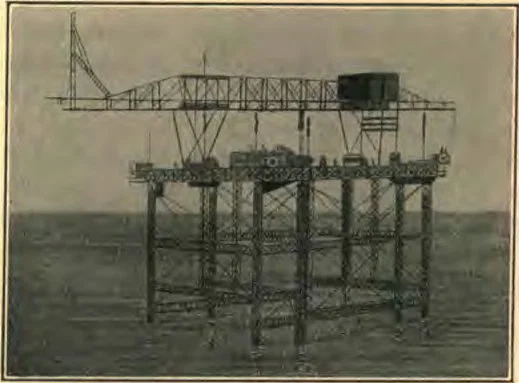
The “walking” operation is simple. The legs of the inner frame are raised, in which condition, carried on rollers resting on the outer frame, the inner frame is hauled forward by tackles also attached to the outer frame. The spuds of the inner frame are then lowered again, and those of the outer frame raised, which, in turn, is carried on rollers resting on the inner frame, this operation being repeated until the staging reaches the desired location.
The structure can move sidewise as well as forward or backward, but the sidewise steps are limited to only five feet, while forward or backward, the step is ten feet. The spuds are each operated by an independent motor, this independence of action being made necessary by the varying depths of bottom. The overhanging gantry is carried on the outer frame, while the plant necessary for construction work is mounted mainly on the inner frame.
These stages are said to have traveled distances of three thousand feet over sand bottom. A ten-foot step can be completed in fifteen minutes, if the crew is experienced.— Popular Mechanics.