WHILE we are on the subject of woodpeckers, it may be well to mention one or two others, so you will not get them confused.
The Hairy Woodpecker looks much like the Downy, but is nearly a third larger, and has no black bars on the white of his tail. He is a shy bird, and you are not so apt to see him about houses as the Downy. In the nesting season the male spends his spare time drumming on the resonant dead limb of a tree; and the louder the noise he makes, the more satisfaction it seems to give him. It is his way of telling his mate that he loves her; if she likes his ability as a drummer, that settles it; they set up housekeeping. It takes them about a week to build a home. The opening into their nest is as round as if made with an auger. It is supposed that two birds, once mated, remain so through life.
The Hairy Woodpecker is a very useful bird, destroying many injurious insects. It never attacks a sound tree.
Description.— Male: upper parts black, spotted and striped with white; red band on back of head; under parts white. The female is similar, but has no red on neck. Length, nine to ten inches.
The Flicker
Among the woodpecker family, I must not forget to mention the Flicker. He has a number of other names; as, Highhole, Yellowhammer, Clape, Yucker, Yellow-flicker, Golden-winged Woodpecker, and some twenty-five or thirty more, including Woodchuck, and Piquebois Jaune.
The Flicker is the most interesting of all our woodpeckers. When he utters his cries, he is bound to be heard. His most common note is a signal, or salute, not unlike Kee-yer! In the spring he utters his If-if-if-if-if, many times repeated; or, as some give it, Cuh-cuh-cuh-cuh, etc.
The Flicker is not so much a carpenter as the other woodpeckers, and nearly half his food is made up of ants, which he digs out of decaying logs, stumps, and fence-posts. When, in the spring, he makes love to the lady Flicker of his choice, you should watch him; his antics are most ludicrous and amusing.
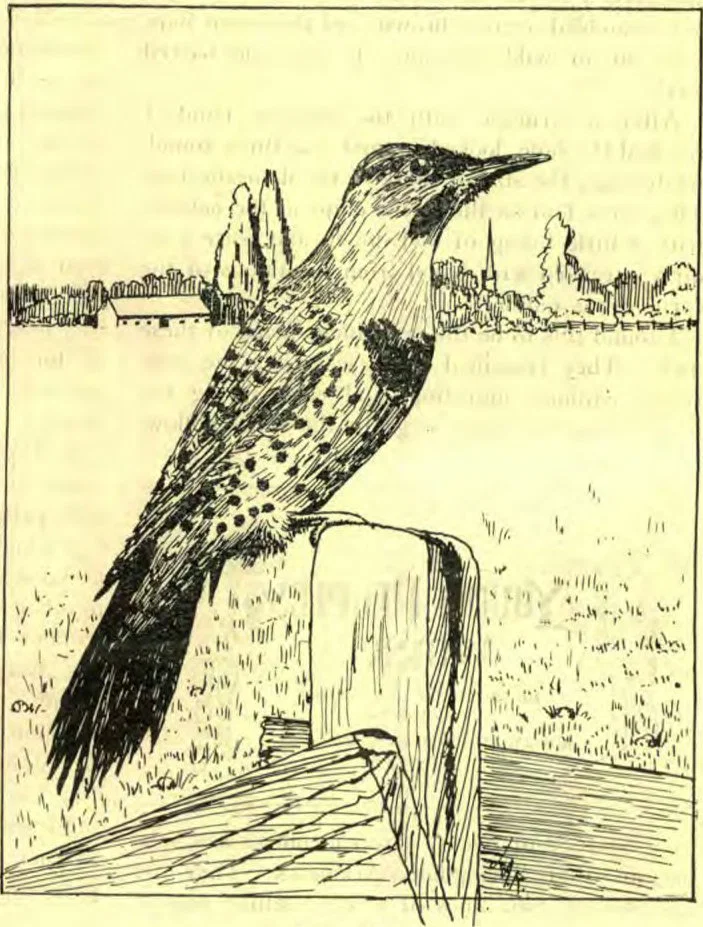
Description.— Adult: back brownish, marked with black bars; throat pinkish; under parts lighter, spotted with black; red band on back of neck; rump white; black stripes on side of throat (the female does not have this stripe); black crescent on breast; under sides of wings and tail yellow. Length, twelve inches.
The Shrike
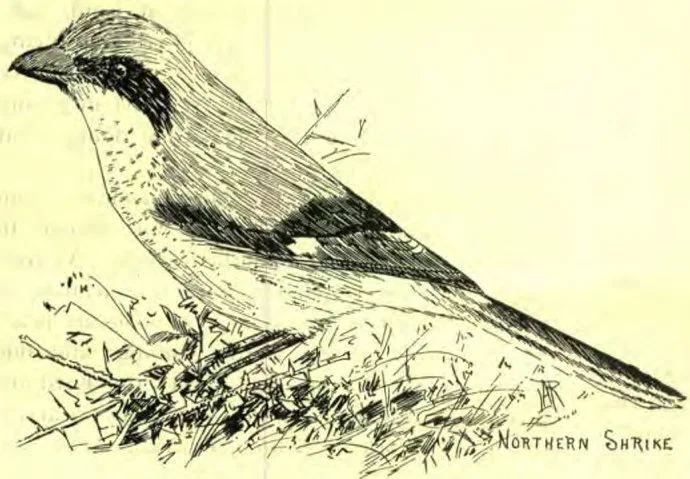
Another bird you may meet with in winter is the Northern Shrike, or Butcher-bird. In summer he lives and nests within the arctic circle, but in October moves down into the United States, though rarely farther south than Virginia, Kansas, and California.
There is a Southern Shrike also, and the two birds are very much alike. This other bird is called the Loggerhead Shrike. The Northern Shrike may be known from the Southern, or Loggerhead, by its larger size, lack of black on the forehead, and gray rather than black in front of the eye. The time of year will help you to some extent in determining which bird you see, because you will meet with the Northern Shrike only from October 20 until about the first of April, and in the neighborhood of St. Louis it is rare at any time of the winter. The Loggerhead comes from the south about the middle of March, and nests as far north as Virginia, and west of the Alleghanies, northward to the Great Lakes, through central New York to Vermont and Maine.
When the Northern Shrike visits us in the winter, it does good work in making away with mice and English sparrows.
Description.— Upper parts gray; wings, tail, and line back of the eye, black; under parts white, barred with black; forehead whitish, without black line. Length, ten and one-fourth inches.
The Loggerhead Shrike is a very quiet bird. I have often, when driving in the country of central Illinois, seen six or eight of these birds in company along the fence, or on some wayside tree. They are always to be found in the open country, where they have an opportunity to see all that is going on; for they are always on the watch for any small creatures that will serve as food, such as crickets, grasshoppers, meadow-mice, small snakes, besides cutworms, cankerworms, and the like. On this account the Loggerhead Shrike is a very useful bird. Sometimes when food is scarce, he will eat small birds, but this is not usual. I think you will watch them many months before you will discover a Shrike harming other birds. The Agricultural Department of the government, after making a careful study of this bird and its habits, tells us that it should be protected, as its food all over the country consists mainly of grasshoppers.
The Shrike impales its victims on thorns or any other sharp projection. It doubtless does this to assist it in tearing the thing into pieces to be eaten. A Shrike was observed to catch a meadow-mouse, and carry it up into a tree, where, after it had killed it, it tried to wedge it into a crotch, so that it could eat. Finally it found the sharp end of a snag, on which it fastened its prey.
Olive Thorne Miller says she has seen a Shrike throw a dead meadow-mouse over a fence wire that had sagged to the ground, in order to get bits off to eat. She also says that a lady in New Hampshire had a Shrike in captivity. The bird could not eat a piece of meat until he had a place to fasten it. He hopped about, looking for something, until she guessed what the little creature wanted. She brought it a kitchen fork, which had two tines, and the moment the bird saw it, he ran to her, hopped up on her hand, jerked the meat onto the tines, and immediately began to eat.
Let us never forget, as we see these manifestations of wisdom and intelligence on the part of the lower creatures, that their knowledge, or lack of knowledge, as the case may be, is the direct will and gift of God. Job 39: 13-18. And he who gives the Shrike its bright intelligence for its work, will do far more for us; for “he teacheth us more than the beasts of the earth, and maketh us wiser than the fowls of heaven.” And “if any of you lack wisdom, let him ask of God, that giveth to all men liberally, and upbraideth not; and it shall be given him.” Therefore, “Who maketh thee to differ from another? and what hast thou that thou didst not receive? Now if thou didst receive it, why dost thou glory, as if thou hadst not received it?” So, “Let not the wise man glory in his wisdom. . . . But let him that glorieth glory in this, that he understandeth and knoweth me, that I am the Lord which exercise loving-kindness, judgment, and righteousness in the earth: for in these things do I delight, saith the Lord.” L. A. REED.