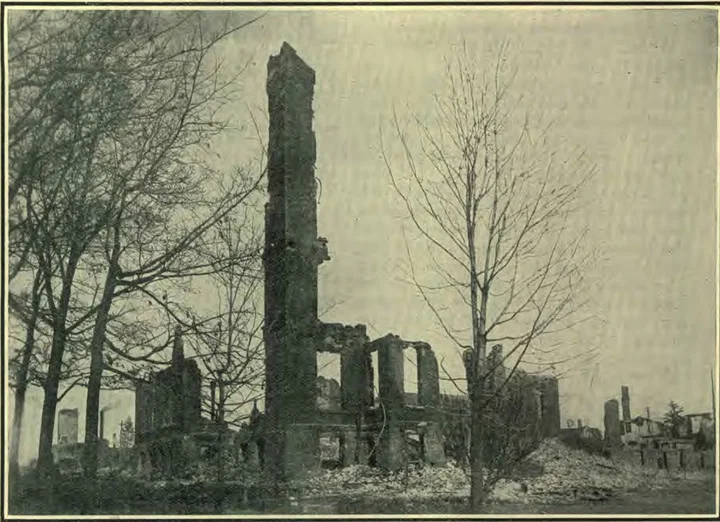
As the burning of the Sanitarium and Hospital has been fully written up in our papers, it is thought best not to repeat the facts in the INSTRUCTOR. We have, however, secured permission to print, by courtesy of B. C. Peterson, two pictures, one showing the center of the main building as it appeared about five o’clock on the morning of the fire (which will be given next week), and the accompanying view of the ruins, from the southwest corner of the Sanitarium. Other views will be given from time to time.
As was expressed again and again during the morning of the fire, the principles which, under the blessing of Heaven, made the institution what it was, can not be burned. Correct health principles; the advancement in rational methods of treating disease; the skill and experience of physicians and nurses; and, above all, the unselfishness, loyalty, and self-sacrifice of the employees,— all these are of far more value than any facilities; for without these any equipment, however splendid, would be useless in the specific work for which the Sanitarium was founded, for which it has always stood, and for which it still stands.
As soon as the workers of the institution could be gathered together after the fire, a short meeting was held, in which only words of courage and hope and trust in God were expressed. At this, and at later meetings, the employees have offered to give their services to the institution, receiving only board and room, until such time as the new building is finished. This will mean a gift from the helpers of about four hundred dollars a day to the new building.
During the days following the fire, one standing in the crowded hallway of the old College Dormitory, where the patients and guests were temporarily cared for, could not but be impressed with the spirit of cheerfulness, courage, and “making the best of it” pervading the very atmosphere. Patients who had lost everything, even their clothing, and others (like Ira D. Sankey and Colonel Hadley, who lost valuable book manuscripts) whose losses are of a nature to be beyond money value, seem to forget their personal loss in gratitude for their escape with life. And, indeed, those who are familiar with the buildings, the rapidity with which the fire spread, and the loss of life under similar circumstances in other places, can not but feel the sense of wonder and gratitude expressed by the words: “This is the Lord’s doing: and it is marvelous in our eyes.”
Shortly after the fire, an “Extra” containing a brief report was being sold on the streets of a large Western city. An old friend of the institution, seeing the headlines, asked to look at the paper; and it was handed to her with the remark: “I am sorry. I was there nine months, and they did me good.” That sentiment is echoed by thousands upon thousands of men and women in all parts of the world. Hundreds of telegrams and other messages expressing sympathy and offering financial aid, have been received from former patients who were benefited while at the Sanitarium, and who have become its friends.
While we deplore the loss of these buildings to which many, through long association had become personally attached, let us not fail to learn the lesson God would teach us by their removal. Would he not have us learn that buildings are nothing in his sight, but that he honors the principles which these buildings represented—that the things which are seen, in which men so often put their trust and confidence, are at the best only temporal, but that the things which are not seen are eternal? And if again he allows us to hold in trust another great Sanitarium, shall it not be with humble, thankful hearts, in which there shall be no trace of faultfinding or criticism, but only gratitude for the opportunities of education it affords to us as young people, and a determination to carry its life-saving message to the world?
THOSE wishing to secure copies of this photograph can do so by sending twenty-five cents to B. C. Peterson, Review and Herald, Battle Creek, Mich.