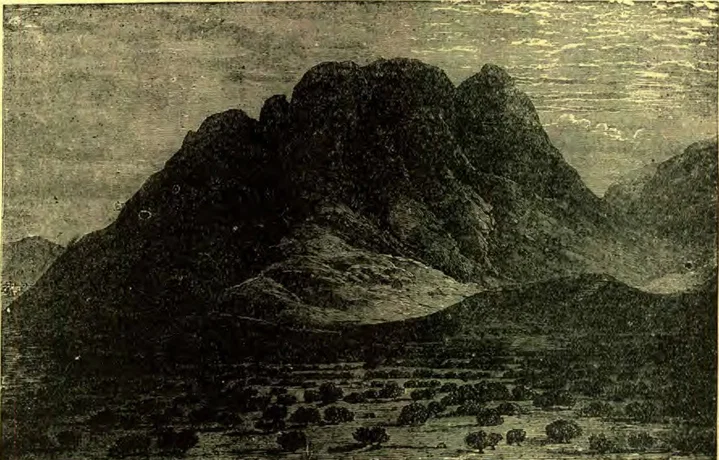
I spent a beautiful Sabbath day not long ago, within full view of Sinai. Coming up from Bombay through the Red Sea, our ship passed closely along the Arabian coast. The first sight that caught my eye as I looked out of the cabin window that Sabbath morning, was the mount of God. Far ahead of us, it rose above the morning mists of the foothills, a sublimely grand monument.
Until the early evening I watched the changing colors and shadows move across its face. How real the story seemed to me that day, as I read again and again the narrative of Israel at Horeb. In fancy I could almost see the tents of the camp through the mists, and hear the sound of the trumpet calling to solemn assembly. Up which of these rocky defiles did Moses press, as he “drew near unto the thick darkness where God was”?
Here and there on its lower slopes, the glass showed grassy plots, with trees and shrubs. Above, all was apparently rocky and barren. The summit is cleft in twain, as if by the power that one day, so long ago, shook not this mountain only, but all the earth, as God’s law was spoken from this majestic pulpit.
Most of my fellow passengers were French soldiers. They were interested in the sight for but a moment. Some who knew explained the history to their comrades. But without doubt the general impression was that Sinai represented an extinct power.
There is a common tradition in the Orient that there are no ten commandments east of Suez. A passing glance, a wondering interest, and the soldiers were again at their games, or handling and trading the loot which they had taken in the China war. Does not this fitly represent the attitude of the world? Under the very shadow of the mount that burned with fire at the presence of the living God, our little world on shipboard devoted the holy hours of the Sabbath to pleasure and gaiety. They cared as little for its sacred associations as the Bedouin Arabs who still watch their flocks, as Moses did those of Jethro, at the base of Sinai.
As for myself, all day long I thanked God for the peace of the Sabbath, with its associations of Eden and of heaven, spent within the range of the holy mount. I thanked him, too, for the hope of the promise that the voice that once shook the world from Sinai’s summit will soon speak again, shaking not the earth only but the heavens. The Near East is full of the sacred associations of the past. We must hasten into it with the living message of God for the present.
W. A. SPICER.