In our national museum at Washington, there is a cozy room set apart just for the children—the Children’s Room, it is called by the one who planned it, and made it what it is—Dr. S. P. Langley, the honorable Secretary of the Institution. He wished to make it a small, pleasant room, where little children might come, and learn the common, every-day names of curious and interesting birds and fishes, and look at them through cases on a level with their own eyes, and not have to be lifted up, or stretch their small necks in an attempt to “see.” You know that when the small child has done this, it is often very disappointing to read, on the card fastened to a bird’s toes, only a long, hard name that he never heard of, and doesn’t understand, and can’t pronounce to save his life. The secretary, who loves children, thought of all these things, and decided to take the time to fit up a room that should be just such as the children themselves would enjoy.
The Children’s Room is just across from the main entrance, and is a sunny, pleasant place. Its ceiling is painted to represent a vine-clad arbor, and the doors and windows open into a garden where there are real vines and trees, and where, during the long, bright days of summer, real birds sing and build their nests. But even when the outside birds have flown away, there are still live birds under the painted vines,—Redbirds, South American Cardinals, Bullfinches and Goldfinches, Javan Sparrows, Japanese Robins, Mocking-birds, Canaries, and many others. These supply a “chorus of nations,” filling the Children’s Room with happy music.
Around the gilt cages, and a little below them, are the aquariums, both salt and fresh, “so simply and carefully arranged that even the very little child may look and love and wonder from every side; where bright fishes and baby turtles wave and dart and paddle amid feathery green and over pebbly beds.”
Above the low glass cases along the wall are prints and water-color pictures of the specimens arranged below, and these are to be added to year by year.
Albert Bigelow Paine has described this room so well for the readers of St. Nicholas, that we will let him take the children of the INSTRUCTOR family on a little tour among the cases of birds in the Children’s Room:—
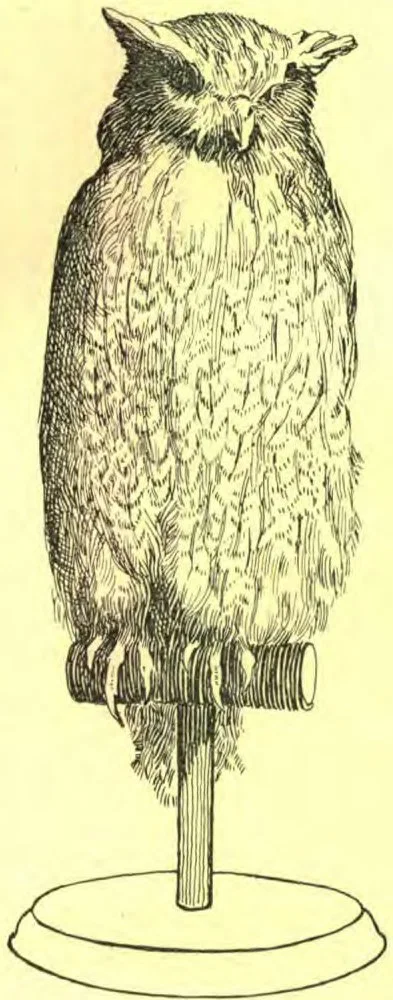
“These cases are arranged as a child would wish them, and he will begin, perhaps, with those on the left as he enters—the cases of birds. At the first of these he will linger. Within are the ‘Largest and Smallest Birds of Prey.’ He will look at the great Condor of the Andes, and the Bald Eagle, and then at the tiny Sparrow-hawk; and he will wonder why these are so big, and that so little, and if the Bald Eagle could whip the Condor in a fair fight. He thinks it likely, because the Condor has blunt claws,—so blunt, the card says, that he can not carry off the big animals he sometimes kills. The Condor is bigger than the Bald Eagle, but he is not so good-looking, and the child does not like him. He likes much better the largest owl, the Great Eagle Owl, who lives in the vast, trackless woods of northern Europe and Asia—a monarch of the far, dim stillness; and if the child is a little girl, she adores the smallest of his race, the tiny Elf Owl.”
“The small observer passes on. ‘Some Curious Birds’ come next, and he must see them, even if he has to come back to the Bald Eagle and the Condor, and the different-sized owls, by and by. He wonders and laughs, too, at the curious birds. Truly they are a funny lot. Some of them have fans that fold. Others have veils, aprons, crowns, lappets, armor, and what not. The Toucan has such an absurd big bill. The Black Skimmer’s flat bill is set the wrong way. A queer Paradise-bird has one tail where it should be, besides two very long tails that are half saw and half feather, and that start from behind his ears. Then there is a row of little Bat-parrakeets, that sleep with their heads hanging down. The child wonders why even from Australia, which has paltry, half-formed feathers, and no wings at all. The child pities the Apteryx—he looks so timid and sorry; and the card tells us he is often killed by dogs, because he can not fly. He is so different from his fine neighbor, the Laughing Jackass, whose expression is always humorous, and who seems always about to make merry.”
“Just below these is a shelf of ‘Bright-colored Birds.’ If the child is a little girl, here she will linger long. The vividly blue Cotinga of British Guiana, the Beautiful—the most beautiful—Parrakeet, the Rose Cockatoo of Australia, the Elegant Minivet, and the Crimson-winged Lory—these she will love and admire. To me the Mandarin Duck seems the gem of this collection—a fowl whose dress is so Chinese in its cut and coloring that one wonders whether he has really imitated the mandarins or they him.”
“And now come the ‘Common Birds of Europe’ and the ‘Familiar Birds of the United States.’ The child has yearned long to see the Raven, the Magpie, the Starling, and the Jackdaw of his story-books, and the English Lark and Robin from which, long ago, our meadow singer and redbreast were named by a people homesick for their own far lands. The Curlew, the Rook, and the Lapwing,—these, too, are among the European birds,—while the Phoebe, the Bittern, the Kingfisher, the Bob White, and the Bobolink are among their American cousins, as well as our own Lark and Robin, not forgetting the beautiful Blue Jay, and the tiny Ruby-throated Humming-bird, so familiar to us all.”
“The child is proud of his own birds. Perhaps he wishes they were more gaudily colored, and wonders why Parrakeets and Pink Cockatoos do not dwell in his own woods and fields. Still, there is the gay Cardinal, and the pretty Bluebird, whose color is like a bit of sky.p. 390
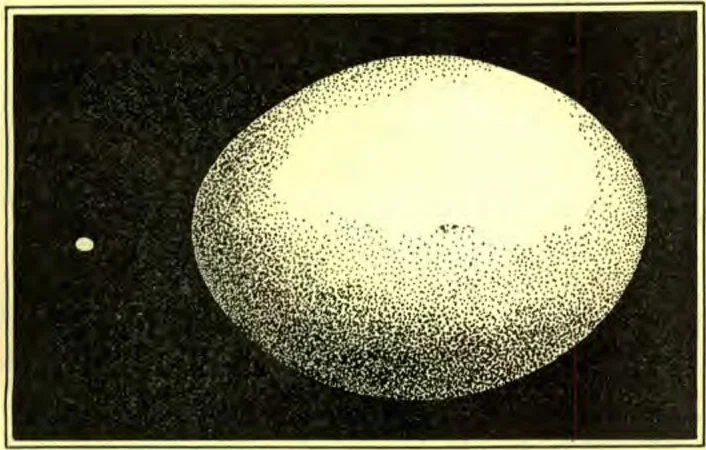
“In the case next to this are ‘Birds with Curious Nests and Eggs.’ The heart of the small observer finds great joy in this case. The smallest and largest eggs in the world, those of the Humming-bird and of the Giant Ostrich, or Aepyornis, of Madagascar, which no longer lives, but whose eggs, that were more than a foot in length, are still to be found.”
“The child ponders long over these eggs. He wonders how many times larger the big egg is than the little one. If he asks, as I did, he will be told that it is about thirty thousand times as big, and he will picture to himself the great bird, as tall as a tree, sweeping over the sands with furlong strides.”
“Within this case, too, are other curious eggs, large and small, including those of the Eagle, the Ostrich, and the great Moa of New Zealand, while among the curious nests the child sees the homes of the Hangbird, the Weaver-bird, and the Tailor-bird. Much and long he wonders how these clever house-builders wound in and out the threads and fibers of their marvelously built homes. But just below there is a nest with eggs. It is not a curious nest, but built in a curious place—in a skull, in fact, and it is the nest of the tiny House Wren.”
“And now, beyond these come the ‘Water Birds,’ the Great Albatross; the King Penguin of the far, white South; the White Egret, hunted for his rare plumage; and the Scarlet Ibis, whose flaming feathers make him a shining mark for death.”
“The child is sorry that these rare birds are killed for their wings and plumes. If a little girl, perhaps she resolves never to wear them. She remembers that birds have little folks, too, and she wonders what becomes of them when the parent bird is shot down, and can never return to them with food.”
“But at the next case these things are forgotten. At the top, instead of a picture, there are a mounted Beaver, and a Lyre-bird, with his tall, magnificent tail. Above the Beaver is a fine spray of peacock plumes, and in the case beneath him a Kite carrying a snake, some Bower-birds with their playhouse, and some Ptarmigans in both winter and summer dress. The child rejoices in the Bower-birds. He has a little book with a picture of them, but here they are at home with their playthings. There are several of them, and he wonders if they have invited in friends to see and play with the pretty shells and colored glass they have found.”
“But the Ptarmigans he can hardly believe real, their winter dress is so snow-white, while in their summer plumage they are so brown and mottled, like a pheasant. Still, the cards tell him they are the same, and though he wonders much, yet he must believe.”
“Then he passes on to ‘How Creatures Hide,’ the Children’s Room name—and a very happy one—for Protective Mimicry. Here are the Leaf Insects, that are so like the leaves about them as to make the observer almost ‘give it up’ before he discovers that some of the leaves open and form wings, while beneath others there lie curious creatures so near in shape and color to their hiding-place that only the sharpest eyes will find them. Nests there are, too, that might well be a part of the limb that holds them; and beneath, in a box of sand and pebbles, are some Terns’ eggs and young. And the young Terns are so like the eggs, and the eggs so like the pebbles, that even after he sees them, he must take a second and a third look to make sure.”
“Before the child goes home, he turns once more to the Song Birds and Darting Fish, and before he goes, he must have one more look at the cases. The Owls, the Swallows, the Night Hawk, and the Whippoorwill—such things as these he has been glad to see at close range. Heretofore they have been to him but as darting shadows, or weird voices from the dusk of evening. He has seen Swallows circling about the