Some Common Snow Birds
BIRDS are not so common in winter as in the warmer days of spring and summer. This is due not so much to cold weather as to scarcity of food. In the fall, as the usual forage fails, one after another, the birds migrate to the South.
Many birds, however, remain with us all through the winter months. If you will go out during the warmer hours of the day, when there is no strong wind blowing, you will find a number of these winter-dwellers feeding in favorable, sheltered places.
If you have not been a close observer of birds, you may be surprised to learn that August is one of the poorest months in which to study them. During this month they leave their accustomed haunts, and retire to secluded places to renew their worn-out plumage. They are inactive and silent, and it is difficult indeed to find them. Later in the month they have grown their new uniforms, and are ready for their long journey southward.
Winter is the best time of year to begin the study of birds. The varieties at that season are not so numerous; and if the beginner makes the acquaintance of all that are to be found during the cold months, he will have a much easier task to identify those that arrive in the spring.
In the Middle States during the winter you should find now and then the following birds:—
- Barred Owl
- Blue Jay
- Crow
- Meadow-lark
- Bob-white
- Ruffled Grouse
- Hairy Woodpecker
- Flicker
- Downy Woodpecker
- Finch
- Long-eared Owl
- Great Horned Owl
- Purple Finch
- Song-sparrow
- White-breasted Nuthatch
- Chickadee
- Sharp-shinned Hawk
- Screech-owl
These birds are all permanent residents; and occasionally the Waxwing, Bluebird, and Robin pass the winter in the North. Besides these we sometimes have visits from the following:—
- Saw-whet Owl
- Horned Lark
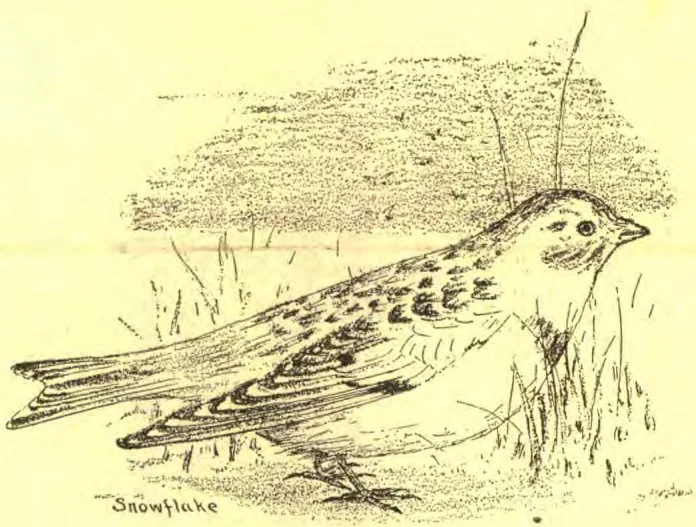
- Snowflake
- Redpoll
- American Crossbill
- White-throated Sparrow
- Tree-sparrow
- Junco
- Northern Shrike
- Winter Wren
- Golden-crowned Kinglet
- Brown Creeper
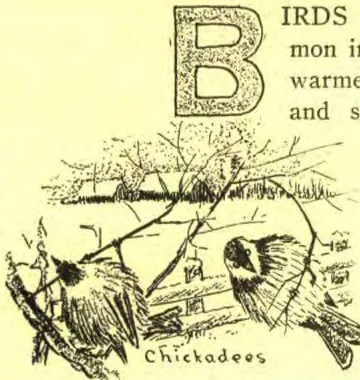
In this paper are given pictures of the Junco, Snowflake, and Chickadee. In following numbers we will describe other of our winter birds, and tell you something about them.
Always remember that in order to study nature, you will have to go to nature; she will never come to you. Though the days may be cold, choose some time when there is bright sunshine; and you will be almost certain to find some of these interesting little creatures. If you live near the edge of town, or, better yet, in the country, you may attract many birds to your door-yard by protecting them from danger when they do come, avoiding frightening them, and above all, by giving them food. A piece of fat meat nailed to a tree will attract Chickadees, Blue Jays, Nuthatches, and Woodpeckers. If you throw out crumbs of bread or grain, they may be blown away or snowed under; but if you will nail up a box with open front, placing it with the back to the prevailing wind, you will have a place where many birds will delight to come for food, if you are faithful in providing it. Some birds prefer to feed on the ground. It is therefore well to have a small cleared place where you can strew waste food, at the same time being careful not to frighten or disturb them. I have heard of one lady who cared so much to have the birds about, that she baked bread especially for them, using one third wheat and two thirds corn-meal, as such bread will not freeze so hard as bread made from wheat flour alone. She had many birds around her home. She also fed them hemp-seed, sunflower-seed, nuts, and finely crushed corn.
God cares for the birds. We should always remember what the Saviour said about them. Having the birds about us will be the best reminder that our souls are in his sight worth infinitely more than many of these creatures, not one of whom falls to the ground without his notice. L. A. REED.