On the eleventh of December, 1898, I left Johannesburg by an early morning train, in company with two friends, to visit Pretoria. December is well into the summer in South Africa, but the spring rains had been late, so the fields and hills over which we passed were just putting on their most glorious green.
The first twelve miles of our journey lay along the main line of railway leading to the Cape and Natal. The traveler passes many of the richest and best-known mines, whose great smoke-stacks rise high into the blue, some near the road, others away to the east and west as far as the eye can see. Near by the great piles of cyanid-treated ore, now left as finely powdered sand, glisten in the sun like huge banks of snow.
A few halts at some of the mining suburbs, then at the village of Germiston, and we are at Elandsfontein, the junction. Here a population of a few thousand has collected, living within easy reach of the mines, which extend in all directions except southward, along the lines of railway. At the junction our train takes on a few more passengers, and puffs away up-grade toward Pretoria. In Africa, railway trains are never in a hurry; so we proceed at the leisurely rate of fifteen miles an hour, stops excluded. The common difficulties of making observations and obtaining good landscape views along the way, on account of rapidly moving trains, are almost wholly obviated here.
We are traveling northward, and the first thing noticeable is what is said to be a lime-kiln on our left near the railroad. Not far from it is a villa, almost hidden by beautiful ornamental gardens, the property of a Johannesburg gentleman of wealth. Now and then a farmhouse may be seen in the distance, but every mile brings us farther into the hills, so that all but nearer views are cut off.
The recent December showers have given a good start to the grass and early flowers of the veld. The Boers usually burn over their lands once a year, and now they are covered with the freshness of new-grown meadows, rich in their natural beauty. Riding for about two hours, with hills growing in size and roughness, a few stops at sidings to “pick up” or “set down” a passenger, and our attention is drawn to a prominent eminence away on our right several miles ahead. On its top there is an appearance of excavations, or at any rate evidence of some disturbance, shown by the patch of reddish-gray (characteristic of Transvaal soil) near its crest. Soon we become aware that we are approaching within range of one of Pretoria’s far-famed forts. Soon another reddish-capped hill, farther away in the same direction, comes into view; then another, on our left. Still our train climbs higher and higher, until, passing a rugged, rock-strewn kopje, we quickly emerge, with Pretoria lying away below, in a rounded valley shut in by high hills. The first impression is that the place is indeed “beautiful for situation.”
The station is soon reached, and passing through it we notice street-cars drawn by horses, waiting at the other side. Several hotel buses are also in waiting, and in one of these we decide to ride up-town. It is about a mile and a half over level and well-kept streets to the central part of the capital. Making a turn down one of the principal streets, our bus stops in front of the Royal Hotel. There is nothing imposing about this one-story building, which, like all other up-country hotels in Africa, has its sleeping-apartments at the rear, surrounding an open square.
We had purposely selected Sunday for this visit, that we might attend service at President Kruger’s Dopper church, and possibly hear him preach, as he often did there. While waiting a short time for the hour of service, several carriages passed our hotel, among whose occupants were pointed out members of the Executive Council and of the Government Raad, or Congress. Eagerly expectant, we watched for the imposing turn-out of the president, of which we had heard so much. In this we were disappointed, afterward learning that he had obviated the necessity of driving to worship by building a residence opposite the church.
At 10:30 A. M. our Dutch friend, Mr. De Beer, reminding us that the time of service was near, led the way toward the lower part of town. Crossing two blocks to Government Square, we walk down a long street, where we observe that while the houses are unpretentious, the gardens are often beautiful and extensive. A walk of three quarters of a mile brings us to the lower end of the street, where it merges into a country road. Here, on the left, is a plain brick church, with no spire. Directly opposite is a house, well shut in by trees and shrubs, built of brick, plastered over and painted white,—a one-story structure in no way imposing,—the president’s residence.
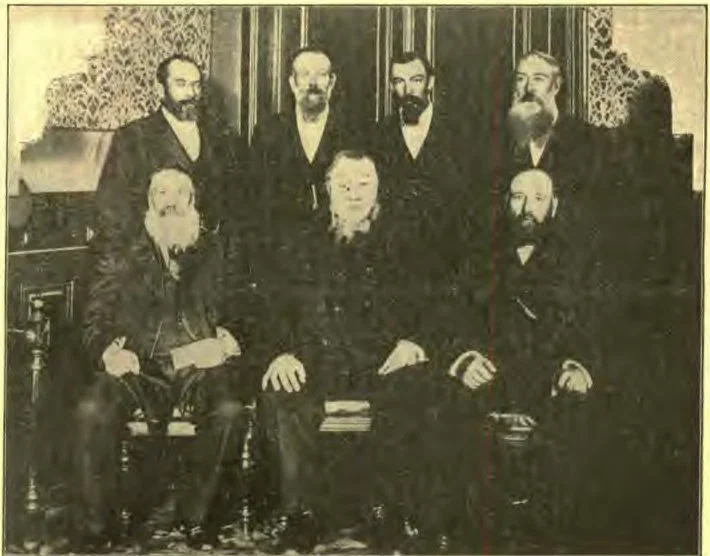
Entering the church, which stands only a little back from the street, we are seated by one of the pleasant wardens. I notice that there are two entrances, one at the front, where we entered from the street, the other opposite the pulpit on the right. The seats are plain, uncushioned benches, the furniture altogether being plain, finished in a modest brown. While interested in the service soon to begin, of course we anxiously wait the arrival of the president. As the minister takes his place for the opening service, a small party enters by the side door,—an elderly lady of medium build and short stature, dressed in black, a younger woman by her side, and two gentlemen; but the well-known form of President Kruger is missing. The elder lady was Mrs. Kruger, the others being members of the family. The service was one of devout simplicity, and was conducted entirely in Dutch. At its close Mrs. Kruger was seen greeting many of the congregation, then walking quietly over to her home. We learned that Mr. Kruger was confined at home by illness. Knowing this would be our only opportunity of visiting Pretoria, we determined to make an effort to see him.
Going across to the house, Mr. De Beer spokep. 28 to the single sentry at the gate, saying at my request that I desired very much to see the president before returning to America. The sentry, a nephew of Mr. Kruger, went inside, and soon returned, explaining that the president was suffering from a disease of the eyes, making it necessary to bandage them to exclude all light, so it was impossible for him to see anybody. I had brought a small book in Dutch, which I had intended to present him, and this I now sent in, with my card. The attendant returned, expressing the president’s sincere thanks, regrets that he was unable to receive our party on that day, and an invitation to come at another time.
We now had time to visit several interesting parts of the capital. Of course the government buildings were all closed, so we could see them only from the outside, with the exception of the Palace of Justice, then being erected. This is acknowledged to be one of the finest structures in South Africa. For an hour we walked along clean, well-kept streets, the dwellings on either side being surrounded by gardens among the most beautiful to be found anywhere.
After dinner we visited the public park, and the botanical gardens, which are famed for their luxuriance and beauty. The whole town bore an air of quiet and good order. Little did we think that within a few months the peoples of this country would be engaged in deadly strife.
JOEL C. ROGERS.