13. And one of the company said unto him, Master, speak to my brother, that he divide the inheritance with me.
14. And he said unto him, Man, who made me a judge or a divider over you?
15. And he said unto them, Take heed, and beware of covetousness: for a man’s life consisteth not in the abundance of the things which he possesseth.
16. And he spake a parable unto them, saying, The ground of a certain rich man brought forth plentifully:
17. And he thought within himself, saying, What shall I do, because I have no room where to bestow my fruits?
18. And he said, This will I do: I will pull down my barns, and build greater; and there will I bestow all my fruits and my goods.
19. And I will say to my soul, Soul, thou hast much goods laid up for many years; take thine ease, eat, drink, and be merry.
20. But God said unto him, Thou fool, this night thy soul shall be required of thee: then whose shall those things be, which thou hast provided?
21. So is he that layeth up treasure for himself, and is not rich toward God.
Synopsis
An innumerable company of people were gathered before Christ, and he had been teaching them concerning the Holy Spirit. With severity he had rebuked the Pharisees, and sought to turn his disciples from their doctrines. But one of the company, seeing what an influence Jesus had, thought to get him to use this over his brother with whom he had quarreled about the property. This covetous man would have the Saviour turn from his work of saving men to provide things for this life only. The Saviour said that he had not come to do such work, and as a warning against covetousness spoke the parable of the Foolish Rich Man.
Questions
1. As Jesus was teaching, what selfish request was made by one of the company?
2. What trouble had evidently come up between this man and his brother?
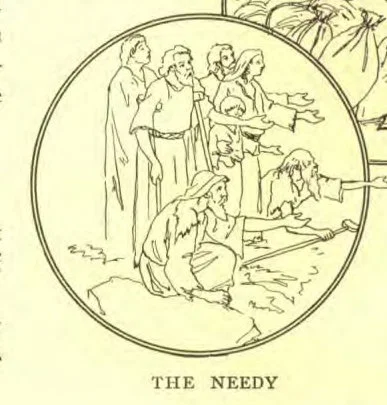
THE NEEDY
3. How did Jesus answer him?
4. What warning did he then give the people?
5. Why is covetousness a thing to be shunned?
6. How did Christ further warn against sin?
7. What had made a certain man rich?
8. As his fruits increased, what did he think within himself?
9. What did he decide to do with them?
10. For whom were his goods to be laid up?
11. How long did he think they would last?
12. In what way did he plan to spend this time?
13. But what did God suddenly require of him?
14. What did he call this covetous man?
15. What startling question did he ask him?
16. To whom is the sad fate of this man a warning?
17. Is it so that one who lays up treasure for himself is not rich toward God?
Notes
1. The foolish rich man looked upon those things which he had laid up as my fruits, my goods. He did not pay his tithe, and thus acknowledge that all things come from God, and therefore belong to him.
2. Hence God sternly calls him to account with the question, “Then whose shall those things be?” The rich man could not answer (Ps. 39:6); but one thing was certain, they would not be his.
Quotations
1. Through Moses God had given directions concerning the transmission of property. The eldest son received a double portion of the father’s estate, while the younger brothers were to share alike. This man thinks that his brother has defrauded him of his inheritance. His own efforts have failed to secure what he regards as his due; but if Christ will interpose, the end will surely be gained. He has heard Christ’s stirring appeals, and his solemn denunciations of the scribes and Pharisees. If words of such command could be spoken to this brother, he would not dare to refuse the aggrieved man his portion.—“Christ’s Object Lessons,” page 253.
2. Jesus could have told this man just what was right. He knew the right in the case; but the brothers were in a quarrel because both were covetous. Christ virtually said, It is not my work to settle controversies of this kind. He came for another purpose,—to preach the gospel, and thus to arouse men to a sense of eternal realities.—Id., page 254.
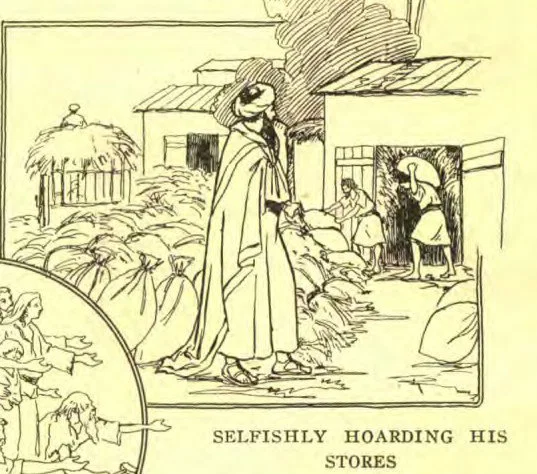
SELFISHLY HOARDING HIS STORES
3. This foolish rich man in his supreme selfishness had laid up for himself treasures that he could not use. He had lived only for himself. He had overreached in trade, had made sharp bargains, and had not exercised mercy or the love of God. He had robbed the fatherless and widow, and defrauded his fellow men, to add to his increasing stock of worldly possessions. He might have laid up his treasure in heaven, in bags that wax not old; but through his covetousness he lost both worlds.—“Testimonies for the Church,” Vol. III, page 402.
4. I have given you, says God, nine tenths; I ask one tenth of all the increase. That one tenth the rich man withheld from God. If he had not done this, he would not have accumulated so great treasures that there would be lack of room to bestow them. Had he bestowed his goods upon his needy brethren, there would have been no need of tearing down and building greater barns.—Id., page 546.
5. Men may have boundless wealth; yet if they are not rich toward God, if they have no interest to secure the heavenly treasure and divine wisdom they are counted fools by their Creator, and we leave them just where God leaves them.—Id., page 154.