Nearly every one is more or less acquainted with the white and yellow lilies which form so conspicuous a part of the vegetation of lakes and ponds. Many have experienced the pleasure of plucking them with their own hands while boating some fine summer day. Others have perhaps seen them only away from their native habitat, and have no thorough acquaintance with the habits of these plants.
The family represented by the Water Lilies is not very large, and while its members differ considerably in some particulars, yet there is one characteristic common to all of them, that of living in the water. Hence they are known as Aquatic Plants, as are all others that have at least their lower part growing under water.
To this family has been given the botanical name Nymphaeaceae, from the fact that the Water Lilies, the principal plants belonging to the family, were dedicated by the Greeks to the water nymphs, an inferior class of heathen deities. If we keep this name in mind, it will serve as a reminder to us, while enjoying the beauty and fragrance of the lilies, that there are still heathen in the world who are waiting for some one to tell them the gospel story.
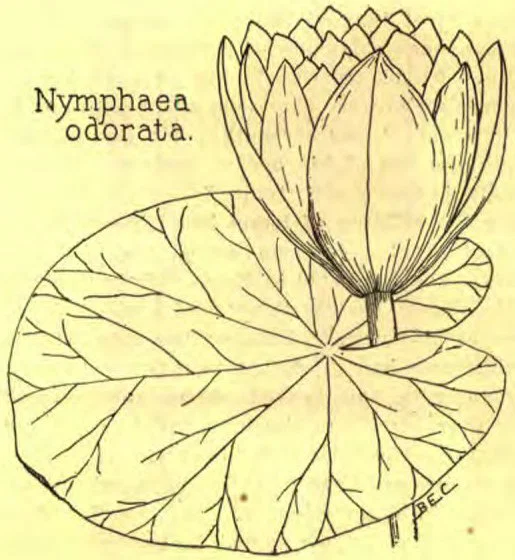
The plants are safely anchored at the bottom of the water by means of thick, fleshy rhizomes, or rootstocks, embedded in the mud, and from these are sent up, on long peticles, rounded, heart-shaped leaves, which generally float upon the surface of the water, but sometimes rise above it or remain beneath the surface.
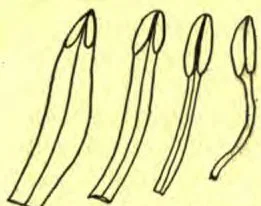
The rhizomes are often as thick as a man's arm, the leaves float upon the surface of the water, and the large, handsome flowers are produced all summer. The four sepals are green on the outside, but petal-like on the inside. The petals and stamens, both of which are numerous, present a remarkable peculiarity. In all the plants that we have thus far studied these two sets of organs differ decidedly in form, but in the Water Lilies the petals gradually grow narrower from the circumference toward the center of the flower. Some of these, though undoubtedly petals, are tipped with a small yellow anther. Nearer the center of the flower they become still more stamen-like, until they assume the form of the genuine stamen. In this case there is no distinct dividing line between the petals and stamens.
From the axils of the leaves the flower stalks are produced. These lengthen until they reach the surface of the water, where each is terminated by a single flower, often of great beauty.
A somewhat similar peculiarity is found to a greater or less degree in some other plants. The rose, for example, in its natural condition, as shown by the various species of wild roses, has but few petals and numerous stamens; though when brought under cultivation, some of the stamens may be replaced by petals, forming the so-called double flowers; or all of the stamens, as well as the pistils, may be replaced by petals, producing the full double flowers. These are of course unnatural, and incapable of producing seed, as the essential organs of the flower are absent. While they serve to gratify our love of the beautiful, they are useless as far as propagation of the plant is concerned.
This unnatural condition of plants brought on by cultivation can be preserved and propagated only by skillful management on the part of the cultivator. When left to themselves, such plants either perish or return to their original form.
Because of the tendency exhibited by the different parts of the flower to replace each other, and also on account of their close resemblance to leaves in many cases, all the parts of flowers are now regarded by botanists as modified leaves.
This view helps us to understand something of the unity of plan in the mind of the Creator before plants were brought into existence, and the boundless resources of the infinite mind in the creation of the endless variety of beautiful forms exhibited by flowers from modifications of a single type of structure. In all the Creator's works can be seen an orderly design, a unity in diversity.
The following words are quoted from Wood's Class Book of Botany: —
“The scientific world was slow to learn that the numerous organs of plants, so diversified in form and use, are all modeled from a single type, one radical form, and that form the leaf!”
“This interesting doctrine, now universally admitted, sheds a new light upon nature, making it all luminous with the divine Presence. It brings the operations of the Great Architect almost within the grasp of human intelligence, revealing the conceptions which occupied his mind before they were embodied in actual existence by his word.”
There is another peculiar thing about the flowers of Water Lilies. They open about eight o'clock in the morning, and close about two o'clock or a little later in the afternoon, this being continued for several days in succession. After pollination has taken place, the flower closes into the form of a bud, and is drawn beneath the surface, where the seeds are ripened beyond the reach of aerial dangers.
The ovary is globular and many-celled, with a little knob at the top, from which the numerous stigmas radiate as in a poppy-head. The seeds are numerous.
There are two species of white Water Lilies native in the Northern States. The sweet-scented Water Lily (Nymphaea odorata) bears flowers from two to six inches broad, usually white, but sometimes pinkish or pinkish-red, or with a delicate tinge of purple, and exceedingly fragrant. The leaves are from two to nine inches broad.
Nymphaea reniformis or Nymphaea tuberosa has somewhat larger flowers, four to nine inches in diameter, pure-white, and with only a faint odor, which bears some resemblance to that of apples. The leaves are also larger, being from eight to fifteen inches wide.
The white Water Lily has often been referred to as a symbol of purity. Growing amid the slime and filth at the bottom of the water, it remains uncontaminated by its surroundings, while it develops its beautiful, spotless, white blossoms, which are a joy and inspiration to both old and young. So may we, though surrounded by sin on every hand, develop beautiful, Christlike characters, which shall bring joy and gladness to all with whom we come in contact.
There are cultivated and tropical species of Water Lilies with flowers of various colors, ranging from white to rose-color, yellow, and blue.
The Egyptian Lotus (Nymphaea lotus), or Water Lily of the Nile, is common in the tropical countries of the Old World. It is held sacred by the Hindus of India, who use it extensively for medicinal purposes.
Victoria regia is a gigantic Water Lily native to South America, but successfully cultivated in the Northern States. When full grown, the leaves are from four to six feet in diameter, and the flowers one foot across when expanded. When growing in its native rivers in the South, the leaves are still larger, often from eight to twelve feet in diameter.
Pond Lilies are in some ways much like Water Lilies, but they have smaller, rather inconspicuous, yellow flowers, sometimes tinged with purple. The leaves often rise above the water instead of floating upon its surface, and its fruit, unlike that of the Water Lilies, is ripened above the water. There are several species common in sluggish streams and muddy lakes in most parts of the United States. B. E. Crawford.