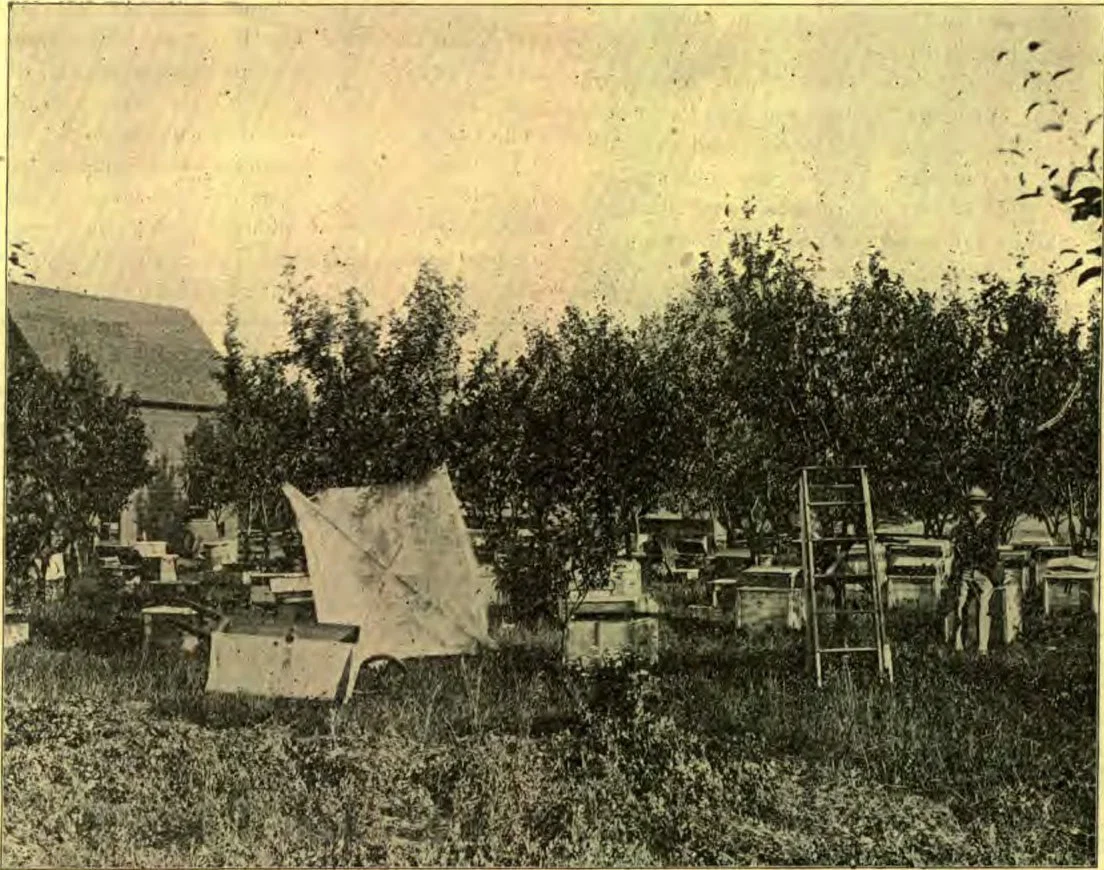
UNDER THE APPLE TREES

4%

Review and Herald Publishing Company · Battle Creek, Mich. · July 25, 1901

FromThe Youth's Instructor, Vol. XLIX, No. 30

Read the full edition

UNDER THE APPLE TREES

Under the apple trees in front of my home is a row of white houses. In each house are thousands of beings, little, to be sure, and, to those who do not know them, scarce worthy of regard. They are sometimes misjudged and even insulted by persons unacquainted with them. To those who love them, they are among the most wonderful of all created things. Whole books could be written of them, and still something would be left unsaid. To write the biography of a single honey bee is to write that of millions of the same family. And were one in writing to make a single misstatement, these millions, in a wordless protest, would correct the error.
In the soft spring air, when the buds on the apple trees are breaking their hearts with delight, these people in my row of white houses send their doorkeepers to peep out. I smile into their small, intelligent faces, and say, “Welcome to the best we have; for the best has come.” From this time on, and all through the long summer, they are my friends, my daily companions, my nearest neighbors, creatures whom our dear God thinks about. They are everywhere upon tree and flower and spilled sweetness, singing as they go. I have many times picked a bee from the city pavement, where she had fallen exhausted from a long flight, and taken her to a safe resting-place, lest she be trod upon. Footsteps of passers-by are so heavy and careless, unless the brain which is above the feet takes notice.
The honey bee, like every other created thing, be it animate life or plant, has once a—

BABYHOOD

The doorkeepers, peeping out at the spring, return to their comrades, and say, “It is time to be at work.” They know this by instinct, not by experience, for they have never seen a spring before. Born in late autumn, by a forethought of Mother Nature, that they might survive the winter unworn by toil, they proceed joyously to their tasks. The empty combs, made on purpose of the right size for the baby bees to grow in, are carefully looked over and made clean. In one of the wax cells, or cradles, a tiny egg is placed. It is one of thousands, but we will leave the rest, and watch just one.
The egg is no larger than the point of a girl’s hat-pin, but it grows. In a few days it becomes a little white maggot, or worm. It has a large mouth, like a baby bird, and is very hungry. It is fed constantly with bee-bread from the lips of a nurse bee. In a little while it has filled the cell with its soft white body. And then it requires to be fed no longer. The old nurse looks at it, and seems to say, “Poor little dear, you are sleepy!” Then she spreads a coverlet of some suitable stuff which she makes on purpose, and which has never been used before, all over the top of the cell, and the baby is tucked in. No one can see it, so securely is it housed, but the nurse bee listens. She hears a sound. By it she knows that the little creature of her care is all right, and she goes away to look after the other babies.
THE HOME OF LITTLE MISS APIS
In about three weeks from the time the egg was placed in the cell, if one is on good terms with the bees, and will lift the house roof to look in, one will see the top of the cell, or the waxen coverlet, break gently. Then a tiny face peeps through the opening. If one is accustomed to the look of bees, one will notice that this is a baby face in its expression. It has the innocent, wondering look of many infantile beings, such as birdlings and young animals. It turns about and looks around, seeming to take in its new situation with wonder. Then it puts two hands on the broken rim of the cell, and lifts itself. Little by little one may see it emerge from its cradle until it stands on the comb outside.

LITTLE MISS APIS

She is pale-yellow in color, if of Italian stock, but she is a perfect bee. She is wet, and her wings are in folds, like the wings of a new-born butterfly. She hastens to dry herself, and to adjust her dress. There are too many helpless maggot babies in the nursery to spare a nurse for Miss Apis. She must wait upon herself, and begin her busy life in real earnest. She stretches her wings and her limbs to make herself as full-grown as possible, and they expand in drying, seeming to increase in size. All about her, hundreds of nurse bees are fanning the air with their wings, and this helps in the drying. The hard work of putting herself in order makes her hungry, and she helps herself to honey from an uncovered jar, left in her way on purpose. The honey makes her strong. “Eat as much as you like,” say the nurse bees, “and then come and help us at the nursing.”
And this last is the first duty of little Miss Apis. She is not quite accustomed to herself, nor is she wise enough to go out into the honey world. She must remain for a time in the home, and make herself useful in the nursery, just as little sisters take care of their baby brothers and sisters in the human world. She goes to the bee-bread boxes, and brings food, and puts it in the large mouths of the little infant maggots, just as she herself was fed but a short time ago. As she works, she learns, and the pale color of her body takes on the deeper brown of the mature bee,—the brown with the golden bands. She belongs to a royal household, and wears its insignia of dress. She gradually loses her childish look, and longs to do what she sees the old workers doing. She smells the breath of the flowers, when she follows the old bees to the door, and sees them bring back the nectar and the pollen. She spreads her wings, and tests them on the threshold. Then she flies.

A BUSY WORKER

Every morning she goes out to her labors. She hums at her work or on the wing as if life were a delight to her. She clings with her dainty feet to the cups of the flowers, and sips the nectar from their pockets. She carries always with her a long-handled dipper, which we call her proboscis, that she may reach into the heart of sweetness. She tells many a human wanderer, by the way, which of the plants he may touch. She puts the nectar in her pouch, or honey-bag, and takes it home with her. Sometimes her load is heavy, and she falls by the way. But she is soon up and flying again.
Arrived in the house, she seeks an empty cell, and deposits her harvest. When she has filled the entire cell, or jar, by many excursions to the honey fields, she does not close it over, or put the cover on the jar of preserves, until the nectar has “ripened,” or turned to a nutritious thickness.
Sometimes, if one watches at the bee-house door, one will see her come home with balls of yellow or white or red pollen on her thighs, upon which are baskets for that very purpose. She has dived into the deeper flowers, and covered herself all over with the powder with which the blossoms are wont to dust themselves in making their toilet. It adheres to the fringed hairs which thickly cover her like down; and she is very careful of the precious stuff; for well she knows it is needed for baby food. She packs every particle into her baskets. Once in the nursery, other bees help her to pull it out of the baskets, knead it into paste, and put it into the wax pots, just as any woman kneads her bread, and puts it in the pans.
At another time she brings home a sort of glue called “propolis,” which she collects to seal the cracks of the hive, and to cover all over the underside of the roof, to keep the house warm and dry. This glue is resinous and dark of color, and is not used for food. Many a time in a storm I have gently tested the cover of the hive to be sure that the roof can not blow off. The bees have anticipated the weather, and glued the roof to the walls.
One can see this woman bee inserting her dipper into the torn rents of such fruit as the kind birds have made an opening in. She could not possibly make an aperture for herself, for her proboscis is delicate, and unsuited to boring. Foolish persons who meet her in the fields or on the road she is traversing run away from her, and scream that she will “sting.” They do not know that the honey bee never stings away from home unless she is pinched. She will let you smell of the flower from which she is gathering sweets, and sing you a hymn while you admire her. She stings only in defense of home and family, and stores which she has gathered with so much labor.
House-cleaning occupies a great part of this busy worker’s life. Her house is always clean, whether it be found in a decayed tree stump or in a choice hive made by the carpenter. No untidy thing is permitted to lie about on the floor, or in the nursery, or on the walls. She is neat in dress and habit, as any one can see who watches her at her toilet. When it is cold, the bees keep a constant fanning with their wings to warm the brood, which is so delicate that a few seconds of exposure to the outside air would destroy it. When it is warm, they keep on fanning to make the air comfortably cool. One can hear this fanning by placing the ear close to the hive. Always it is kept at an even temperature; for it is really an incubator. It is with the bees as with some people, who “blow their tea to cool it,” and “blow their hands to warm them.”
So all day long and all night long our dear bee works, never resting, toiling not for herself but for others, for she seldom partakes of her harvested stores.

WHEN LONG FLIGHTS ARE OVER

Some day in midsummer one can see that the edges of her wings are a little frayed. But still she flies short trips to the honey fields, or, if one places a saucer of sweet at the door, she will go no farther. She often sips water at a puddle or a city trough. One with a kind heart will not frighten her away, but will watch the frail tongue sip the water eagerly, as if she were thirsty, as indeed she is. Without water she could not live.
A few more days, and she can fly no longer. She has literally “worked herself to death.” She still goes out to the door, and smells the flowers, but her wings are jagged and broken with her long flights. Her body has lost its gloss of brown and gold, though but two or three short months have passed since she was a baby in the cell cradle, tucked in by an old nurse bee. She still strives to make herself useful among the little ones, but she is slow and “in the way,” and the younger bees do not want her. She creeps out to the doorstep for one more whiff of the fragrance she loves, and falls in her attempt to fly.
When the time comes that she is too weak to creep to the door, and is but a cumberer of the ground, then the strong bees, two or three of them, take hold of her, and, pulling her from the door, drop her over the edge of the platform upon which the hive rests. She falls among the grass or in the dust, and the workers go back to their duties, to take their turn at old age and decay not many days hence. In her fall from the house doorstep, our bee may have slipped into a crevasse between foundation boards, and there she lies buried, as I have seen a Kiowa Indian in a natural cleft of his native rock. She is but one of many hundreds in a summer time from the same hive, who ask no favor of any, unless it be a kind thought when the honey-comb is broken at the tea table.—Elizabeth Grinnell, in Young People’s Weekly.