Conclusion of Chapter X—Volcanoes
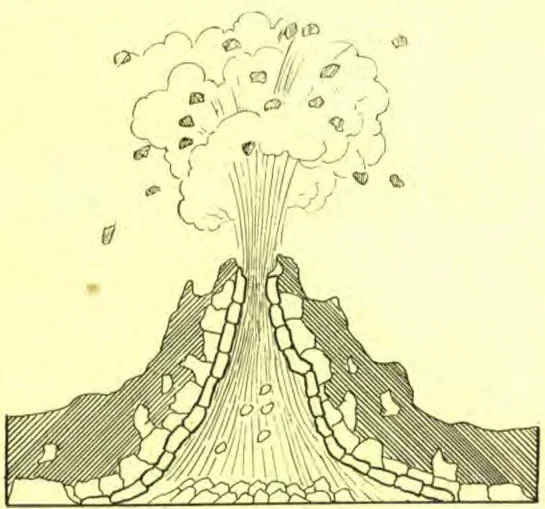
§100. VOLCANOES have their origin largely from the same source as do earthquakes. The internal heat evolved from the coming together of various chemicals, also water and previously burned limestone, ignite large fields of coal and oil; and as a result the most intense heat is produced. When this combination occurs in mountainous districts, especially where they are formed by “upheaval” (see Section 75), the lava, which is produced by the melting together of rock and different ores, in connection with mud, water, fire, smoke, and cinders, finds an egress between the upturned layers of rock, as shown in the accompanying illustration.
§101. When not in a state of active irritation, the internal portion of a volcano fills with hot mud, water, and molten lava. The internal pressure of this substance is estimated at one hundred and twenty-five pounds to the square inch at a depth of only one hundred feet. Through this viscid mass the heated gases rise, bursting on its surface with a force sufficient to throw great globules of liquid from thirty to forty feet into the air.
§102. In times of moderate action the outburst of cinders from Mt. Vesuvius occurs every three to ten minutes; but in a period of eruption they are almost incessant. According to Sir William Hamilton, the cinders rose to a height of ten thousand feet, or nearly two miles, at the eruption of 1779. This volcano, being situated in the midst of civilized nations, is one of the best known on the earth to-day; but it is insignificant when compared with the mighty spouters of South America and the Indian Archipelago. The largest volcano is that of Kilauea, Hawaiian Islands, which is always active. There are several in South and Central America that are constantly burning; and since the time of the Spanish conquest of Mexico, the lofty peak of Popocatapetl, which towers some 17,550 feet toward the heavens, has never ceased to belch forth its huge volumes of fire and smoke. Before the year 79 A. D. Vesuvius was not known to be active. That year occurred its famous eruption, which destroyed the cities of Herculaneum and Pompeii. So great was even the concussion of the air, that the ceilings at the Palace of Portici, at the foot of the mountain, were destroyed. Sand and ashes fell in such quantities as entirely to bury from sight those ancient cities. Connected with this eruption was a drenching rain, caused by the condensation of the steam and vapors that came gushing from out the crater’s fiery throat. The sand and ashes, being thus converted into mud, flowed into every nook and corner of streets and buildings, preserving these cities and their inhabitants for the inquisitive eye of coming generations. Paintings on the walls, dishes and cooking utensils on the shelves, lady and servant, master and slave, were alike buried instantly where they were when the volume of sand and débris fell upon their unsuspecting city. Bread still in the oven, fruit undergoing the canning process, and manuscript with the writing yet legible have been exhumed. From 1139 to 1307 Vesuvius remained dormant; also between 1500 and 1631 it was apparently extinct; the interior of its crater becoming grown over with rich vegetation. At its eruption in 1779, Sir William Hamilton says that a huge red column of liquid lava mixed with stones was projected to a height of ten thousand feet.
NOTE.—These lessons, comprising a brief study of Geology, Philosophy, Meteorology, and Astronomy have been prepared in response to the many calls that have come for a simple treatise on these subjects, that shall be free from the many infidel theories and deductions that are unscriptural and untrue. They have been written with special reference to the fireside, and the home- and church-school. The author would be pleased to receive, by correspondence, any criticisms or suggestions that will help to make them better adapted to this field of usefulness.
§103. All volcanic eruptions are remarkably similar in their conduct. Immediately preceding the eruption loud subterranean thunders are heard, and earthquake tremors felt. Fountains and springs recede into the earth, while the ground heaves and swells amid an ever-increasing sound as of muffled thunders beneath. Soon a dense cloud of smoke issues from the crater, and spreads out like a gigantic umbrella, enveloping in midnight darkness the cities and villages beneath. But this darkness is only momentary; for immediately follows the terrific roar and the lurid glow of the blood-red torrent of lava that falls in death-dealing floods over the adjacent territory. An oppressive stillness and feelings of foreboding generally precede these occurrences. Horses become restless; herds return from their pastures, bellowing and bleating, as if seeking the protection of man; while insects cease their hum, birds disappear within the quiet of their leafy homes, and all nature seems to portend the coming of some great and terrible event.
§104. Occasionally masses of lava are ejected in the form of huge cannon balls, twelve to fifteen feet in diameter. These, by their rotation, assume a globular form. By cooling off they become solid externally but cellular within.
THERMAL SPRINGS
§105. Thermal, or hot, springs are found most frequently in volcanic regions, for the reason that their origin is similar to that of volcanoes. In Geyser Cañon, north of San Francisco, there is a region of hot springs and fissures emitting steam strongly impregnated with sulphurous fumes. The waters of these springs have a temperature of 206°. Near Clear Lake is Borax Lake, holding borax in solution, and having a deposit of the same on its bottom. Salt springs occur in nearly all parts of the world, generally containing from ten to thirty-five per cent of pure salt.
The hot springs of Napa Valley, California, are thus described by Professor Forest Shepard: “Within the space of a half-mile square are from one to two hundred openings, through which the steam issues with violence, sending up columns of dense vapor to the height of from one hundred and fifty to two hundred feet. The roar of the largest of these can be heard for a mile or more. Many of the openings work spasmodically, precisely like a high-pressure engine, throwing out occasional jets of steam, or volumes of hot, scalding water, some twenty or thirty feet high.”
GEYSERS
§106. For years the geysers of Iceland were a wonder of the world. The largest of these, “The Great Geyser,” has a nearly circular basin, fifty feet in diameter and four feet deep. In the center is a well eight or ten feet in diameter and seventy-five feet deep. Through this perpendicular tube, hot water is continually bubbling over into the basin. When the basin is full, the water becomes agitated, loud explosions like subterranean thunder are heard, steam escapes in large quantities, and finally a column of boiling water is thrown with violent force some two hundred feet in the air. Following this a deafening rush of steam is ejected, and a terrible explosion terminates the phenomenon.
§107. The geysers of Yellowstone Park, in our own country, are now regarded as the finest in the world. The “Beehive Geyser,” represented in the illustration in full action, throws a column of water to a height of over two hundred feet, playing once in about twenty-four hours.
QUESTIONS
Describe an eruption of a volcano, and give its cause. Give the history of Mt. Vesuvius and its eruptions. Describe and give the cause of hot, salt, and mineral springs. Describe the cause and action of a geyser. Do these all spring from local or from one universal cause?
DR. O. C. GODSMARK.