No forests that I have seen exceed in luxuriant and abundant growth those found in the northern extremity of New Zealand, where the semitropical climate, plenty of rain, and a rich soil combine to furnish magnificent examples of what nature can do. Various species of trees peculiar to this region are intermingled. The tongue-puzzling character of their native names forbids their repetition by a newcomer; so I shall not attempt it. Vines and creepers are interwoven among the branches, and hang in beautiful festoons to the ground. The rope-like “supple-jack,” extending from tree-top to ground, awaits the necks and limbs of visitors with many a noose. The provoking shrub, “wait-a-bit,” lurks here and there with a thousand fangs to seize the passer-by. But for these slight annoyances, one might fancy he were in an earthly paradise. The graceful nikau palm and the fern-tree furnish a beautiful undergrowth to the gigantic trees that tower a hundred feet overhead. Among these is found the stately kauri (pronounced cow’ry), a species of pine valuable for nearly all building purposes. It has a fine, dense grain, susceptible of a high finish. The trees often attain a height of one hundred and fifty feet, and are of great size. The demand for building timber is so great in Australasia that these grand forests are fast disappearing, and not many years will pass before they will be entirely gone.
When a kauri tree is wounded, a resinous gum exudes, forming in amber crystal bodies on limb or trunk, and finally falling to the ground. Being indestructible in soil or weather, it remains, and gradually sinks into the earth, where it may lie for ages. The soil absorbs certain deleterious qualities, and leaves the mass a beautiful transparent substance. This gum is used in the manufacture of varnishes, and in the printing or sizing of cloth, and commands a good price in London and New York.
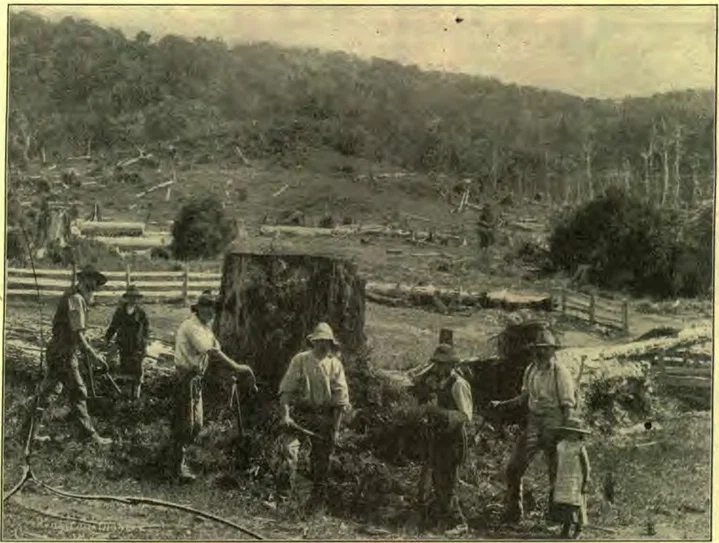
At first kauri gum was picked up from the surface of the ground; but as soon as this visible supply was nearly exhausted, digging was resorted to, and far greater quantities were thus discovered. As time passes, and the price of the gum increases correspondingly, the digging goes deeper into the earth. At first lumps of gum were located by the use of long, sharp prods of steel; but now in many cases the ground is all turned up, so that nothing shall be lost.
The mind is lost in the contemplation of the ages in which these vast forests lived and died, and these deposits were placed by the hand of time.
G. C. TENNEY.