One Day at the Escorial
Leaving Madrid at half-past eight in the morning, we reached the Escorial soon after ten. On the train, while our party engaged in conversation in French and German with an educated Spaniard, I noticed a Spanish peasant looking so eagerly at us that a gentleman near by was smiling at his expression. I approached the peasant, and began to talk with him. After questioning him about his village and occupation, he wanted to know where we came from, and what our business was. I told him we were in the book business, and taking my Spanish New Testament out of my pocket, began to read to him from Revelation 21. He listened attentively, and when I paused, took the book from my hand, and continued to read to me from the same chapter, pausing at every sentence to look at me, as if he feared that I might miss the full meaning of every point. When I offered him the book, he accepted it gratefully, and said: “I know a good many of these things. I have six sons, and we talk these things over. Those are the things that are worth talking about.” I then offered him El Faro and El Mensajero de la Verdad, which he immediately began to read with evident delight.
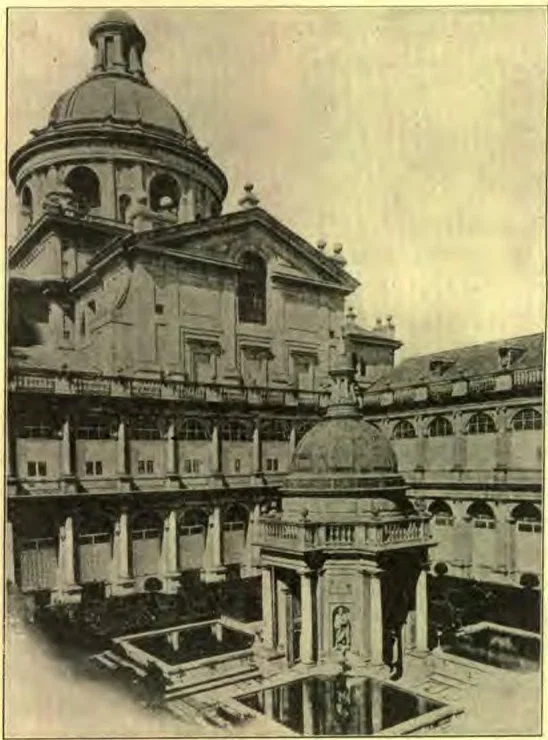
Soon our train reached the Escorial, and we began to ascend the hill, on the top of which stands the mausoleum, or Pantheon, of the Spanish kings. Connected with it is a church, a convent, and a palace. Together, they make an extended, massive stone edifice. It was constructed by Philip II, in memory of his father, Charles V. To give an idea of its enormous proportions, I will mention that the whole fabric has sixteen courts, two thousand six hundred and seventy-three windows, eighty-nine fountains, eighty-six staircases, twelve hundred doors, and that the total length of its corridors is said to be one hundred miles.
We first visited the church, which is devoted to St. Lawrence, a Spanish soldier and martyr. Fitly to describe the awe-inspiring architecture of the interior, the grandeur and beauty of its artistic decorations, the richness of its ornaments in bronze, gold, marble, jasper, and agate, would be a difficult task. The choir, at the opposite side from the main altar, has one hundred and thirty carved hardwood seats. In one corner, the last in the row, is the seat where Philip II used to sit in mass, and from which the officiating priest can be distinctly seen at the altar. It was while sitting here, that the king first learned the news of the battle at Lepanto against the Turks. He said nothing; but when mass was over, he ordered the Te Deum sung. Here also, while hearing mass, the same king received the sad news of the destruction of the Invincible Armada. He said, simply: “I sent my fleet to make war against the English, not against the elements.”
Next come the Pantheon, or royal tombs, situated in the vaults under the church proper. It is divided into two sections,—the Pantheon of the kings and the Pantheon of the infants. In the former are the kings, from Charles V down, in marble coffins. A new coffin is waiting for the present king, young Alfonso XIII, who is expected to visit the place for the first time in a few days. A solemn reminder it will be to him of the fleeting character of life. The latter section, containing the members of the royal family, is composed of several rooms. The floors are of marble, the ceilings of granite, the passage vaults from one room to the other of polished white marble.
Nothing richer can be seen than these coffins of the whitest of marble, with here and there a life-sized sculpture representing the dead. These tombs, begun in 1862, were executed by a sculptor who worked at them till his death.
A whole section of the building is devoted to “the palace,” a suite of rooms, parlors, and sleeping-rooms occupied by the royal family after the death of Philip II. The walls of all these rooms are covered with tapestry, on which the works of a few great painters were embroidered in the most vivid colors and with remarkable exactness. This in itself is a collection of great artistic and commercial wealth. The total number of these pictures is three hundred and thirty. A large dining-room in the chamber of the ambassadors may be mentioned as a truly royal apartment. Then come more rooms, with cases containing works of embroidery, made by royal hands, and with more paintings decorating the walls. Among these are life-size portraits of Charles V and Philip II. Both kings wear on their faces a striking expression of melancholy and doubt, with the addition of reckless obstinacy on the features of the son.
And now we are led to the private apartments of Philip II, composed of a sleeping-room and a small office. The simplicity of these rooms, with their tile floors and whitewashed, unadorned walls, makes a striking contrast with all we have seen. Philip II is said to have remarked that his intention was to make a palace for God and a cell for himself. A small, dark room connects with the choir of the church. Here Philip II died in his bed while hearing mass. Over the door is the following inscription in Spanish:—
*In this little precinct Died Philip the Second When the world was too small For the son of Charles V.*
It was impossible for Brethren Wilkinson, Robert, and myself to refrain from a deep sense of sadness, mingled with gratitude to God, as we went through these buildings, which reveal some of the past glories of Spain, knowing how it has sunken in the scale of national greatness. Here are a few samples of the power of two men who dreamed and dared everything against the Protestant faith and nations. The gold of the world was theirs; at their bidding, streams of blood ran in the mad attempt to re-establish the supremacy of the pope, and effect the destruction of the gospel. But they failed, died in despair, and left their country exhausted and their people discouraged and reduced. And all this for blindly following the suggestions of the man of sin!
While thus musing among ourselves, and eating our lunch in an adjoining park, we were joined by our Spanish friend, who expressed to us some thoughts on the same line, which go to show how at least some Spaniards view the political and moral degeneration of their country. This he said, in substance:—
“In its many royal palaces, museums, and cathedrals, Spain possesses millions upon millions worth of works of art and jewels, which might as well be sold, and the proceeds used for schools and other beneficial institutions. Instead of that, we are all the time increasing our debt to maintain our army and navy. Our politics are rotten, justice is nowhere found. When we see how other countries, like England and the United States, are going ahead, we are heartily ashamed. Now let me tell you my candid opinion about the late war between the United States and Spain. The greatest mistake the United States made when they took Cuba and the Philippines from us, was that they did not take the whole motherland with the rest, and give us a decent form of government.”
Of course that would not have helped matters; but can you imagine anything sadder than these remarks, made by an intelligent Spaniard, speaking of his own fatherland?—a country coveted by all the great powers of history,—a country which yields the best grapes, olives, almonds, and pomegranates,—a country with a ravishing variety of climates, and one of the gems of this old earth? Are not that wistful look from the peasant, the speechless joy with which he pressed that New Testament in his hands, and the sad confession from the merchant, impressive appeals to your heart? Can we underestimate the bitter humiliation and sorrow concealed by these men, when we remember the natural pride of man? and can we longer refuse this country the light and help that we who possess the wonderful gospel of Jesus, can give it? Can we, “to men benighted, the lamp of life deny”?
That these lines may awaken in some heart a true missionary spirit for Spain, is my fervent prayer.
J. VUILLEUMIER.