THERE can be no condition of life such that we can afford to be unthankful. And as this is the time of year when all the world professes to make thanksgiving, the Christian can hardly afford to be outdone in appreciating the good things that have come to him. It has been a good summer to most of us; and now, as we are about to settle down to a snug winter, we ought to have in our hearts a strong tide of appreciation flowing out toward the great Giver.
It is true that Thanksgiving comes at a time when all the world wears an aspect of melancholy; but it is only an aspect. True, the leaves are gone; but as they went, under the stem of the old leaf grew the bud that will open in leaf next spring. To be sure, the flowers are gone; but before they went, they gave birth to seeds that will bring the flowers that will appear next season; and, hidden away in the earth, there are multitudes of roots and tubers and bulbs that will reveal new life when the warm days come again.
As I meditate upon these things, my thoughts go to a favorite retreat just a little way out of the city,—The Willows, as I have named it. It is one of nature's quiet nooks, untouched by the evils of the world. Most of us can find such a spot somewhere near by,—a place where nature seems in happier mood than in other places,—a spot where she has had her way more fully than in others. Here one can find the first birds in the spring; and in this spot the spring flowers are a week ahead of the season. Here there is more sunshine than in any other place. A brook runs near by on its way to the lake, and along its bank grows a great clump of willows.
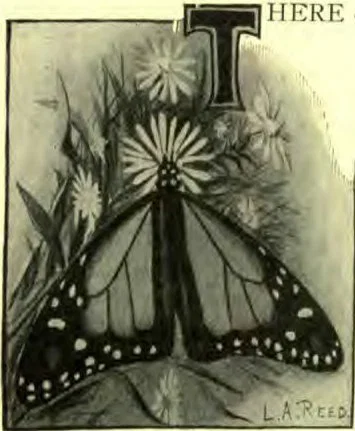
I have found strange birds here that I could not find anywhere else. And here, in their time, grew countless masses of asters and goldenrod and ironweed. Of course the butterflies came. I have sat in the fall sunshine, and watched them hours at a time, flitting hither and thither, their lustrous wings changing color in the brilliant sunlight; while others rested on the aster blooms, their great orange and black wings, spotted with silver, slowly opening and shutting while they drank the nectar of the flowers.
And the bumblebees, how they bumbled! Here, too, were digger-wasps and blue-flies and spotted flying beetles—a large variety of nature's beautiful and curious children.
But they are about all gone now. And if I should take you there with me this Thanksgiving day, and you should look at the naked trees, and the dry, dead weed-stalks; if you should hear the ice cracking on the lake, and feel the cold wind sweep down the frozen bed of the brook, doubtless you would ask me to come away from the cheerless place.
And it would be a dreary place indeed to you, but it could never be quite that to me. Yonder in the bare branches is a deserted bird's nest, the very sight of which brings to mind, with a rush of grateful thanks, the happy times we had here, the birds and I, all last summer. I know they will return next season—even now on warm days a few of them may still be seen. And the old, brown relics of weeds remind me of the asters and goldenrods and blue ironweed blossoms; and these, in turn, make me think of the butterflies and the bumblebees, and, in short, of all the blessed things I have enjoyed here through many a blessed day.
It is much this way in our lives. There may come cheerless times for him who does not enjoy life and God's blessings as they are given. But though Thanksgiving comes at a comparatively dreary time of the year, it is so only in a relative sense. If the good things are not flowing into our hands in such a steady stream now, it is nevertheless a good season for memories. Let the day be a sort of reminder of the things that have been, and of others yet to come. If we have not appreciated the blessings as they were bestowed, let us now “catch up” by giving thanks for all that has been, and all that we hope may be.
Although the melancholy days have come, as the poet has sung, and though they be the saddest of the year, they can never be wholly sad to us, or very melancholy, while our hearts are full to bursting with memories of the goodness and blessings that have followed, are following, and shall, please God, follow us to the end of the days.
For such let us make a glad Thanksgiving. L. A. REED.