OUR FRIEND THE ROBIN

7%

Review and Herald Publishing Company · Battle Creek, Mich. · March 20, 1902

FromThe Youth’s Instructor, Vol. I, No. 12

Read the full edition

OUR FRIEND THE ROBIN

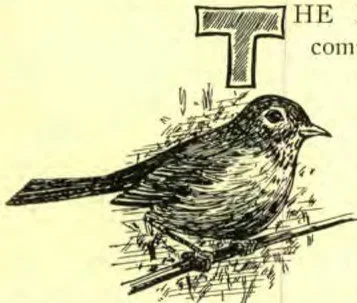
The Robin is a very common bird, and doubtless all are more or less familiar with it. This interesting bird is much the same wherever we find him, and he may be seen all over the United States, from Maine to California, and from the Great Lakes to the Gulf. Now and then in winter we run across Robins that did not go South in the fall, but stayed with us all through the winter; on bright days you will find them feeding, and as happy as birds can be, though the skies may soon send snow, and the air may be ready to chill.
The Robin’s nest is usually made of small twigs with a mud lining, fastened somewhere in a tree. The bird comes North early in March, and remains until late in the fall. Robins begin nest-building almost the first of the birds. They do not always build their nests in the same way, but usually there is considerable mud about them; for this bird is something of a mason. Olive Thorne Miller says she has seen a Robin’s nest made of the white flowers of life-everlasting. The bird had woven the stems together for the framework, and the little clusters of blossoms were left outside for ornament.
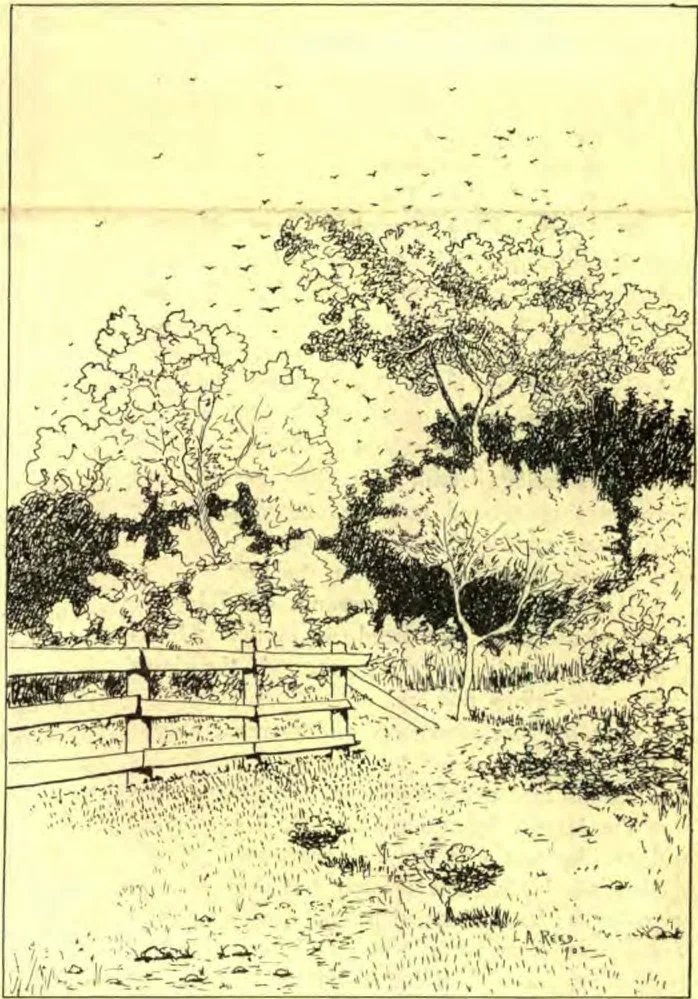
The latter part of June the young birds of the first brood, with some of the old males, each night resort to a roosting-place. This habit is a peculiar one, and one with which many are not familiar; so we will say a few words about it. Mrs. Robin remains on the nest during the night, as she is busy hatching the second brood; but it seems that Mr. Robin and his oldest children prefer to have each night an evening party, with plenty of company. Mr. Bradford Torrey has written considerable upon this characteristic of the Robins. Toward the end of summer some years ago, he saw what looked like a daily trip back and forth of small companies of Robins. A friend in a near-by town had observed a similar thing; and they talked the matter over, and decided that the birds must have a resort somewhere. Later, on learning that another bird-lover had discovered a Robin roost, Mr. Torrey kept a sharper eye upon the Robins he had seen. Every evening, shortly before and after sunset, he saw them flying, by twos, threes, or even by the half dozen, all going toward one place. At last he found the place where they roosted overnight,—an isolated piece of swampy wood, a few acres in extent, covered with a dense growth of gray birches and swamp white-oaks, with a sprinkling of maples and other trees.
Having found their nightly resort, whenever it was so he could, he set himself, a trifle before sundown, to count the number of Robins that gathered there. The first night he counted three hundred fly by the place where he was. The next time, in less than an hour he counted over one thousand. At another time he counted over twelve hundred; and at a still later date, fourteen hundred.
A ROBIN ROOST
A ROBIN ROOST
Why do the Robins congregate thus at night? Is it the husbands going off to the nightly club, and leaving the wife at home alone? Do they, as men sometimes do, have a night of it out in their own company? If so, the lesson is not a good one. But before we believe such an idea, we should ask the Robins themselves. How can we do this? do you say?—Easily enough. Mr. Torrey undertook the task. He entered the wood early in the evening, and took a sheltered position where, as the Robins flew by him, or alighted for a moment in the trees just across the brook, they would have the sunlight on their breasts. Then when they came near enough for observation, he noted whether it was an old bird, or a streaked, spotted bird, lately out of the nest. He counted fifty-seven birds altogether, forty-nine of which were surely young birds, and only eight were old birds. So it seems that the fathers do not run away from home at night, after all. But the young birds, who have but lately left the nests, thus assemble to keep one another company.
But why do the young birds thus congregate? What motive draws them together? It can not be that they are afraid of the dark. Why, then, does not each one sleep on its own feeding-grounds, alone, or with a few neighbors for company? Why fly two or three miles, twice a day, simply to pass the night in a common roost? I can give no answer, only to say that it is probably their love of society that brings them together in this manner each night.
And this is not so strange an explanation. Sociability is a common mark throughout nature. The family, which is but one aspect of the social instinct, is not by any means confined to the human race, but is to be met with everywhere throughout the animal kingdom. Even the plants produce seed, in the greater number of instances, by cross-fertilization, the pollen of one plant fertilizing the anthers of the other.
The only explanation of the fact that there is a universe, the only explanation we can give for the fact that there is anything outside of God himself, lies in this—that God himself is governed by this same great law of associating others with himself. And thus he has bound up the world and the universe into one associated whole. As in the human body we have the sympathetic system, which puts all parts of the body in touch, so that if one member suffers, the others suffer with it, so in the world of nature, each part is co-ordinated with every other part. We can not wantonly destroy the birds without increasing the bugs and worms, and thus decreasing the amount of food we otherwise should have. Similarly, no man can live an evil life, and prevent the retribution which shall thereby be visited upon him; and he can not so live without leaving about him an influence that mars and destroys. On the other hand, no man can live a good life but the world shall be made the better for it.
The birds associate for help and protection. Men sometimes associate for that which will leave them none the better, and often much the worse. Here, again, we can learn a lesson from the birds. To have our hearts as light as those of the birds, to have our associations as pure as theirs, we must live a life as true as theirs.
“Then let your secret thoughts be fair— They have a vital part and share In shaping worlds and molding fate; God’s system is so intricate.”
L. A. REED.