The vegetable kingdom has been divided by botanists into six distinct branches, beginning with plants of the most simple structure, and ending with those that are most complicated. In our present study, it is the last branch that we have to deal with. This includes about three fourths of all plant life, and almost all those plants that are of any special economic importance.
11. This branch is called Sper-moph'y-ta or Phae"no-ga'mi-a, sper-mophyta meaning “plants that bear seeds,” and phænogamia “plants that bear flowers.” These two characteristics distinguish them from all other forms of vegetable life. None of the other plants have flowers or true seeds.
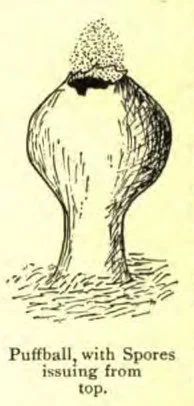
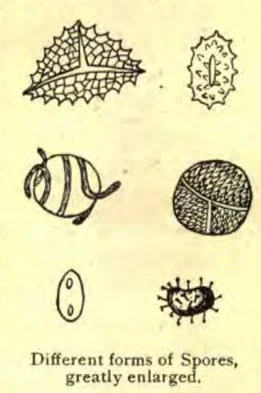
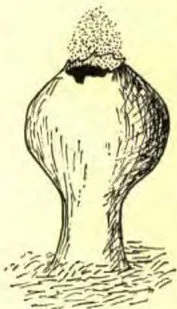
12. The lower forms of vegetable life are propagated by spores, which are often produced in immense numbers. Spores are special reproductive cells which, after separation from the parent body, will, under favorable conditions, develop into new organisms. They are usually microscopic in size, and in quantity appear as fine dust. The fine powder from the puffball is made up entirely of spores.
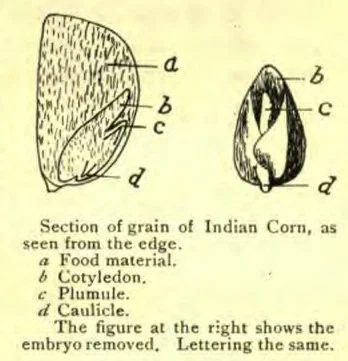
13. Seeds, on the other hand, are not simple cells, but complex structures made up of many cells. A seed consists of a plantlet surrounded with a protective covering, with a supply of food material stored up either in the plantlet itself, or deposited beside or around it. In the bean this food material is stored up in the thickened seed leaves of the plant; while in Indian corn the little plantlet occupies only a small portion of the seed. Upon this stored-up food the plant must live until it has developed roots and leaves sufficient to enable it to take nourishment from the soil and the air.
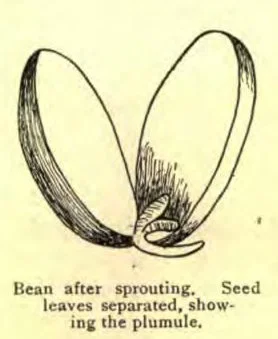
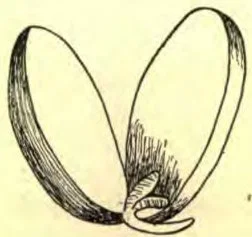
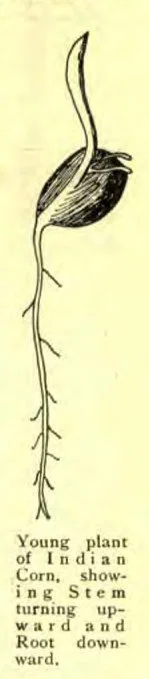
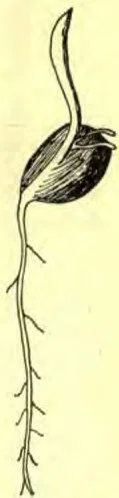
14. When placed under favorable conditions, as in moist, warm soil, or in water that is not too cold, the seed absorbs a portion of the moisture; this causes it to swell, and burst its protective covering, so that the young plantlet, or embryo, is set free to continue its growth until it reaches maturity. In whatever position the seed may be planted, as soon as germination takes place, the root-end of the embryo, usually called the “caulicle,” always turns downward, giving off roots, which fasten it firmly to the soil, and at the same time furnish channels through which nourishment is absorbed, to be carried to all parts of the plant. The opposite, or stem, end always turns upward, and gets into the light as soon as possible. Continuing to grow, it gives off leaves and branches at the proper places, until the plant has reached its full development.
15. We may well ask, in wonder, Does the little plant never make a mistake, and send its roots upward and its stem downward? How does it know which way to find the light? —No; it never makes a mistake; for it is directed by Him who does not make mistakes, but does all things well. The embryonic plantlet, inclosed within its prison-house, and buried beneath the soil, where not a ray of light penetrates the darkness, obeys the voice of its Maker, and at his bidding comes forth to the light to fulfill the purposes for which it was called into existence. What a lesson for man who, in his blindness and foolishness, loves darkness rather than light!
16. All the flowering plants are constructed on one general plan, or type, so that the parts of one plant correspond to the parts of every other. All have root, stem, and leaf, which may be either simple or branched. In most cases they also bear flowers and seeds, though the flowers may not be produced each year. The century plant, for example, blossoms only once in about a hundred years.
17. Of all these parts, root, stem, leaf, flower, and seed, there are many different forms and sizes in the different species of plants, each form having its own particular name. These various forms, together with their names, will receive further consideration when we come to a more definite study of individual plants.
18. The flowering plants have been divided into a large number of natural orders, or families. Some of these orders contain plants of great economic importance, including our common grains, vegetables, and trees, of field, garden, orchard, and forest. In our future studies we will consider the chief characteristics of the more important of these orders, and under each order the life, history, habits, and uses of representative species.
B. E. Crawford.