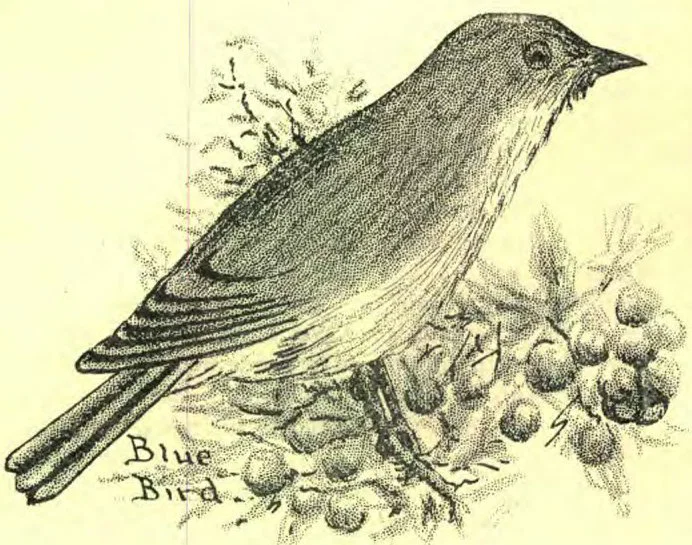
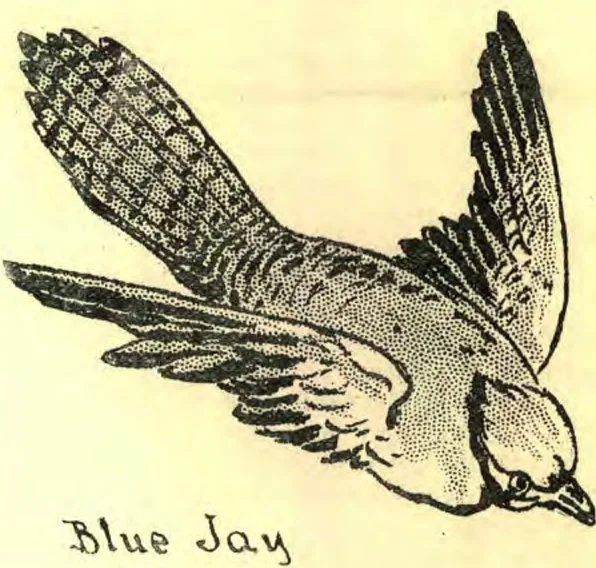
THERE are several birds which, by different people, are called “bluebirds,” but only one of them is the Bluebird. The other two are the Indigo-bird and the Blue Jay. As well known as the Blue Jay should be, it seems rather strange that any should confuse it with the Bluebird. Its piercing, hawk-like cry alone should forever distinguish it from any other bird that wears blue clothes. Besides, it wears a crest, or topknot, and there are black stripes on its tail and wings, and it has a black collar. The Bluebird has none of these marks; it is blue above, reddish-brown on throat and breast, and the under parts are white. The Indigo-bunting is wholly blue, and is smaller than either of the others.
The Indigo-Bird
The Indigo-bird, or Indigo-bunting, sings late into the summer. His song is given by some as Chritty-chritty-chritty-chrit, chrit, chrit, chee! Florence A. Merriam says: “I well remember watching one Indigo-bird who, day after day, used to fly to the lowest limb of a high tree, and sing his way up from branch to branch, bursting into jubilant song when he reached the topmost bough. I watched him climb as high into the air as he could, when, against a background of blue sky and rolling white clouds, the blessed little songster broke out into the blithest roundelay that ever bubbled up from a glad heart.”
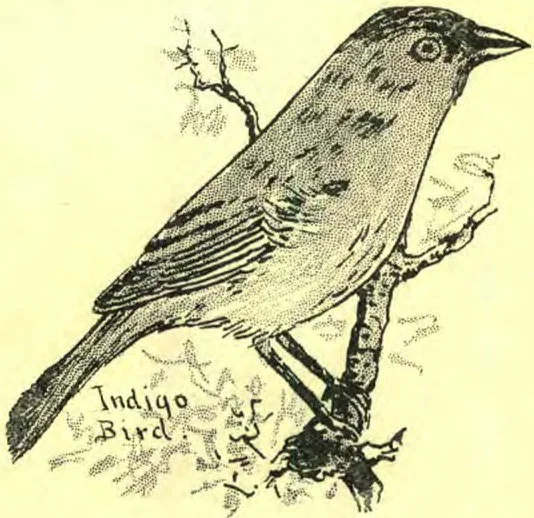
The female Indigo-bird is not blue, like the male. When you see her, you will have found a small, sparrow-like bird, though unlike any of the sparrows. You will see a gleam of blue on her shoulders and tail. Wait a little, till she calls her mate; when he comes, all dressed in indigo-blue, you will know you have not been mistaken. But Mr. Indigo-bird is the singer. His lady utters only a plain cheep, cheep, and nervously twitches her tail from side to side. You will find her very suspicious of you, and not at all willing to take you into her confidence. Her husband seems very happy, and sings when almost all the other birds have ceased, his clear notes ringing out even in the long, dry days of August.
Description.— Adult male: entire body deep-blue. Adult female: plain olive-brown above, dusky below; wings and tail black, with glint of blue on shoulders and tail.
The Bluebird
There is hardly any bird that will more fully repay our kindness than the Bluebird. He loves to live in our orchards and gardens or near our homes. If you make boxes for the Bluebird, be sure to put no perch at the entrance. Make the opening in the flat wall of the box; then the sparrows will be unable to dispossess the Bluebirds. Keep away cats and gunners. Plant a corner of your yard with sunflowers and berry bushes, so that they will have food and tangled thickets for safety, and Bluebirds will build their nests there. Cans, gourds, and bird-houses will be further invitations for them to take up their abode with you. The mulberry, June-berry, shadberry, buckthorn, elder, choke-cherry, wild black cherry, Virginia creeper, dogwood, mountain ash, pokeberry, etc., are all valuable in enticing birds; and as the birds love wild berries better than cultivated, you will, by planting these, protect your own fruit as well.
As the Indigo-bird is the embodiment of good cheer, so the Bluebird is the type of amiability. He is so given to peace and good will that the pugnacious English Sparrows have driven him away from many gardens and orchards where once he was a permanent resident.
In the winter the Bluebird is a great rover, and travels in flocks through the Southern States; but in the spring he is back to the North again, and soon sets up housekeeping.
As we study the birds, we find that each has some distinguishing characteristic or attribute, and generally it is something that we should strive to possess ourselves. God has put for us in the Indigo-bird a picture of bubbling good cheer, of happy thanksgiving, which we should aim to embody in our own character; and in the life of the Bluebird we see an amiability and sweetness of temper that wins us in spite of ourselves, thus teaching us the wondrous power of a truly kind heart.
Description.— Adult male: upper parts, blue. Adult female: upper parts grayish-blue; under parts duller. Length about seven inches.
L. A. REED.