THE family of Flycatchers numbers among its members some very interesting birds. None of them are songsters, but they may be known by their calls. They have large heads and shoulders, and broad, flat, bristly bills. From high places on the tips of dead branches or tree-top perches, they watch for insects. As soon as they see their prey, they shoot out upon it, catch it with a snap of their hooked beaks, and instantly return to their perch to watch for still other unfortunate flies. Swallows, swifts, and nighthawks also feed upon insects, but in a different way; when feeding, they fly through the air, snapping up insects as they go. In the North, as you know, the insects disappear in the fall, and then the Flycatchers have to migrate farther South to get food. They leave the North early in the fall, and return late in the spring.
One of the best known of the Flycatchers is the Kingbird. I think most boys are acquainted with this interesting bird. He is not quite so large as the robin, brownish-black, with white breast, and white tips to his tail. If you watch him very closely, you may possibly see a small spot of orange color hidden among the dark feathers of his crest.
The Kingbird is also called the Bee-Martin because it eats some kinds of bees. Some bird students have written in quite a mournful strain regarding this seemingly bad trait, but it seems that their conclusions were somewhat mistaken. For instance, it is said that a certain bee-keeper in California saw a great many Kingbirds among his bees. Thinking the birds were eating his bees, he killed one hundred of the birds. After all this damage to the birds, he went a little further, and examined their stomachs to see if they had eaten honey-bees, when he made the astounding discovery that they had eaten only drones! The birds had been working for him all the time by killing off the drones, and now he had killed them in return for their good service. The labor of these birds had not been appreciated.
For that matter, very few appreciate the work that any of the birds do for us. But when we come to the matter of appreciation, where shall we stop? The birds are doing but a small part of the work of their Creator. Through every avenue possible, God is working for the good of his creatures; and who appreciates it? Christ Jesus came to the world on a special mission of mercy and love, and how was he received? We need not multiply instances. The sun rises on the evil and the good, and the rain is sent on the just and the unjust alike. And who is thankful?
But to return to the Kingbird. An examination made by Professor Beal of two hundred and eighteen Kingbirds' stomachs is a further demonstration of the fact that the Kingbird is not given to the eating of honey-bees. Out of this number only fourteen contained remains of bees, nearly all of which were drones, while sixty per cent of the Kingbirds' food was found to consist of injurious insects.
The Kingbird is not such a tyrant, either, as some have made him out to be. He is a good fighter in a good cause, but he is not a rowdy. Some birds are afraid of him, that is true. I remember watching some birds that were feeding on the fruit of the mulberry one day in the latter part of June. Among them were a number of our familiar small birds. Suddenly, as if by a given signal, they flew swiftly away; and as I stood wondering at their sudden flight, a Kingbird appeared, and alighted in the top of the mulberry. He made no show of fight, he did not chase any of the birds, but they always left when he came. This happened a number of times. The rose-breasted grosbeak, however, and the robin held him in no fear whatever. In fact, the robin seemed always to take pleasure in driving the Kingbird as far away as he could; the Kingbird is certainly not king of the robin.
The Kingbird is usually peaceable, and does not molest other birds unless they come about his nest; but he is very faithful to his young, and for their sakes will fight gallantly. But always and ever the Kingbird is death on the crow. During the nesting season, no crow can venture near the home of the Kingbird without paying the penalty for his lack of discretion. From his high lookout, the Kingbird darts forth at his enemy, charging at him with a fervor and fearlessness impossible for the crow or any other bird to withstand. Though the crow is much the larger, the Kingbird is fighting for home and family, and as if he realized that right is on his side, and that right through might must win. The crow soon learns that it will not do to stay,—nor even to attempt defense against the bill and wings of the Kingbird; and so, squawking, he flies away faster than he came. But the Kingbird cares nothing for his squawks; he is deaf to his cries for mercy; he has had experience with crows, and knows their treachery. On and on, without mercy, he pursues and punishes the foolish crow until the creature has learned a lesson he will not soon forget. Then back to his post comes the triumphant Kingbird, and with crest erect, and wings quivering, sounds forth his notes of victory.
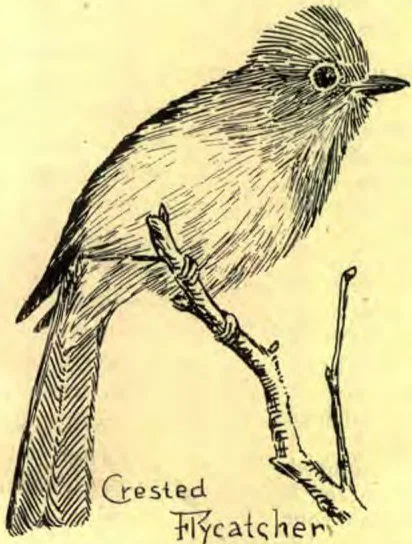
The Crested Flycatcher is generally not so common as the Kingbird, and therefore not so well known. You will find him in the woods, high up in the trees, and also in old orchards. The nest is usually built in a hollow limb, and almost always among the materials of which it is made may be found a bit of cast snake-skin.
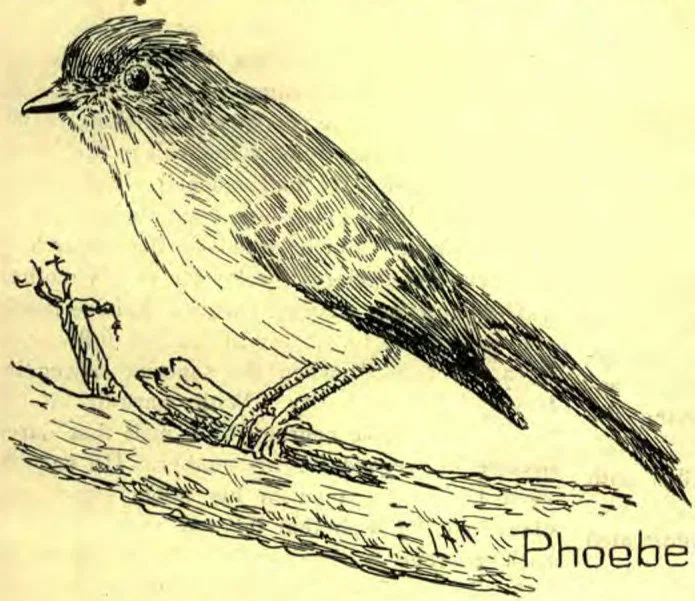
The Phoebe places its somewhat large nest, made of moss and mud, on a beam in the barn, the shed, or the piazza.
The Least Flycatcher usually builds its nest in the crotch of a fruit-tree. It is made of plant-down, fibers, and rootlets.
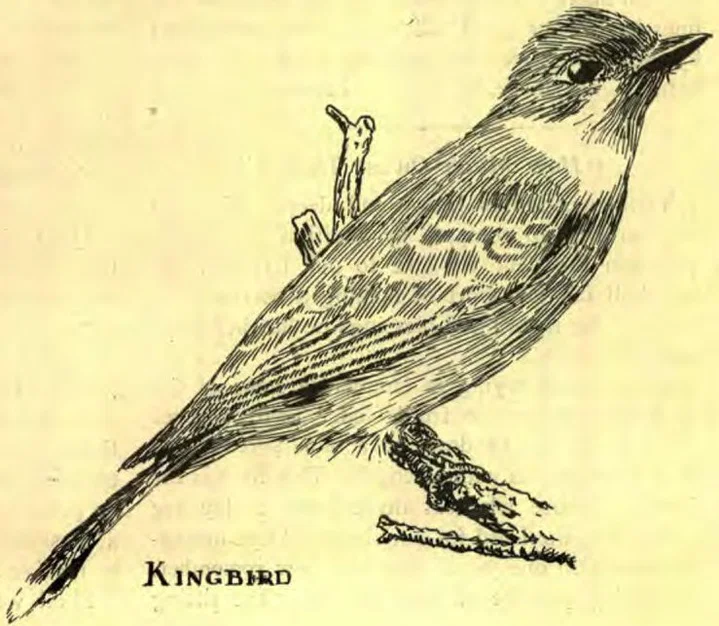
But these birds look somewhat alike, and how shall we know them apart? Well, first of all,p. 122 you probably already know the Kingbird; anyway, he may be easily recognized by the white band on the end of his tail. The Wood Pewee is strongly marked on the wings with bands of white. Its call is somewhat longer than the Phoebe's, as, Pee-ah-we! while the Phoebe calls more shortly, Phoe-be! The Least Flycatcher calls, Che-beck! che-beck! till you tire of hearing him; and the Crested Flycatcher whistles from the treetop in the woods, Whair, whahee, whit-whit! L. A. REED.