THIS is perhaps the best known of the cultivated clematis, and is regarded by many as the most beautiful hardy climbing plant in cultivation. The blossoms are from four to six inches in diameter, of an intense violet-purple color, and remarkable for their rich, velvety appearance. They are produced in great profusion until the arrival of cold weather.
It is a hybrid between a cultivated species from China, which bears lavender-colored flowers from six to ten inches across, and the Vine Bower Clematis from Europe, with flowers from two to three inches across.
There are several different varieties of large-flowering clematis, the flowers being of various colors,—pure-white, creamy-white, sky-blue, purple, crimson, and red.
These vines are excellent for trellises and piazza pillars, and for covering rocks, mounds, stumps, stone walls, etc. They may be cultivated as low trailers, when this is desired, by fastening the branches to the ground.
The large, showy blossoms are often produced so abundantly that they almost completely hide the foliage during the blooming season.
A little time spent in planting some of these vines about the home premises will be well repaid by their beautiful flowers, neat foliage, and graceful habits.
Clematis Paniculata
This vine was brought from Japan, and is now becoming popular in this country. The plant derives its specific name from its mode of inflorescence; that is, the arrangement of its flowers, which are borne in large, compound clusters, something like those of oats and many of the grasses.
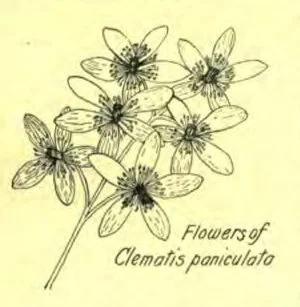
Compound flower clusters of this kind, in which the branching is apparently irregular, are known as “panicles.” As this mode of inflorescence is one of the most striking characteristics of the plant, it has been given the name “paniculata.”
The flowers bear both stamens and pistils, and for this reason are said to be perfect, these two organs being always essential to form a perfect flower. This would perhaps be as good a place as any to state the difference between a complete flower and a perfect one. When we speak of a complete flower, we mean one that has all the parts present,—calyx, corolla, stamens, and pistils. But a flower is perfect if it has stamens and pistils, even though both calyx and corolla are lacking.
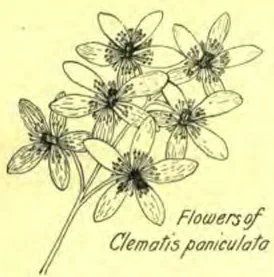
The foliage is attractive and glossy. In August and September the vine is covered with a sheet of snow-white bloom, which gives off a delicious fragrance. The plant grows rapidly, and can be easily raised from the seed.
This vine, like the large-flowering varieties, is well worth planting about the home.
B. E. CRAWFORD.