THE housekeeper says:— “A pint’s a pound The world around,” and that will do very well for mixing toothsome cakes and biscuit; for your genuine cook depends far more upon her instinct in taking “a little pinch of this and a handful of that” for her savory magic than she does upon a stiff pair of scales. But it will not answer when the drug clerk is making up a prescription calling for arsenic or opium, nor when the people at the mint are getting out their silver and gold coins. A pint of water will weigh just about a pound, but a pint of sugar weighs two ounces less than a pound, and a pint of salt weighs two ounces more. A pint of ordinary bird-shot (No. 5) and a pint of roasted peanuts in the shell—well, let your friends guess. The shot will weigh six pounds thirteen ounces, and the peanuts a neat quarter of a pound.
There are to-day in use among English-speaking people two very different pounds. The one is the ordinary grocer’s pound, by which are bought sugar and tea, butter and coal, and by which we ascertain our personal gains when we step upon the penny-in-the-slot scales at the end of a summer vacation. This is known as the “avoirdupois pound,” and, when right, equals seven thousand grains, or sixteen ounces of four hundred and thirty-seven and one-half grains each. Then there is the lighter pound, called “apothecaries” when used for compounding medicines, and “troy” when used by jewelers or at the mint. This is equal to five thousand, seven hundred and sixty grains, or twelve ounces of four hundred and eighty grains each.
Now you have seen all this in your arithmetics, and your fathers and mothers have, too,—and have probably forgotten all about it. But don’t score them with forgetting, or they may turn on you with a few awkward questions. For example, they might ask you, “What does ‘pound’ mean? and why do we use lb. instead of pd. for its abbreviation?” Or, “What does ‘ounce’ mean? and how does its abbreviation come to be oz.?” “What do ‘avoirdupois’ and ‘troy’ mean? and what about those grains? what are they,—grains of sand or of sugar or of wheat?” Wouldn’t they corner you? Let’s get ready for such an attack.
Pound is from the Latin pondus, and that is from pendere, to hang, probably because heavy things are likely to hang down. But what about that lb.?—Lb. comes from the old Latin libra, a pound. Look at your Latin dictionaries, and see for yourselves how it is. The oz.?—That is one of the few things we owe to our Spanish friends. Their word for ounce is onza; and as they with their galleons used to gather and spread a good many onzas of silver in those old filibustering days, their word became general, and their abbreviation set the fashion, and is still everywhere retained. As to “avoirdupois” and “troy,” they are of French origin; but there seems to be some learned confusion in regard to their exact history. We will agree with the doctors who say that the first name is a form of an old French phrase, aver-de-pois, meaning “havings,” or “goods of weight;” and that the second comes from Troyes, a town in France, where the bartering of goods at their great town fairs set the standard, and gave the name of the place to that kind of weighing.
What will you say about those “grains”?—They are, or were, grains of wheat. But people could make loads of difference by their choice of grains, so King Henry VII had to come in again, as he did in the case of the yardstick. He did not fix the number at seven thousand; but he did decree that the grains “should be all taken from the middle of the ear, and well dried.” But various numbers of grains were still used in various places, and not only different nations but different articles had their differing pounds. The Viennese must have been a sweet-toothed people; for they had a chocolate pound eight per cent heavier than the ordinary grocer’s weight. The medicine pound of Germany must have been somewhat afraid of the small boy with his wry face and sturdy kicks; for it was nearly two per cent lighter than usual. The folk of Valencia evidently thought it was better to deal with the butcher than with the doctor, since they had a meat pound more than two and a third times as heavy as the medicine pound. The Century Dictionary gives other varieties under this word, and we begin to see how the government official could say there were three hundred and ninety-one different kinds of pound in the world.
No wonder that efforts were made toward some sort of uniformity. The French system seemed to open a way, and so Uncle Sam and John Bull, the two biggest traders in the world, agreed, without putting their heads together, that a pound avoirdupois should equal seven thousand grains, and that the grain should be computed from the 15,432.36 kilogram; that is, that the grains shall be reckoned at 15,432.36 to a kilogram. It will take in round numbers, two and one-fifth pounds avoirdupois (exactly 2.20460 pounds) to equal one kilogram. A boy that weighs one hundred and twelve pounds will weigh fifty and eight-tenths kilograms.
What is a kilogram?—It is a thousand grams. Are we much wiser? We may guess that kilo means “a thousand,” and that will be a good guess. Kilo is the Greek word for one thousand, and always has that value in the metric system. But the gram—what is that? Do you happen to have a nickel about you? We will not ask to borrow it, but you just “heft it,” as the farmers say, on the palm of your hand. Not much “heft” about it, is there? but enough to make five grams. Put that down, that a nickel weighs five grams. But do not launch another “cart-before-the-horse” theory, and assume that we get the gram from our coin. It is the other way again. When Congress introduced the new five-cent piece in 1866, it was decreed that it should be just five grams in weight and two centimeters in diameter.
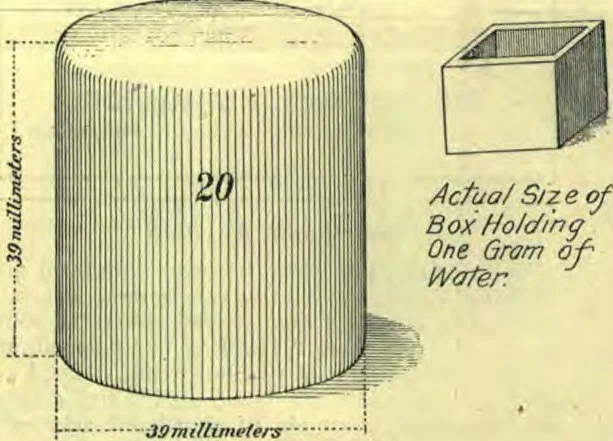
Then, what is a gram? Let us take to the water. Water?—Yes. These French sages, when they first undertook to get a uniform system of weights and measures, after settling upon the meter, said, “Now what can we do for weights? Everybody can get water, and everybody can distill, or boil, it. Let us take, then, a cubic centimeter of pure, or distilled, water—that is, the water that will exactly fill this little box,—and call that weight a gram.” Now we have the modern starting-point of weights.
But while grams, and even thousandths of grams, are necessary in medical and other scientific matters, they are much too small for ordinary trade or business, and so one thousand grams, or the kilogram, was taken as the unit for common use, and a standard kilogram of platinum was made. That was way back in Tallyrand’s day. The International Commission, appointed to revise the whole subject, was very particular in regard to the kilogram. A fine composition of platinum and iridium, after many heatings and hammerings, was finally rolled between two steel cylinders into a round bar two meters long and forty-four thousandths of a meter in diameter. Specimens of it were cut off, and analyzed, and found to have less than 1/3600 of impurity! That is, they were within one thirty-sixth of one per cent of being absolutely pure. We will grade it at 99 35/36 per cent.
Then this bar was cut into forty spools, or cylinders, and each one was placed in a collar, and squeezed a dozen times under a pressure of three hundred and sixty tons. Each poor little roll must have felt as if ten or a dozen big locomotives had sat upon it, all at one and the same time and on the same spot. Thus they were finally brought down to the shape and size of the illustration. Then, after more adjustings and polishings, they were compared upon balances so delicate that the operator could not stand too near, lest the warmth of the body or the moisture of the breath or some other personal attraction or distraction might affect the comparison. So mechanical devices were used by which he could stand a dozen feet away. This, then, is the kilogram, which regulates our pound; that is, our avoirdupois pound must now be nearly five-elevenths—more nearly 453590/1000000 of a kilogram, and all our other weights—ounces, grains, troy pounds, etc.—are determined accordingly.—Albert B. Carner, in Well Spring.