Early Buttercup (Ranunculus Fascicularis)
Description.—About six inches high; leaves numerous, mostly radical, much divided, and borne on long, slender petioles; cauline leaves sessile; flowers perfect and complete, each borne on a separate peduncle; petals bright-yellow, rather narrow and distant, and much larger than the sepals; roots fasciculate, some of them thickened and fleshy.
Cauline leaves are those which grow from the stem (caulis) above the base. Some plants have only cauline leaves, some only radical leaves, and others have both sorts. Sessile leaves are those that are attached to the stem by the base of the leaf blade, without an intervening petiole. The petals of the early buttercup are said to be distant because they are separated so that they do not touch one another. Fasciculate roots are those that are arranged in a bundle (fascicle).
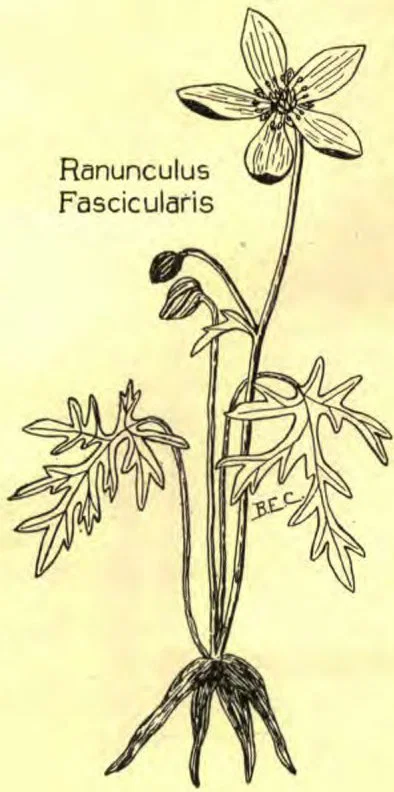
They may be either thickened or not. Thickened roots, like those of the early buttercup, are strong and durable, containing a large amount of nourishment stored up for future use. At the approach of cold weather, the plant dies down to the ground; but the roots and base of the stem live on year after year through the storms and frosts of winter. As soon as the sun warms the earth in spring, the plant begins the development of its new leaves and flowers and fruit, the process being hastened by the abundant supply of food material stored up in the thickened roots.
Plants that live year after year through an indefinite period are said to be perennial. All trees and shrubs are perennials, as are also many of the herbs, although in the temperate and cooler climates the stems of herbs die down to the ground every year.
The species here described is the earliest of all the buttercups, decking the woods and rocky hills with its bright-yellow flowers during the month of April.
Bulbous Buttercup (Ranunculus Bulbous)
Description.—Stem about one foot high, springing from a solid bulbous base nearly as large as a hickory-nut; leaves mostly radical, long-petioled, ternately parted (incisions extending nearly to the midrib) or ternately divided (incisions extending quite to the midrib); flowers single on long, slender, grooved peduncles; petals broad, rounded, and of a shiny golden color, forming a cup-shaped corolla; sepals reflexed (bent backward).
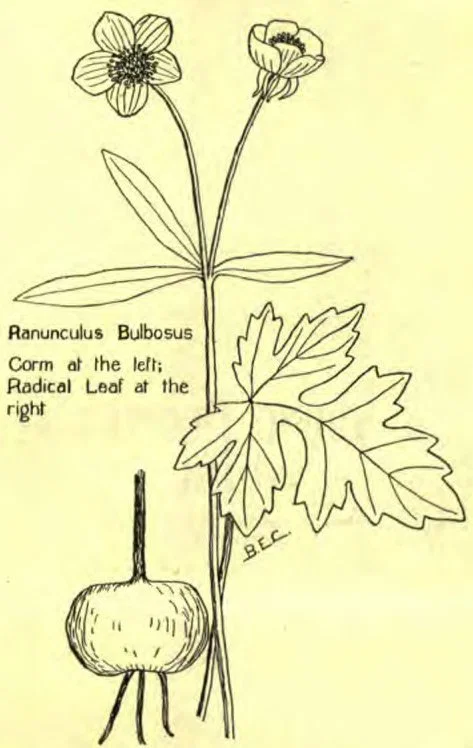
The bulbous buttercup is common in New England, but quite rare farther west. The blossoms appear during the month of May, adorning the meadows and hilly pastures with their bright, golden cups.
This species is considered “pre-eminently the true buttercup.” It is about twice as tall as the early buttercup, and the stem is more erect.
The enlarged base of the stem is sometimes called a bulb, but more properly a corm, which is a solid, bulb-like stem, and not made up of scales, as is the onion. The very short and thick subterranean stem of cyclamen and of Indian turnip are excellent examples of the corm.
The corm of the bulbous buttercup in its fresh state is acrid and emetic, and is sometimes used in medicine. The leaves and stems also contain acrid properties, which serve as a means of protection to the plant. Cattle seem to understand its nature, as it remains unmolested, even in closely cropped pastures.
Other Buttercups
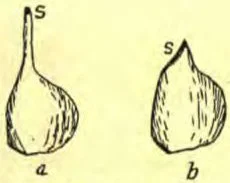
There are two species of creeping buttercups, one of which, Ranunculus septentrionalis, is common almost everywhere in wet or moist places,p. 236 flowering in spring and summer. The other, Ranunculus repens, is somewhat less common. They differ principally in the styles and stigmas. In the first the styles are long and slender, and the stigma occupies only the top of the style. In the second the styles are short, with a broad base and a sharp-pointed apex, and the stigma occupies the inner edge. The accompanying illustrations will help to make this plain.
Ranunculus acris, the tall buttercup, grows two or three feet high. The stem has no bulbous base, and the peduncles are round and not grooved. These characteristics make it easily distinguishable from the other buttercups. A full double-flowered variety of this species is sometimes cultivated in flower gardens.
Those who have read this article through carefully, should now be able to answer the following questions:—
Questions
- Define fasciculate and cauline.
- What are perennial plants?
- Which is the earliest of all the buttercups? and when does it bloom?
- Define reflexed.
- Which species is “pre-eminently the true buttercup”?
- Where is it most abundant? When does it bloom?
- What is a corm?
- How are the different species of buttercups distinguished?
B. E. Crawford.