Downy Woodpecker
You may possibly see the Downy Woodpecker any day in the year; for he does not go South in the fall, when so many other birds leave us. If you wish to bring him near, and he is anywhere in your neighborhood, a piece of fat meat nailed to a tree or other suitable place ought to accomplish your purpose.
But whether you feed him or not, he will find plenty to eat, even though the weather is severe. He often is to be found in the company of chickadees and nuthatches, for they are boon companions. His food is made up of what he can get from cocoons, along with insect eggs and larvæ he obtains from the bark.
Some people ignorantly suppose that he injures the fruit-trees by boring in the bark; but let me tell you that if he pecks into the bark of fruit-trees, it is always to get the insects and eggs hidden there. And the more he gets, the better; for there will be fewer insects later on.
Some people say the Downy Woodpecker eats fruit, but if he does, it is a very small quantity. Men employed by the government in examining one hundred and forty stomachs of this bird found fruit in only three. Nearly three fourths of the bird’s food is insects. He eats many grasshopper eggs, May-beetles, plant lice, ants, and wood-boring and other destructive caterpillars. You may depend upon it, the Downy Woodpecker is our friend.
No matter how cold the nights, he sleeps very comfortably in his little home. The wind may storm and blow, and the snow may drift, but he is snug and warm. He has a hole in a tree, which he has dug for the purpose. He does not have the opening of this toward the north, whence all the cold winds and storms come, but toward the sunny south. And in this hole he snuggles down, with his bill warmly tucked away among his feathers. Jesus once said, “Foxes have holes, and the birds of the air have nests; but the Son of man hath not where to lay his head.” Surely the Downy Woodpecker has a nest, and a good, warm one; for his Creator has given him wisdom and ability to make it safe and comfortable.
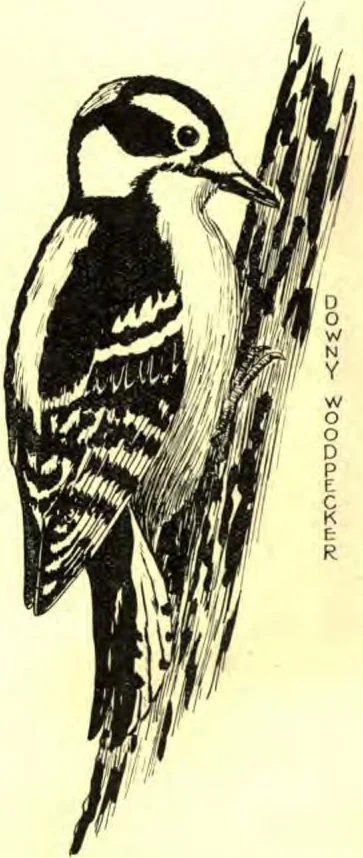
Description.—Adult male: upper parts black, spotted and striped with white; under parts white; scarlet band back of neck. Female: similar, but without scarlet patch. Length, six and three-fourths inches.
Red-headed Woodpecker
This bird is much more beautifully colored than the Downy Woodpecker. He has a head that is as red as anything you ever looked at, fairly dazzling the eye whenever the light strikes it. But bright as he is, it is surprising how difficult it is to see him when he settles down on the side of a fence-post. The reason for this is that the black on him looks like the shadows on the post, and the red of his head, seen against the green of the grass or trees beyond, loses its color. Although of such brilliant coloring, he is nevertheless protected by the great Artist of the universe from the sharp eyes of many of his enemies. And this fact you will find true of every creature that lives wild about us. God’s tender mercies are over all his works. Ps. 145:9. For instance, almost all birds that live most of the time on the ground, such as snipe, plover, quail, sparrows, and grouse, are generally dull-brown or gray, like the ground, grasses, or leaves about them. On the other hand, birds that live in trees, near flowers and fruits, are more highly colored; such are the orioles, humming-birds, finches, tanagers, warblers, and many others.
Again: the flycatchers are, as a rule, quietly attired in a grayish or olive-green coat, because they live almost constantly in and about the green foliage of trees that have neither conspicuous fruit nor blossoms. Further: many animals living in the arctic regions take on a white coat as soon as winter approaches.
Even the birds themselves seem to understand that they have been given this protection, for game birds will “lie to a dog;” that is, when there is enough cover, they trust to their protective coloring to escape being discovered, and take flight only as a last resort. When there is not good cover, however, they rise early enough to be out of reach of the gun. “A sitting woodcock,” says Professor Chapman, “had such confidence in its own invisibility that it permitted itself to be stroked without leaving the nest; but when a light snow fell, and the bird became a conspicuous dark object against a white background, it took wing on the first suspicion of danger.”
Sin has brought death and danger into the world; but under all we see the tender mercy of God, seeking to give all his creatures a chance against their enemy. It is a parable, a picture, shadowy in parts, perhaps, but true, of the greater things, the infinitely greater things, which God is doing for those who trust in him. How much more will he not do for you, O ye of little faith?
The Red-headed Woodpecker is a very useful bird, and eats large quantities of injurious insects. He devours more grasshoppers than any other woodpecker. He also eats the June-bug. He does eat some fruit, but could probably be diverted from this if wild fruit was planted near. He dearly loves beechnuts. Sometimes he stores whole handfuls in a single knot-hole, in cracks in gate-posts, and in crevices in the end of railroad ties.
I remember a Red-head which, a couple of years ago, made its nest in a very high tree in a small patch of woods on the edge of the city. He would not let any birds come near his quarters withoutp. 4 dashing at them fiercely, and chasing them for some distance. I remember he made the most vigorous warfare against squirrels, which I suppose were attempting to get into his nest. He was always too good a warrior for his foes, and drove them into quick retreat. I learned to imitate his notes to some extent; and whenever I stuffed up my throat until the tissues would vibrate well, and sounded an imitation of his krit-ter-rah, he never failed to stick his head out of his hole, and defiantly answer back.
Some of the nesting-holes of these birds show remarkably neat workmanship, the edges of the openings into their nests being artistically beveled, and the inside of the hole finished as smoothly as if with a rasp.
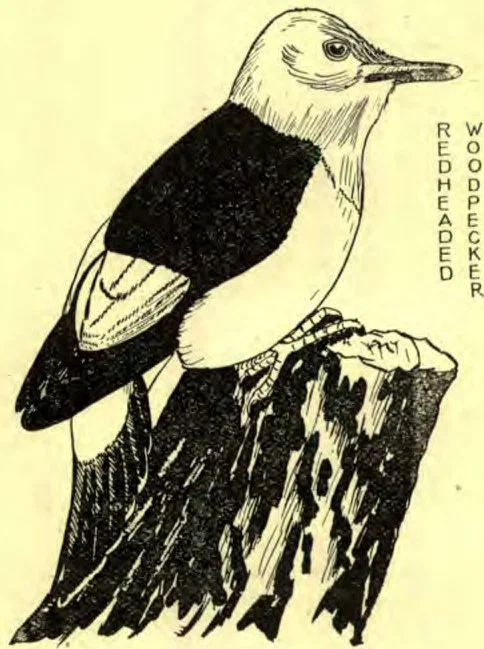
Description.—Male and female: head, neck, and breast brilliant red; rest of under parts white; upper part of back black; wings show white in flight. Length, nine and three-fourths inches.
L. A. REED.