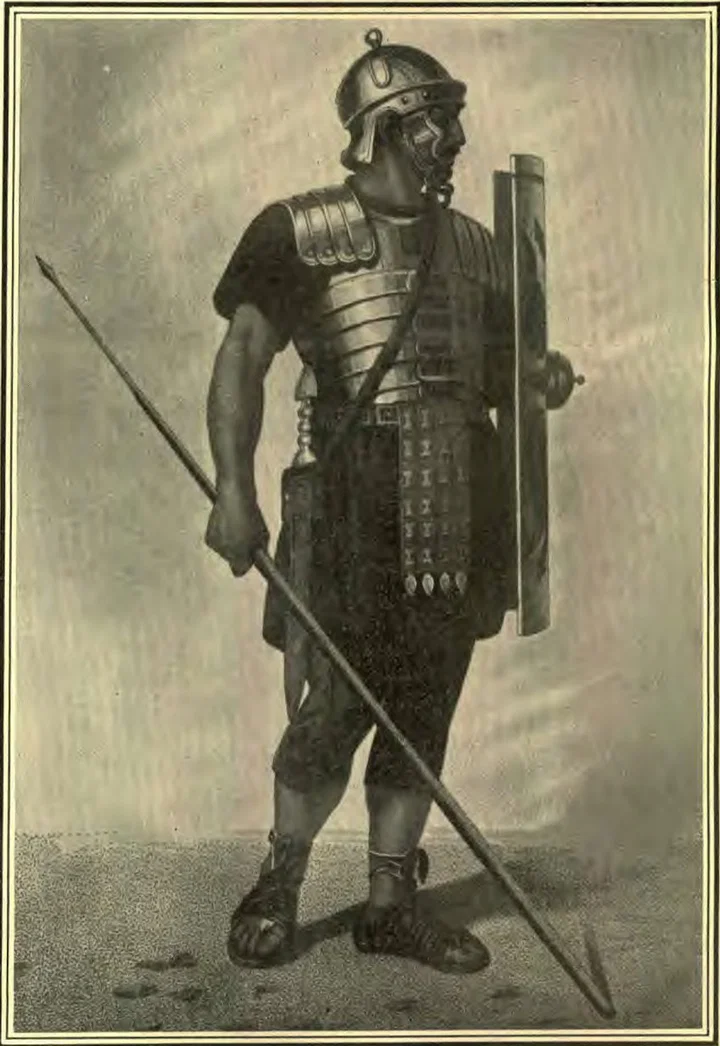
In the Bible the Christian life is called a warfare. Many texts in both the Old and New Testaments show this. Paul, in writing to young Timothy, exhorts him to “war a good warfare,” and to “endure hardness, as a good soldier of Jesus Christ.” He also says that “the weapons of our warfare are not carnal, but mighty through God;” and that “though we walk in the flesh, we do not war after the flesh.”
In this Christian warfare the Lord Jesus is leader; for he is the Captain of our salvation. And God’s people serve under a banner; for it is written, “Thou hast given a banner to them that fear thee, that it may be displayed because of the truth.” The enemies that we encounter are threefold: Our sinful hearts, the evil world, and Satan himself. For is it not written that “the heart is deceitful above all things, and desperately wicked!” and that, “If any man love the world, the love of the Father is not in him”? Peter also says, “Your adversary the devil, as a roaring lion, walketh about, seeking whom he may devour.”
But for our encouragement it is recorded that Jesus, our great leader, NEVER ONCE FAILED (John 8: 29), and that in his daily conflicts with sin and Satan he was always victorious. So the Christian may ever prevail in the battle for eternal life. It was this thought that led Paul to exclaim, “Thanks be unto God, which always causeth us to triumph in Christ!” and again he declares that in all our struggles “we are more than conquerors through him that loved us.” Are not these very comforting words for both old and young?
But in the lifelong conflict with evil we are not left to carry on a warfare at our own charges; for our Saviour says, “Lo, I am with you alway,” and though the weapons used are not carnal, yet they “are mighty through God,” even to “the pulling down of strongholds” of sin.
There is also a complete armor provided for every soldier of Christ. Read carefully the sixth chapter of Ephesians, where this armor is so minutely described. There we learn that the Christian’s war dress is composed of six different pieces, as follows:—
The Girdle of Truth.
The Breastplate of Righteousness.
The Gospel Sandals.
The Shield of Faith.
The Helmet of Salvation.
The Sword of the Spirit.
In other places Paul calls this “The Armor of Light,” and “The Armor of Righteousness.” But note also that it is “The Armor of God;” for he provides it.
In Ephesians 6 Paul exhorts us to “put on the whole armor of God,” and the reason given is, “that ye may be able to stand against the wiles of the devil.” A “wile” is a snare, or trap, laid for the unwary. And after stating that we “wrestle not against flesh and blood, but against principalities, against powers,” he repeats the admonition, “Wherefore take unto you the whole armor of God,” adding, “that ye may be able to withstand in the evil day.”
Let us now look at the armor provided for the Christian soldier, that he may be battle-proof:—
1. The girdle. Note that this is called the girdle of “TRUTH.” The Saviour refers to this in Luke 12 where he says, “Let your loins be girded about, and your lights burning,” referring to his second coming. And Peter writes, “Gird up the loins of your mind, be sober, and hope to the end.” In the Lord’s girdle of truth there is not one thread of error or falsehood. Of the Saviour, Isaiah says, “Righteousness shall be the girdle of his loins, and faithfulness the girdle of his reins.” And the psalmist adds that the Lord girds his people with strength for the battle. Ps. 18: 39.
2. The breastplate of righteousness. The breastplate of the old Romans was a piece of brass about a foot square to protect the chest. It covered the heart and vital parts. Isaiah, in speaking of our Saviour, says, “He put on righteousness as a breastplate.” Paul also exhorts, “Let us, who are of the day, be sober, putting on the breastplate of faith and love.” Faith and love include all the Christian graces. If we have the perfect righteousness of Christ as our breastplate, we may be very certain that it will stand every test. No fiery dart of Satan can pierce it.
3. The gospel sandals. Modern boots and shoes were not known to the ancients. In olden times the foot-dress of soldiers was made of leather, or metal, and sometimes of wood, and these were often studded with short nails or spikes. But note that the Christian’s foot-armor is “the preparation of the gospel of peace.” Every Christian is a child of peace, and the gospel is a path of peace, and the Lord is the God of peace. In Isaiah it is written, “How beautiful upon the mountains are the feet of him that bringeth good tidings, . . . that publisheth salvation.” Paul instructs to “make straight paths for your feet,” and the psalmist says, “I . . . turned my feet unto thy testimonies.” When this is done, a person may be very sure that he has on the genuine gospel sandals.
4. The shield of faith. Ancient warriors always had a shield to protect them from the missiles of the enemy. This was of various forms and texture. The Christian soldier also has a shield which will turn aside all the fiery darts of the evil one. Paul calls this “the shield of faith.” John says, “This is the victory that overcometh the world, even our faith.” In the psalms we read that God has given his people “the shield of . . . salvation,” and that his “truth” is our shield and buckler. But note Paul’s words, “ABOVE ALL, taking the shield of faith.” This shows the very great importance of this piece of armor; for without faith no one can please God.
5. The helmet of salvation. The helmet is a defense for the head. In Paul’s day the soldier’s helmet was of brass or iron, and served also to protect the neck. When Goliath came out top. 362 meet David, he wore a helmet of brass. In a prophecy of the Saviour’s work it says that he had “an helmet of salvation upon his head,” and Paul exhorts to put on “for an helmet, the hope of salvation.” The psalmist in his prayer says that God “covered my head in the day of battle.” One of the precious promises of the Bible is that “the very hairs of your head are all numbered.” How precious is the keeping power of God, and how good it is to hope in his mercy.
6. The sword of the Spirit. Paul says that this is the word of God, and that it is quick and powerful. It is even sharper than a sword with two edges. The word of God is also “a discerner of the thoughts and intents of the heart,” for it points out even our secret sins. Jeremiah says that it is like a hammer that breaks in pieces the flinty rock,—even our flinty hearts. Paul writes that “all Scripture is given by inspiration of God,”—literally, it is God-breathed,—and that by it the man of God “will be thoroughly furnished unto all good works.” The Saviour’s command is to “search the Scriptures,” for through them we gain everlasting life. It is written of the child Samuel that he let none of God’s words “fall to the ground,” and David says that he hid God’s word in his heart, that he might not sin against the Lord. In his forty-days’ conflict with Satan, Jesus repelled him with these three words, “IT IS WRITTEN.”
Clad in this heavenly panoply, may each reader of the INSTRUCTOR go forward to that certain victory which will last through the age of ages.
G. W. Amadon.