Parks
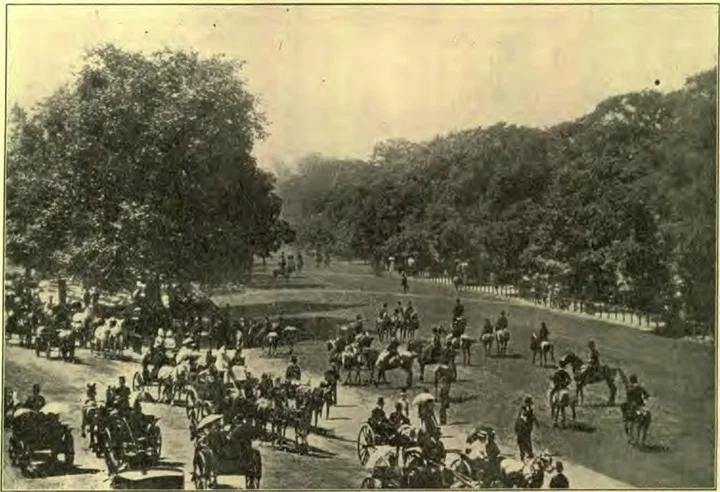
Although London is a great city, it is not so crowded as many smaller cities are. The Englishman prefers the country. He wants plenty of air and wide breathing-spaces. He lives in cities only from necessity, in order to be near his business. This natural love for the country, for the green grass and trees, has led to the wise provision of scores, yes, even hundreds, of well-kept parks within the city limits. Prominent among these are Regent's Park, Hyde Park, Richmond Park, Kew Gardens, and Hampstead Heath. Many of these “people's playgrounds” are open to the public night and day. They are well kept, and are preserved as nearly as possible like the natural fields and woodlands, thus enabling the poor, who can not take trips to the country, a little glimpse of country beauties, and a breath of country air.
The Zoological Gardens
The London Zoo, located in Regent's Park, enjoys world-wide fame; and is probably the most popular resort in London. There are over sixty houses and yards where different varieties of animals from all parts of the world are kept. Many of these animals are very rare and valuable specimens indeed. The white polar bear and the two grizzly bears are the best I have ever seen. There is an excellent collection, also, of kangaroos and wallabies from Australia. The giraffe is a beauty. I had previously thought that the pictures must have overdrawn the matter considerably in representing the giraffe as able to eat the leaves and fruit comfortably from an ordinary banana tree. When standing in a natural position, however, the head of this animal is fully thirty feet from the ground, and his forelegs measure no less than ten feet. The crib from which he eats his hay and straw is up in the corner near the roof, about twenty-five feet from the floor. When you visit London, do not fail to spend one day at the Zoo. Thousands of animals from every land and clime, and varying in size from the little field-mouse to the elephant are gathered there.
English Restaurants
The restaurants of England are good, bad, and indifferent. It took us some time to find any but the latter. The first one we visited seemed to be a very respectable place, patronized by clerks and shop-keepers; but on entering we found the gentlemen nearly all sitting at the tables with their hats on, and either smoking or reading the papers between the courses. The room was extremely unpleasant to a non-smoker, although the food was excellent and well cooked.
The second place we visited was near the London Zoo. We were ravenously hungry; for we had just spent a half-day traveling through the gardens. There were twenty-five of us, I believe, all in one group; and we marched into a restaurant and took possession of every seat.
We asked the proprietor if he could provide us with dinner; and he answered, “Certainly, sir. Take a seat, sir.” We sat down, and gave in our orders for a good vegetarian dinner. The proprietor took the orders in as matter-of-fact a way as if he would be able to bring on the dinners in two minutes; but, instead of that, he turned the orders over to the cook, who went deliberately to work and cooked our dinner for us. We were served just thirty minutes after we had passed in the order. These two experiences did not give us a favorable opinion of English restaurants; but later on, when we found the fine lunch-rooms of the Hovis Bread Company, and several other good systems of restaurants, together with a half-dozen well-equipped vegetarian lunch-rooms, our opinion was quite reversed; and we had one more little evidence of the truth that many unfavorable impressions of countries and people are derived from forming an opinion prematurely, and, therefore, ignorantly.
The Wax Works
No one should visit London without spending an evening at Madame Tussaud's Wax Works, situated in Baker Street, near Baker Street Station. Here one can stand face to face with life-like representations of the great men of all nations. The figures are life-size, and dressed as they were most commonly seen in life. There are the kings and queens of England, surrounded by their most intimate advisors. There are the great Reformers,—Luther, Knox, Melanchthon, and Calvin. In a prominent position is a group of United States presidents, among whom are Washington, Lincoln, Garfield, Harrison, and Grover Cleveland; and beneath a great black awning, draped with fitting symbols of mourning, sits our late president, William McKinley. There is Disraeli, surrounded by the stern, sober-faced men of his cabinet. There also are Gladstone and Lord Salisbury, with their advisors, whose names are quite familiar to us.
I can best illustrate the striking lifelike appearance of these figures by giving one or two rather amusing incidents. Before visiting the rooms, we had been told by our friends that we would find ourselves talking to wax figures before we got away; and as to be forewarned is to be forearmed, we were quite positive that we should be able to tell wax figures from human beings. One of our delegates, who is surely a wide-awake gentleman, made a tour of the first room, and got on very nicely; then he wished to make an inquiry concerning the Napoleon Chamber. This was his danger; for it is not very safe to try to make inquiries in the exhibition rooms; but the delegate, without a suspicion, went up to a lady attendant who sat near the door reading the Wax Works' Guide Book. He said: “Madame, will you kindly direct me to the Napoleon Room?” She made no reply. (Louder) “Please, Madame, will you kindly direct me to the Napoleon Room?” No reply. The delegate became anxious; and, according to his own testimony, he felt the perspiration start upon his forehead as he realized that he was trying to obtain information from a wax woman.
A young friend, who has studied painting and molding considerably, and is known to be somewhat an expert in the study of faces, visited the Wax Works one day; and almost immediately endeavored to secure information from the dignified wax policeman that guards the entrance. She was quite chagrined when she entirely failedp. 2 to secure information from him. A little later, when going through another room, she came across another policeman, and said, “O, mother! do look at this policeman. He looks as lifelike as the other one,” and she went up close and looked in his eyes, and even pointed her finger at his eyes, to see if he wasn't sufficiently living to wink. He did wink, and almost frightened her out of her wits by jumping at her. He was posing on purpose to permit people to mistake him for a wax figure.
The Napoleon Chamber, the Tableau Chamber, and the Chamber of Horrors, are also very interesting.
Crooked Lanes
One of the most striking features of London is its short and very crooked lanes and streets. True, there are a few long streets running partially across the city; but they can be counted on one's fingers. It was a constant puzzle to me to account for some of the crooks. There were little lanes so narrow that the walls on each side could be touched at once by one's extended hands; and yet great blocks of buildings have been built with a serpentine front on just such narrow lanes. Why was the path not straightened or closed up altogether? In other places where it was necessary for a building to be built across a path, the building was arched over the pathway; but the pathway itself was not moved. I became more and more curious, and made many inquiries; and finally was told, what is probably true, that for centuries it has been a sacred law in Great Britain that no footpath or right of way can be changed or closed up after being used by the people for fifteen years. Thus the whole city of London, and, in fact, all the cities of England, have been built so as to conform to this peculiar law, which has protected as sacred all the old footpaths of the people.
Miscellaneous
After seeing some of the principal features of London, do not fail to take a trip through some of the oldest portions, just to see what you can run across accidentally. It is a delightful experience to rummage through the little old streets and crooked lanes in such crowded quarters as that section of the city lying between Holborn and the Strand.
One day when we were walking down Holborn Street, we noticed a little street called Chancery Lane, just wide enough for two vehicles to pass each other. As we had read in various books many times about this Lane, we decided to follow it up, and see what we could find on our own account. From here we strayed into Lincoln Inn Fields, mentioned so often by Charles Dickens. Here we found the old Inn, the offices occupied by Charles Dickens; and only a few steps from the square the old Curiosity Shop immortalized by Dickens in his book by that name. We also found Chancery Court, where so many cases have been tried year after year for several generations; and, near it, the famous old chapel, which is still attended by many of the legal profession. Of course it is interesting to have a guide, and have these old places distinctly pointed out and described; but that experience does not compare with the delight one feels in discovering, for himself, places which have long been held in the imagination, and have become somewhat sacred to memory by being associated with the books and histories of our childhood days.
It is interesting, also, to stand about on the street corners, and watch the ever-shifting tide of humanity constantly flowing by. One evening about eight o'clock I was strolling through one of the narrow lanes near the Strand when I came across the most wretched appearing little creature I have ever seen,—a little girl about ten years of age, and apparently cruelly deformed. Her head was drawn down upon her breast. One arm was crooked and twisted up behind her back, and the other was as badly twisted in front. Her right leg was so deformed that she actually walked on the left side with her right foot. I watched her for some time as she moved along with slow, painful steps, and wondered what I could do for the poor child. Soon she turned a corner into a quiet, secluded lane; and, presto! she lifted up her head, shook out her arms and legs, and went running up the street for home, happy, probably, with the good earnings of a day's begging on the streets. Such queer characters are seen in London more often than anywhere else; and it is a fascinating study to observe the people, and the various means by which both the poor and the wicked endeavor to battle for a livelihood with the cruel, relentless conditions which they must meet in a great city like London.
E. R. PALMER.