KARMATAR, March, 1903.
DEAR YOUNG READERS: There are many very interesting places in the world, which you may never have an opportunity to visit; still you can not afford to miss becoming acquainted with them. You need to know the world, because the world needs your help; and unless you become familiar at home with the different countries and their people, how will you be able to help them? When the Bible speaks about our teaching the gospel to every nation, kindred, tongue, and people, we know this includes Burma, in far-away India. Still very little has thus far been done to proclaim the message of Christ’s soon coming to these precious souls.
No doubt all of you have learned something about Burma in your geography lessons; thus you know it is bounded on the west by India and the Bay of Bengal, and on the north by China. Look on your map, and see what is on the south and east sides. The country is divided into Lower and Upper Burma.
The whole of Burma is now under British rule. A chief commissioner presides over both provinces. The former native government of Burma was very despotic. The king was absolute master of the lives and property of his subjects, and regarded with a reverence amounting almost to adoration.
Lower Burma has an area of nearly ninety thousand square miles. It is intersected by chains of hills, running north and south, between which flow the principal rivers, the Irrawaddy, the Sitang, and the Salwin.
Burma is the most thinly peopled territory belonging to the Indian empire. There are only about twenty-nine inhabitants to the square mile. The Burmese belong to a race intermediate between the Chinese and Malays. Wild tribes are numerous, and in some cases independent. There are many Chinese settlers. The Burmese are short-headed, broad skulled, and flat-faced, with black hair and dark-brown complexion. Their dress is simple, but peculiar. The in-gie, a white linen jacket, is worn by both sexes. Wrapped round the lower part of the body, the men wear the put-so, a piece of cloth several yards in length. The women wear the termin, a scant garment of cotton or silk. Silks of all colors and valuable gold ornaments are worn on special occasions. Betel-nut chewing and cigar-smoking are largely practised, by both men and women. Indeed, in no other place have I seen women so attached to their cigars, which are from eight to ten inches long. In all their occupations, as well in the house as on the street and in the market-place, the weed is used. I found it very hard in my association with the Burmese to convince them of the danger of the smoking habit; however, they were much interested in the studies we had on Bible temperance. The Burmese are clever as carpenters and smiths, also as tailors.
I was much interested in the comfortable, large, cool houses in which the Burmese live. They are made of a framework of bamboo, thatched with the leaf of the water-palm, and invariably raised on posts several feet from the ground.
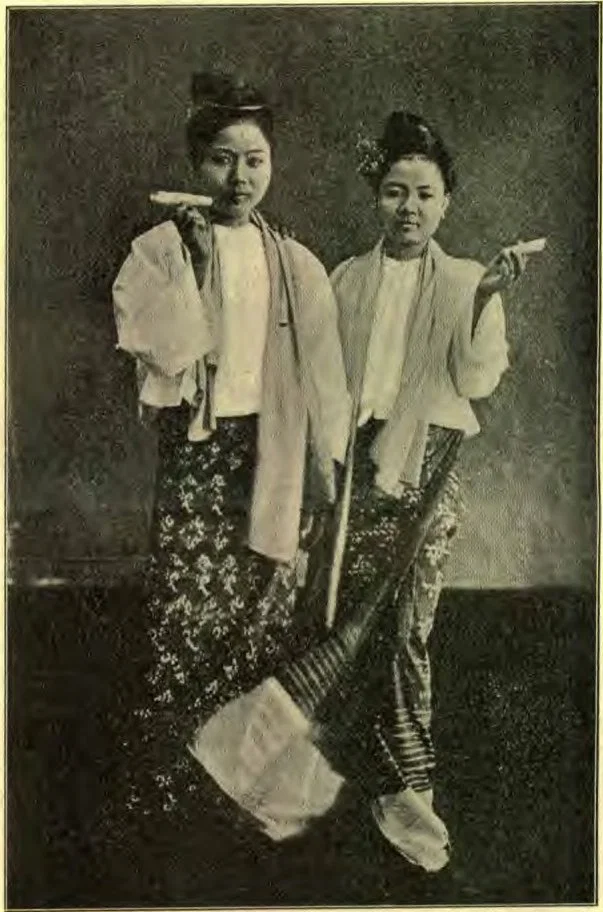
The women of Burma are much more industrious than the men; they buy, sell, weave, and attend to the domestic concerns. In one house where we made a visit, the women were all busy making cigars. We tried to show them the danger of living in such an unhealthful atmosphere.
Next time I will tell you something about what one Burmese sister did to interest the people of her city in the matter of healthful living.
THEKLA BLACK.