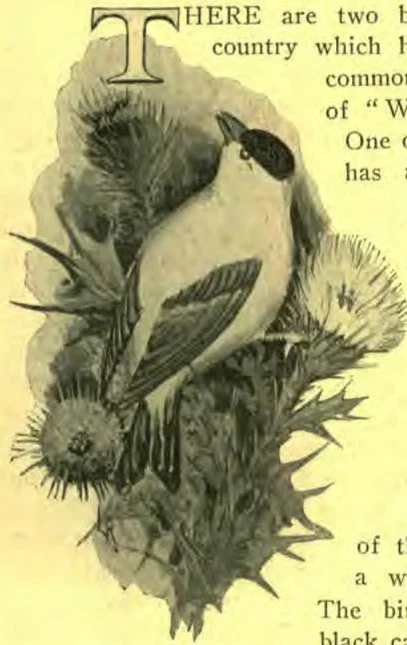
There are two birds in this country which have the one common nickname of “Wild Canary.” One of these birds has a black cap and black wings; the other is yellow or greenish-yellow nearly throughout its plumage. In point of fact, neither of these birds is a wild canary. The bird with the black cap and wings and the bright-yellow plumage is the American Goldfinch, Yellowbird, or Thistlebird, as it is variously called. The other is the Yellow Warbler, or Summer Yellowbird. The two birds are not very much alike, save that both are yellow.
Early in the spring, before the leaves are yet out, you may hear, in the depths of an evergreen tree, the musical question, See-e-me? You may be sure it is the Goldfinch, and his yellow robe will make it an easy matter to see him. Later in the season you will find him swaying on the feathery side of some gay thistle-top. In a moment he is off, winging graceful curves through the air not far in front of you. He is as bright and cheery as his coat. The dotted line in the drawing will help you to understand how he flies through the air. But the bird himself is better than any diagram.
“I wish that every one knew the Goldfinch. His gentle ways and sweet disposition are never-failing antidotes for discontent. One can not be long near a flock of these birds without being impressed with the refinement which seems to mark their every note and action. They show, too, a spirit of contentment, from which we may draw more than a passing lesson. Hear me, hear me, dearie! they call as they feed among the weeds or on the birch buds; and no matter how poorly they fare, they seem thankful for what they have. The seeds of the dandelion, thistle, and sunflower are among their favorites; and if you would attract Goldfinches as well as some other birds, devote a corner of your garden to sunflowers.

“The meal finished, the birds launch out into the air; and to the tune of Per-chic'-o-ree! per-chic'-o-ree! go swinging through the air in long, bounding undulations.”
In the fall you will lose track of the Goldfinches. Gradually they will disappear. But now an unfamiliar bird, yellowish-white beneath, with a greenish-brown back, will attract your attention. It will be hard for you to believe that this soberly dressed bird is the same smart little fellow you saw in summer, all attired in bright-yellow and velvety black; but so it is. He wears two suits each year,—yellow and black for summer, a more plain garb for winter. The birds now remain in flocks, roving here and there to find food. “But in the spring, when the dandelions show yellow, so do they.”
In April the males regain their bright colors, but it is not until June that the birds set up housekeeping. Then the song season reaches its height. Each bird perches near his home, or flies in broad circles about it, and pours forth his bursts of rapturous melody.
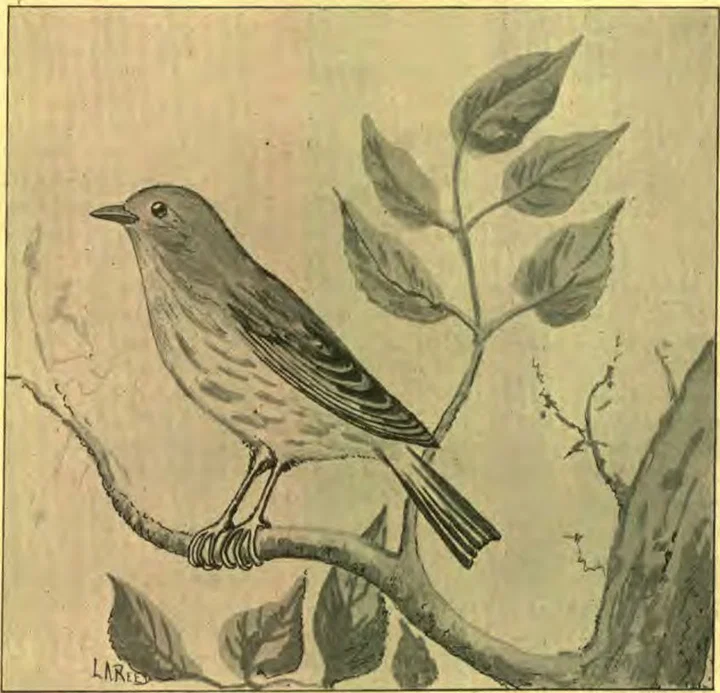
The Yellow Warbler is, as its name indicates, a member of the great, puzzling family of Warblers. There are very many members of this family, and most of them live in close shrubbery or the depths of trees, where it is difficult to study them. Even if you set out to form their acquaintance, it will take several years to find them all, and become in the least familiar with their habits.
But the Yellow Warbler prefers lawns, parks, or orchards to the woodlands, and hence is better known. It is greenish-yellow above; crown and under parts golden, streaked with reddish-brown; wings and tail dusky, somewhat edged with yellow.
The female cowbird is the constant enemy of the Yellow Warbler. She does not build a nest of her own, but seeks, instead, some other bird’s nest in which to deposit her eggs, that of the Yellow Warbler being a favorite. But the Yellow Warbler does not believe in being imposed upon if it is to be avoided. Sometimes when Mother Yellow Warbler is away from home for a few moments for a drink, or a few turns through the air, a cowbird will leave one, two, or three of its large eggs in her nest. When the little bird returns, it sees at once what has happened; but the egg of the cowbird is large and heavy, else the Warbler doubtless would promptly roll it out. There is only one other way to be rid of it,—build a new nest over the old one, and begin again. This the Warbler may be compelled to do twice, and even three times. True, it has to abandon its own eggs as well; but better so than to hatch out an ugly black cowbird, which would gobble all the food, and eventually crowd the little Warblers out of the nest. Thus you see that even the birds have serious troubles. But in one thing they are different from us,—they do not allow these things to sour their tempers, and shortly they forget, and sing as sweetly as ever. In this, as well as in their happy trust for their daily food, they are an example to man.
L. A. REED.