“Land! Land!” the Emerald Isle
On the morning of the sixth day there is a stir of excitement on board. All eyes are strained to catch the first glimpse of the south-western point of Ireland, which, in fair weather, is the first land that is sighted. It is not difficult on this morning to pick out every Irishman on board, each is so proud of his native land, and talks with such enthusiasm of the wonders of the little “emerald isle.” In fair weather the sailing along the southern coast of Ireland is pleasant indeed. The numerous fishing-boats; the hills covered with greener grass than an American ever saw in his native land; the ruins of gray old castles, with an occasional white fort, its heavy guns looking out threateningly upon the sea,—all are items of absorbing interest. The enjoyment of the scenery is intensified in contrast with the monotony of the previous six days. The sight-seeing of a whole week seems to be crowded into a single day.
Queenstown, the Port of Cork
As we near Queenstown, the signals are run up the mast to inform the out-lookers that they must “come off” for the mails. Queenstown is the port of Cork. Vessels stop here long enough to leave the mail and the passengers for Ireland. These are taken to the town by a “tender” (a small boat), which comes out to the open sea to meet the largest vessels. In pleasant weather two or three rowboats usually come out to the ship to trade with the passengers over the ship’s side. One of the occupants of the little boat climbs aboard the ship, lets down a string for a basket of wares, and one thing after another is brought up for passengers to examine. Irish lace, blackthorn canes, and “schellales” are the most common articles offered for sale. Bits of shamrock are also sold at a shilling a bunch. “Will it grow?” asks a woman who wants a bit of sport at the expense of the poor peasant. “It will grow if you smile on it, lady,” answers the witty salesman, who is always ready for the many questions that are asked of him over the ship’s railing.
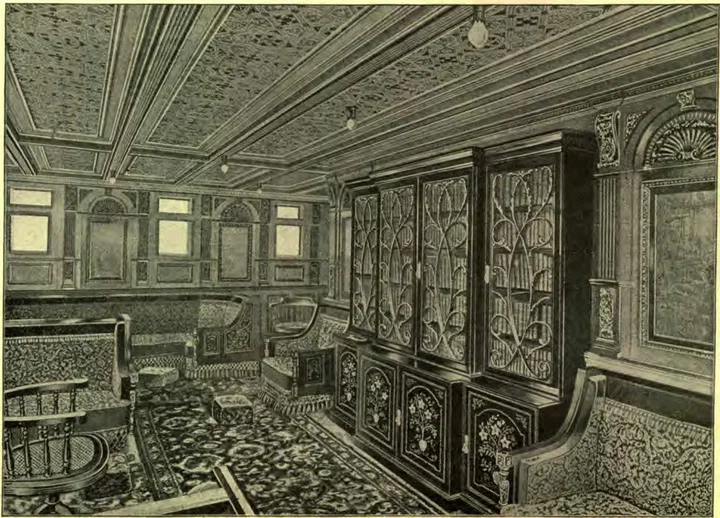
On to Liverpool
But the tender is soon loaded, and off to the town; and our good ship steams ahead again, through St. George’s Channel and the Irish Sea to Liverpool. The stately ship works her way carefully and proudly up the narrow channel of the River Mersey, among the hundreds and hundreds of other vessels going in and out, or lying at anchor. Little by little she finds her way to her position at the landing stage. The ropes are carried ashore in a small rowboat, and made fast, the donkey engines on board wind in the rope, and the ship is drawn to the side of the wharf and secured.
The landing stage at Liverpool is the largest and best floating dock in the world, being nearly a mile long, and about one hundred and fifty feet wide. It floats on the surface of the water, rising and falling with the tide, and is connected with the shore by run-ways on hinges. This is a fine arrangement; for ships fastened at this landing stage are not inconvenienced by the rising and falling tide, as the wharf rises with the ship, and their relation to each other is always the same. At an ordinary stationary wharf it is often difficult to manage a ship, and load and unload cargo, when the tide is rising and falling from four to twenty feet.
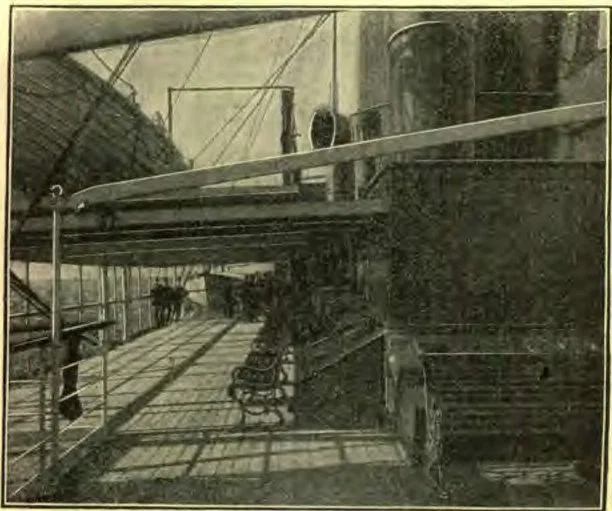
The second-class passengers must wait patiently while the gangway is thrown down for the first-class passengers, and the fine ladies and gentlemen go ashore, and get their baggage safely on the train. After waiting for the longest kind of a half-hour, the gangway is opened for the second-class; and we hasten down, and again enjoy the blessed privilege of standing squarely on the earth. What a pleasure to walk about on a surface that is not always tipping and falling out from under one’s feet!
But we must not waste time now. This is the one hour above all others on the way to London when it is necessary to be cool-headed and attend to business. We collect the hand baggage in one place; then secure the services of two or three pleasant-looking porters, and pay them a shilling each for giving us good service. They assist in finding the trunks, and in securing a customs officer to pass the baggage. Then it must be labeled for the special train which is waiting at the wharf to take the passengers to London. We are happy indeed when the trunks are all on board, and we have found places in the third-class compartments on the railway carriages.
English Railway Trains
Now, if you please, reserve your comments concerning the railway trains until you become better acquainted with them. Everythingp. 2 looks new and strange; and we are likely to make unfavorable remarks concerning anything that is different from what we have previously been accustomed to. The railway carriages are short and low, and the entrance doors are in the side. Each car is divided by cross-sections into six or eight compartments; and each compartment will hold about eight passengers. The first experience in one of these compartments is a bit like being shut up in a box, and it does not strike an American favorably.
When our company of canvassers went from here to England last April, they greatly enjoyed thinking of the country to which they were going; and they fully resolved not to make any unfavorable comments, or introduce any national comparisons. In other words, they had rolled up the United States flag, and left it at home. They did first rate until they got into the railway train. Then one brother who did not understand about the first-, second-, and third-class compartments in an English train, found a pleasant corner for himself in a first-class compartment, though he had only a third-class ticket. When the porter went through the car to examine the tickets, he hustled this good brother with all his luggage into a third-class compartment, which was rather smoky and stuffy. This was too much; and he could not, or at least did not, restrain himself from remarking to the porter that he “ought to go to America, and see how they manage their railway trains;” but the other members of the party soon got this unruly brother into a corner, and refreshed his memory with his good resolutions.
Liverpool to London
It is about two hundred miles from Liverpool to London, and the run is easily made in four hours. This is a wonderfully charming ride after a long, monotonous voyage, and is likely to give the traveler a favorable impression of English country life. The far-famed hedgerows; the small, irregular fields; the beautiful country-seats, with an occasional ivy-clad ruin of some famous old castle or chapel; the greenest of all green grass; the great English oaks and elms; the numerous little patches of woodland, which are preserved with jealous care,—all unite in making landscapes of unparalleled beauty.
“What a short ride!” some one remarks. “I wish it were as long again,” says another, as we find ourselves actually drawing up to the Euston railway station, in the great city of London.
We are met by at least a half-dozen of our brethren, who are always careful that every missionary shall be properly looked after. Half of them at least are dressed in frock coats and shiny black hats; and we feel almost ashamed of our travel-stained condition, but there is something so cordial about an Englishman’s hand-shake and greeting that all are soon at ease.
A large ’bus has already been engaged. The passengers are hustled inside, trunks and boxes are stacked on the top, and off we roll for 451 Holloway Road, London N., the headquarters of our work in England. We are soon comfortably settled in lodgings, and are endeavoring to adjust ourselves to our new surroundings.
Now we are actually in London. I will not attempt to tell you about the little experiences through which one passes in learning how to do shopping, and how to get on pleasantly with the people. The man who keeps his eyes wide open, and who has thoroughly made up his mind to be pleased with everything, will soon find himself at home, and anxious to look about the grand old city, and see the interesting places about which he has heard from his childhood.
E. R. PALMER.