AMONG the historical and interesting places near Liverpool, is the ancient city of Chester, situated on the banks of the River Dee, and about fifteen or sixteen miles from Birkenhead, England. It may be easily reached by the trains which run every hour or so during the day, on their way to and from the great city of London. Not long ago a company, of which the writer was one, visited Chester for a few hours to view the scenes and ruins of that city.
The main part of Chester is surrounded by a high stone wall, having five gates. This wall was first built by the Romans, who at one time invaded England, and had their headquarters at this place. This was during the early part of the Christian era, some say before that time. Who the founder of Chester was is not known; there is no history in existence which gives his name. Nearly all the wall has been rebuilt in later years; but a part of it, on the heights overlooking the River Dee, remains as originally built. The old castle at this point was probably erected at the same time as the wall on which it stands, but very little of the original structure has been able to withstand the storms which for centuries have beaten upon it. A little farther up the river is a dilapidated old mill, made famous by the song, “The Miller of the Dee.” Three times parts of this old mill have been destroyed by fire, the last one burning out the center, leaving both ends standing. What is left of the building shows that it was a large mill, but it is now fast crumbling to ruins. The window lights are all gone, and the older portions give evidence that it will soon be a thing of the past.
Just below this mill and the old castle, is a beautiful stone bridge, which was opened to traffic by the late Queen Victoria, in the year 1832. It has an arch two hundred feet in width, and when built, was the widest-spanned stone arch in the world.
The River Dee is very pretty at this point, with its clear waters and green banks. It is the dividing-point between England and North Wales. Up this river in an early day, vessels from the ocean came as far as Chester, so history affirms, though it requires some stretch of the imagination to understand how they managed to do so, except on the ground that the vessels then were tiny things compared with those of the present time.
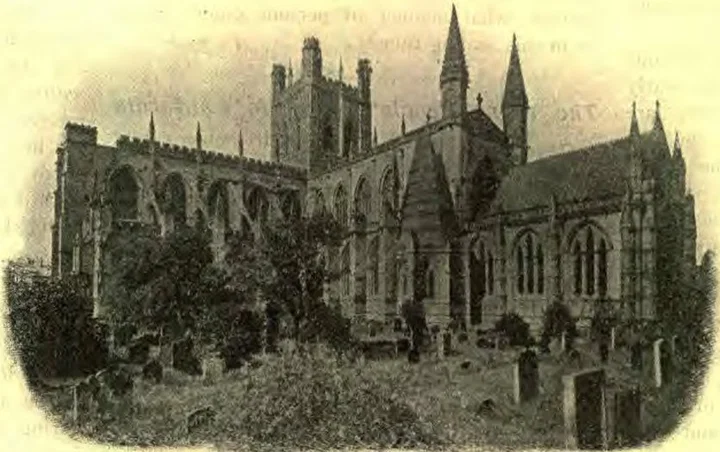
History tells of the visits of kings to this famous place. William the Conqueror came to vanquish this, the last English city to hold out against his dominion. Charles the First honored it with his presence, and Cromwell the usurper appeared, to terrorize its inhabitants. A section of the old cathedral walls still bears the marks of his inroads. A portion of this cathedral, erected in A. D. 1090, still stands as a monument to the faithful work done by its builders. New parts have, however, been added to keep it abreast of the demands of modern worshipers.
We chanced to be present in this mammoth structure during the time of service. The echoing and re-echoing of the grand organ tones through the various parts of the great edifice seemed quite strange, yet its effect was magical. At one time its resonant strain would repeat itself among the pendants of the high ceiling, seeming almost to make them tremble in their places; then a low, sweet note would start on its way, to die in the distance. This was in keeping with the part acted by the black-robed priest, who read his service in a tone of cadence which followed the round of the organ peals.
The ancient refectory, or refreshment room, of the cathedral is now used by the choir in their practise; but there yet remains the old stone pulpit in the wall, from which one priest used to read to the others while they partook of their repast. In this same cathedral we saw two faded and tattered flags which were in the siege of Quebec, at the time when General Wolfe was killed. Not far from the flags was the tomb of a soldier killed at the battle of Waterloo in 1815. People lie buried also in the massive stone walls, so that the church itself, as well as the yard which partly surrounds it, is a place of burial.
Many old dwelling-houses are still standing in this city. The oldest was built in 1003, nearly nine centuries ago. Over the door of one of the houses is written, in plain letters, “God’s Providence Is Mine Inheritance.” It is said that the family who lived in this house during the time of a terrible plague in this part of England, were the only persons who escaped the pestilence. Within the walls of this old city is a small green field, where it is said all the plague-stricken people were buried, though now not a vestige of their graves remains. The place, however, is kept free from buildings.
We visited another old house, in which an ancient Earl of Derby was imprisoned. Here for six weeks he was secretly fed by a servant, who afterward betrayed him. He was then taken to Bolton, where he was beheaded by order of Cromwell. There is still to be seen the room where he was imprisoned,—a little, dark closet, about four by six feet, with a massive door. To look at it, causes one almost to shudder at the thought of a human creature being imprisoned there for six weeks, and then escaping only to meet death. Through the lower floor of this house is a trap-door, the opening to a dark passage which led to the castle where the unfortunate earl was placed on trial.
There are other interesting places in and near Chester, which there is not space in this article to describe, such as Eaton Hall, Hawarden Castle (the famous Gladstone home), and Grosvenor Park. We saw enough, however, to make us thankful that our lot had been cast in brighter days than those in which these ruins had their origin. FLORA SMITH CORLISS.
Birkenhead, England.