A Curious Bird's Nest

14%

Review and Herald Publishing Company · Battle Creek, Michigan · May 14, 1903

FromThe Youth's Instructor, Vol. LI, No. 19

Read the full edition

A Curious Bird's Nest

Those who are familiar with our common house-wren know how often it happens that very strange nesting-sites are at times decided upon by this bird. It is not so long ago that a small watering-pot, hanging within easy reach of a pump constantly used, was taken possession of, and the wrens, all unmindful of people constantly coming and going very near them, raised their broods, and returned the following summer. A permanent box was placed in the spot after the second season, and this has since been used.
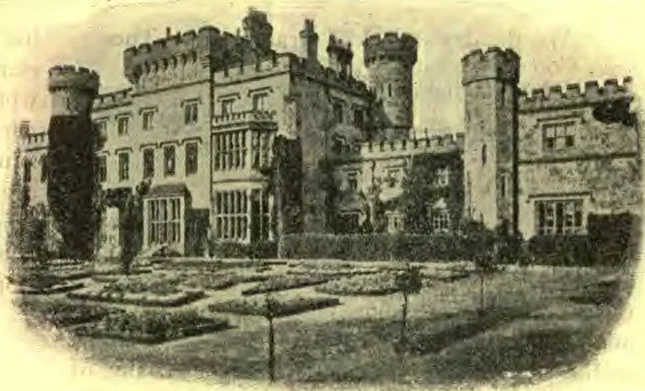
HAWARDEN CASTLE, NEAR CHESTER
Wrens have been known to enter houses through open windows and attempt nest-building indoors, and in places, too, very inconvenient to the family, as in a card-basket on the piano, and on the pole supporting portières. But more curious than all other instances, it seems to me, is the following. In the spring of 1901 a hornets' nest that had long hung in my hall was temporarily placed in a covered porch. Some weeks later, a pair of wrens were noticed examining it very critically, and they finally decided that as a nesting-site it was in every way admirable. The fact that I was frequently sitting on that porch, often with two or three others, in no wise troubled them. The birds were absolutely fearless.
Having chosen the hornets' nest as a summer residence, the wrens first cleared out sufficient space for their use, and chipped a new circular entrance to it. This they made the more secure by placing in front a platform of twigs, many of which were thrust through the paper walls. This was not always easily done, and gave rise to some cross words, or so it seemed. Except a few feathers, there was nothing carried into the hole made by the wrens in the body of the hornets' nest. As soon as all was to their liking, eggs were laid, and the brood sufficiently reared.
While the parent birds were noticeably tame during the days of nest-making, they were even more so when there were young birds to look after. Without really troubling them, I tried in many ways to test their confidence in my good will toward them. Several times I leaned against the pillar supporting the roof of the porch, so as to bring my face within eighteen inches of the opening to the nest. Twice, under such circumstances, one of the old birds darted by me and entered, but at other times waited most impatiently until I again sat down in the chair near by.
One fact that interested me greatly was that when interrupted by my coming, the wren, firmly holding a wriggling worm in its beak, would scold crossly, making a loud whirring and shrill sound. How the bird could make the sound and yet retain the worm in its beak, I leave to others to explain.—Selected.