Virgin’s-Bower, Traveler’s-Joy, Old-Man’s-Beard
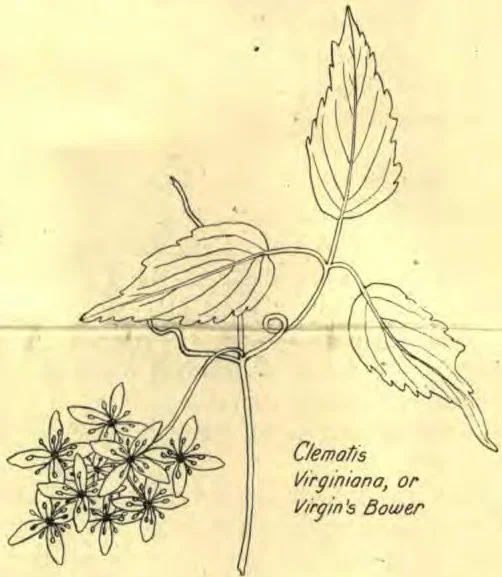
THE accompanying illustrations give a fairly good idea of the appearance of Virgin’s-bower. It will be noticed that the leaves are compound, consisting of three separate pieces known as “leaflets,” all having a common leaf-stalk by which they are attached to the stem.
There are several kinds of compound leaves, some having all the leaflets attached to the tip of the leaf-stalk, while others have them attached along the sides. These will all be mentioned in future articles. Compound leaves having three leaflets, as is the case with the leaves of the Virgin’s-bower, are known as “ternate,” this word being derived from the Latin terni, meaning “by threes.”
The leaf-stalks, as will be seen from the illustration, are inserted opposite each other on the stem, and for this reason the leaves are said to be “opposite.”
If a number of different plants of Virgin’s-bower were examined, some would be found with flowers having stamens but no pistils, and others with flowers having pistils but no stamens. The former are staminate flowers, and the latter pistillate. Since the two kinds of flowers are borne on separate plants, they are described by botanists as dioecious (di-e’shus), meaning “of two households.” The flowers shown in the illustration are of the staminate sort.
The corolla is absent, but the calyx is present, consisting of four greenish-white sepals. It bears so close a resemblance to the corolla of other flowers that one unacquainted with the facts would think it a corolla instead of a calyx. The pistils are indefinite in number; that is, not of the same number in every flower.
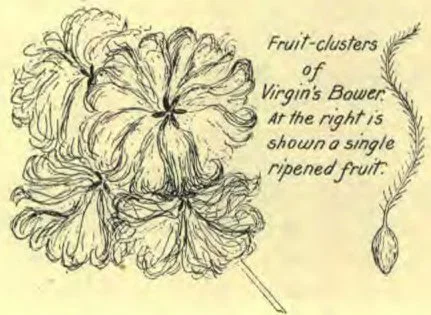
In the lower figure is shown a single ripened fruit, or seed-vessel, of the Virgin’s-bower. The enlarged part containing the seed is the ovary, and the long, feathery appendage is the style. Ordinarily, when speaking of fruit, we refer to such edible products as apples, peaches, plums, grapes, berries, etc.; but in botanical language the term “fruit” is applied to the ripened ovary, together with other parts that are sometimes closely connected with it, such as the calyx, the style, and the receptacle. More will be said about the different kinds of fruits at another time.
The ovary of the Virgin’s-bower, when ripe, is a small, dry, one-seeded fruit, having very much the appearance of a naked seed. Fruits of this kind are called acheniums. The style may remain attached to the fruit, as is true of the plant under consideration, or it may fall off before maturity. When retained, it becomes elongated and feathery, thus aiding in scattering the seeds of the plant, as it enables them to be carried long distances through the air.
Virgin’s-bower is one of the most common wild plants, growing nearly everywhere along the country roads, and in thickets and hedges, supporting itself by means of its bending or twisting leaf-stalks. Experiments regarding the movement of these leaf-stalks show that they make a complete circuit in about six hours, and that they follow the course of the sun. They revolve in as short a space of time as the tips of the morning-glory vine.
There is perhaps no other wild vine more beautiful than Virgin’s-bower as it hangs in graceful festoons from trees, climbs over shrubs and rocks, or covers fences and stone walls by the roadside, especially those roads that follow the river-courses. I have seen large numbers of these vines growing in Colorado along the mountain roads that follow the mountain streams. It flourishes even in extremely cold climates, will bear transplanting, and is excellent for decorating rustic fences.
In July and August it is covered with white blossoms, and a few weeks later the silvery plumes of the ripened fruits present a striking appearance, and have suggested the name, “Old-man’s-beard,” which is sometimes applied to it.
The different botanical terms mentioned in this article should be borne in mind, as we shall have occasion to use them again in future studies.
B. E. CRAWFORD.