He is something of a paradox, is Big Ben; for in his case the part is greater than the whole. “The great clock at Westminster” is really the proper title of one of the largest and most accurate of the world’s public clocks. Popular sentiment, however; a feeling for the picturesque; coupled, perhaps, with the need of some shorter and less cumbrous name, all conspired to transfer the name of the bell on which the hours are struck to the clock itself.
As a matter of fact, Big Ben dates back considerably less than half a century; for he was placed in his present position only in 1859. Six or seven years before that, however, the decision had been reached that a clock should crown the palace at Westminster. That decision taken, the question arose: Who is to construct it? The leading maker of large clocks of the period was consulted; but he refused to consider its construction, as he did not believe that it would be possible for a clock to conform to the conditions laid down by the board of works, among them being the accuracy of the time which the clock should keep.
Under these circumstances the authorities turned to Mr. E. J. Dent, who had made the clock at the Royal Exchange, which was erected in 1845. It had run so well that it was believed its maker would be able satisfactorily to surmount the difficulties which the horologists feared.
Soon after the contract had been given, Mr. Dent died; and in consequence of much unworthy opposition on the part of rival firms, the authorities tried to break the contract, which his son, Mr. Frederick Dent, was prepared to carry out. Eventually, however, the contract was renewed. Even then more difficulties arose; for the clock tower was not ready for its reception, and the clock had to be kept going in the factory until 1859, when it was fixed in its present position.
The room in which the machinery of the clock is fixed is known as the clock-room. It is a large, bare chamber, reached by three hundred and seventy-four steps from the ground, and contains, in addition to the clock, merely a workbench, some ladders, and two benches on which the workmen and winders may rest. The clock is fifteen feet six inches long, four feet seven inches wide, and one foot seven inches deep.
Along the whole of its length, extending in a single line, is the following inscription:— “This clock was made in the year 1854, by Frederick Dent, of the Strand and the Royal Exchange, clockmaker to the Queen, from the designs of Edmund Beckett Denison, Q. C.,” while below it are the words: “Fixed here,” surmounting the date “1859.”
The arrangement of the machinery was almost a new departure from the old style of turret clock. Instead of being built perpendicularly, it is laid horizontally, so that any wheel may, if necessary, be taken out without disturbing the others. This is obviously a point of practical importance in a clock which it is necessary should be, and is, kept going with as few interruptions as possible. In the clock there are forty-four wheels, the largest of which is three feet four inches in diameter, and the smallest is six and three-fourths inches. The pendulum is thirteen feet one-half inch long, and weighs about seven hundred pounds, while the weight of the bob is about four hundredweight. Only a small portion of the pendulum can be seen in the clock-room, as it goes through the floor, and vibrates in a separate chamber below, in order to protect it from the wind.
In the body of the machinery of the clock are four small dials, by means of which the hands are set and the striking parts adjusted, so that all may go off simultaneously; for when the size of the hands is borne in mind, it is obvious that mechanical means must be devised in order that they may be moved and placed with absolute accuracy. In the machinery, too, is an electrical contact apparatus, by means of which twice every day, at twenty-two minutes to twelve and twenty-two minutes to one, the clock signals its time automatically to Greenwich Observatory; and Greenwich, by means of a galvanometer, gives its signal in the clock-room every hour.
How accurate Big Ben is may be judged from the fact that after its last cleaning it did not vary half a second a day for three weeks, while from March 28 to June 9, in a certain year for which the records were kept, its greatest variation was two seconds on one day; and, if fast or slow, it remained so for several days together, so that it practically did not vary at all. When it is remembered what weather we usually get in March and April, the claim that Big Ben is the most accurate public clock in the world can not be questioned.
To wind the clock two men are engaged three afternoons every week. The going part of the machinery is wound in twenty minutes, but it takes five hours to wind the striking. The winding of the strike is done by the turning of the handles of two winches connected with the barrels on which is wound the wire rope which carries the weight that drives the machinery, one hundred and twenty-five turns of the handle being necessary to get one turn of the barrel. As there are sixty turns of rope on each barrel, each man has to make considerably more than seven thousand turns of the handle to wind his part of the machinery.
As each quarter of an hour approaches, the winders are compelled to leave off, so that the machinery may be quiet for the clock to strike. The men need not, however, watch the time for this; for before it strikes, the clock itself always gives a special warning, one for the quarters and one for the hours.
When the strike goes off, one might be in a machine shop, in which a score of smiths were working with might and main. There is a rattle, rattle, rattle of machinery, a clanging and a clanking of steel on steel, making so much noise that it is impossible to hear one’s self speak in the room. The fans above the machinery whirl round and round, letting off the train of wheels which run at a certain speed under a weight of one ton five hundredweight for the quarters and of one ton for the hours. These weights pull down the ropes attached to the hammers of the bell; the hammers rise to a height of eleven inches in the case of the smaller bells, and to a height of fourteen inches for Big Ben, and, when allowed by the machinery to fall from that height, they strike. After the train of wheels working the strike is locked with a curious rattle of the machinery, there is another rattle as the fans themselves are in their turn locked, until the passage of another quarter of an hour releases them to start the striking again.
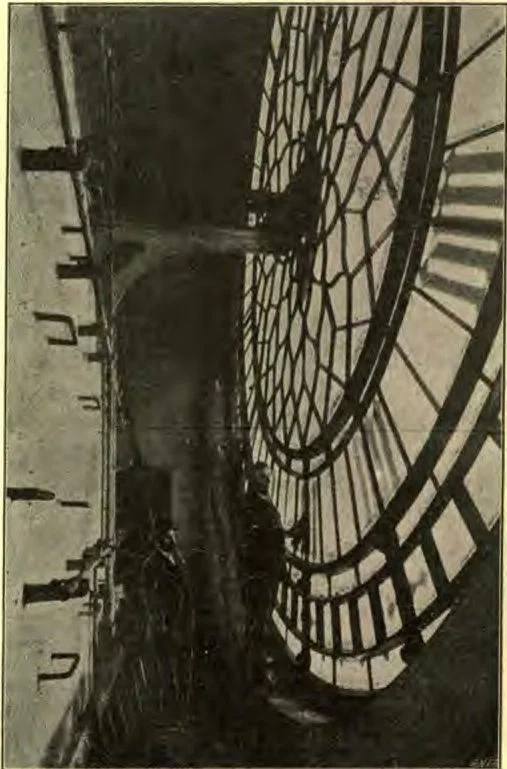
A short flight of nine steps leads from the clock-room into the dial-chamber, where one gets the first really appreciative view of the enormous size of the clock, whose proportions appear so ordinary when seen from the street. The chamber is merely a narrow space in which the four faces of the clock are fixed, with a special arrangement of nineteen or twenty jets arranged in five tiers by means of which the dial is illuminated at night. This room, whose walls are white-washed to reflect as much of the light as possible, furnishes, too, the first opportunity one gets for studying the enormous strength of the tower, the walls being about eighteen inches thick where the dial is fixed, while the corners are twice that depth. So firm and solid is the structure that, even when Big Ben himself strikes; no more vibration is to be felt than if one were in the street half a mile away.
Standing on the margin of the massive masonry into which the dial is fixed, the shoulder of a man of average height comes only just up to the level of the figures. Striking as this statement is, however, it is not wonderful when one is told that each dial, the center of which is one hundred and eighty feet from the ground, has a diameter of twenty-two feet six inches. The minute marks are each one foot long, separated by the distance of one foot, while the figures of the hours are two feet long. The minute-hands and counterpoise are fourteen feet in length, and weigh about two hundredweight each, in spite of the fact that they are hollow.
The first set of hands made were of gun-metal, but it was found that they were so heavy that no clock could drive them, so some lighter mode of design had to be sought; and copper, as being the most durable metal, was substituted for the alloy. The hour-hands, however, which, with their counterpoise, are eleven feet six inches long, are of gun-metal, and weigh about one hundredweight each.
From the clock-room, by means of forty-seven steps, the belfry is reached. In the middle stands Big Ben in all his glory of the largest bell to be seen in a public clock, with, at each angle of the belfry, one of the quarter-bells. Big Ben derives his name from his godfather, Sir Benjamin Hall, who was first commissioner of works at the time the clock was placed in the tower. Since then he has rarely stopped of his own accord, and has seldom been stopped for more than a few days at a time, in order to be cleaned.
Round Big Ben the following inscription may be read in the massive bronze: “This bell, weighing thirteen tons ten hundredweight three quarters fifteen pounds, was cast by George Mears, of Whitechapel, for the clock of the Houses of Parliament, under the direction of Edmund Beckett Denison, Q. C., in the twenty-first year of the reign of Queen Victoria, and in the year of our Lord MDCCCLVIII.”
Big Ben has a diameter of nine feet at the mouth, is struck with a hammer weighing seven hundredweight, and gives out the note E. The fourth quarter is struck on a bell six feet in diameter, weighing three tons eighteen hundredweightp. 132 , its hammer being one hundred and seventy-five pounds, and its note E. This is the bell which is struck twice every quarter in order to make up the necessary notes for the chime. At one time when Big Ben was incapacitated, the hours were struck on it.
The second quarter bell is four feet in diameter, weighs one ton six hundredweight, has a hammer of sixty pounds, and F sharp for its note; while the first quarter is struck on the smallest bell, which is three feet nine inches in diameter, weighs one ton one hundredweight, has a hammer of fifty-six pounds, and G sharp for its note. The chimes of these bells when they sound the four quarters of the hour produce the air of the beautiful verse:—
“All through this hour, Lord, be my guide; And by thy power No foot shall slide.”
Most people know that Big Ben is really the second bell which was cast for the great clock. The first did not stand the tests which were instituted, and so was condemned. The same metal, however, was recast, and the result is Big Ben the second. He is not so perfect as he might be, in spite of his size and the sonority of his voice; for there is a crack in the metal. A platform has been built under the bells for the express purpose of catching the pieces in case the constant striking should ever cause the great bell to break. This, however, is scarcely likely to happen for a very long time to come, as on one occasion when the clock was stopped for the purpose of being cleaned, some fourteen years ago, Big Ben was shifted so that the hammer, which is very much lighter than the one originally intended to be used, does not strike it near the crack. In the platform a great hole has been cut, through which Big Ben’s clapper goes; but so far as can be learned, the bell has never been tolled.—The Strand Magazine.