Tall Anemone, Thimbleweed
THIS is a giant sister of the delicate wood-anemone. The plant grows erect, and two or three feet high, or even more. At its upper part the stem divides into three or more long peduncles, each bearing a single flower. Just below these peduncles is an involucre of three compound leaves, with petioles from six to ten inches long. The middle peduncle is leafless, but each of the lateral ones has an involucre, or secondary involucre, of two short-petioled leaves. From the axils of these leaves other peduncles arise, each bearing an involucre and a single flower. This may continue until the branching becomes quite complicated.
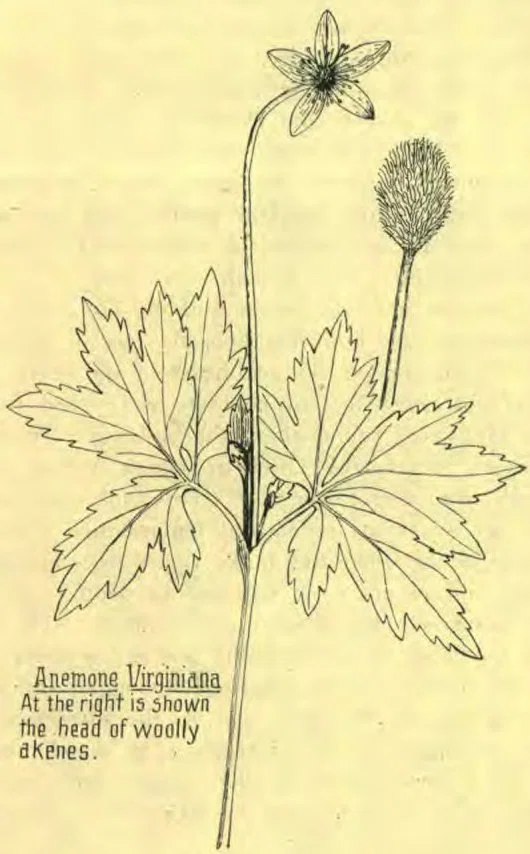
The illustration shows one of the lateral peduncles with its involucre, and the young flower-stalks rising from the axils of the leaves. The flowers are borne in succession all through the summer.
The corolla is absent, but the calyx is somewhat corolla-like, consisting of five small, greenish-white sepals.
The fruit cluster consists of a large number of woolly acheniums crowded together on an oval or oblong receptacle, the cluster when ripe being about three fourths of an inch long, and having much the shape and appearance of a thimble. Because of this resemblance, the plant is commonly known as “Thimbleweed.”
It is a rather common plant in woods and meadows. Though not especially beautiful, nor of economical importance, it is interesting because of its heads of woolly acheniums.
We have already learned that many of the plants belonging to the Crowfoot family bear flowers of considerable interest because of their size, beauty, or peculiar form. But there are some that do not, and of this class the Thimbleweed will serve as an example.
The season of the year has now come when those interested in botany should begin making their collections. Press two or three specimens of all the different kinds of plants you can find. Of the smaller plants retain at least a portion of the root, and whenever possible keep a specimenp. 163 of both flower and fruit. Specimens of trees should include the leaves, flowers, and also the fruits if they are of such a nature that they can be conveniently kept. It is well, also, to add a small piece of the bark.
The staminate and pistillate flowers of trees will, in many cases, not be found on the same tree. This should be remembered in gathering your specimens. B. E. CRAWFORD.