HORSEHAIR may be woven with warp and woof, or with a needle threaded with a single strand, or thread, of hair. The former produces by far the more beautiful results; and where a large amount of the work is to be done, it is less troublesome, and can be carried on much more rapidly, than with a needle. But where only a small piece is to be covered with woven work, as, for example, the places where the braids in our watch-guard are joined, it will not be practical to weave with warp and woof, as there is too much preliminary work on each piece before the actual weaving begins. Weaving with a needle, on the contrary, requires no preliminary work to speak of, and it is in this way that unsightly ends of braids are generally covered.
The thread used on such small work as the watch-guard should contain from eight to ten hairs. The larger end of the hair will be found much stronger than the tips; and as there is a good deal of wear at the point where the thread passes through the needle, it is best to thread it at that end. Cut the knot from the end of the thread, and pass it through the eye of a needle large enough to receive it without crowding. Do not draw it through too far, as the end, having no knot to prevent it, will soon untwist. Now with this horsehair-thread take two or three stitches through the braid at one end of the part to be covered. This will keep the thread from pulling through after the other knot is cut off, as it should be as soon as one circle of stitches has been woven around the work. Next wind the thread twice around the work, pass the needle under the ring so formed, and bring it up over the thread so as to form a loop, as shown in Fig. 5. This is similar to a buttonhole stitch, and will not be found at all difficult.
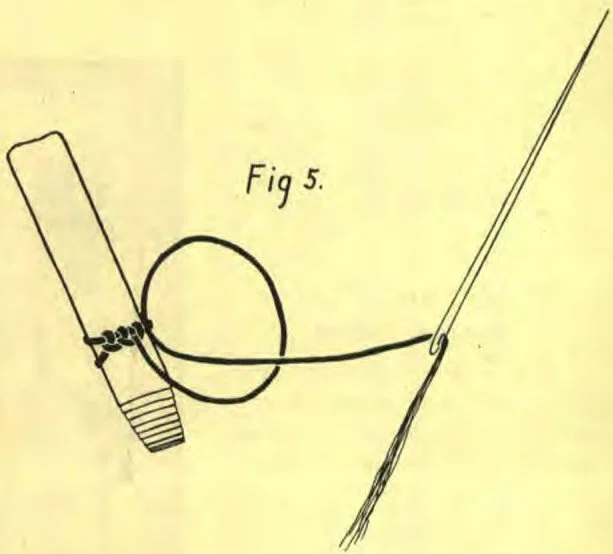
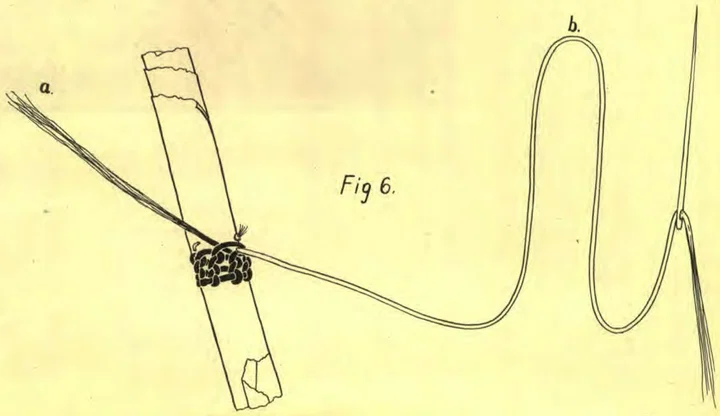
Continue to make these loops all around the work, always drawing the thread taut, so the loops will lie close together. When you have worked entirely around the braids, so that the circle of loops is complete, pass the needle through the first loop formed, and thus begin a new circle. You will now have an endless chain, and you can continue to work around and around till the work is finished, or the thread exhausted. In the latter case, when you come to the last stitch that the thread will take, do not complete the loop, but leave it as shown in a of Fig. 6, except that it should be stitched several times through the braid to prevent it from pulling out. Next place another thread in the needle, and complete the loop, as shown in b of Fig. 6. You can then continue the weaving as before.
When the ends and stitching have all been covered, it will only be necessary to sew the thread several times through the woven part, always being careful to conceal the stitches, and then cut off the remaining end. Horsehair is more or less elastic; and if the thread is drawn taut before it is cut, its elasticity will draw the severed ends back into the work, where they will not show.
In the illustration of the watch-guard published last week, you will remember there was a ring of this woven work uniting the two braids in the middle of the guard. This ring is intended to slide up and down; so of course the thread of which it is made must not be permanently fastened to the braids. Instead of this it is simply wrapped twice around the braids for a foundation upon which to begin the weaving; and after the work is finished, the projecting end is cut off.
This guard is intended to be worn around the neck, and it may be attached to the watch with a snap, such as those used on watch-chains, or the ring of the watch may be sprung from its place, slipped into the loop, and then sprung into position again.
J. EDGAR ROSS.