
THE FROGS.
By Floyd Bralliar
I have raised a number of frogs, but will tell the story of one, and let that do for all. In this story I will tell some things that I noticed with one frog, and some that I observed with others.
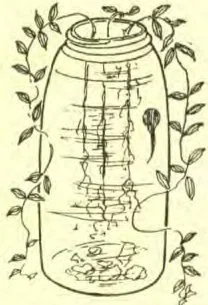
My first frog was a very young tadpole when I put him into a jar of water, and took him to the house. In the jar were planted some water-plants, and of course there were a great many microscopic beings in the water. The tadpole lived mostly on the little organisms that grew on the stems of the plant, though I have no doubt that he also ate some of the germs that were too small for me to see. Tad was a young bullfrog, and of course grew to be about three inches long before he became a frog. When he was a baby, he had gills, and breathed water like a fish. At first he lay near the bottom of the jar most of the time. When he was about three months old, he began to show signs of something happening, and soon he had two little feet growing out where his front legs were to be. Pretty soon legs began to grow, and before long his front legs were fully developed. But so far he had no hind legs. Some frogs get their hind legs first, some their front ones first, and some all at once. There seems to be no rule about it.
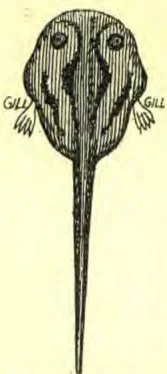
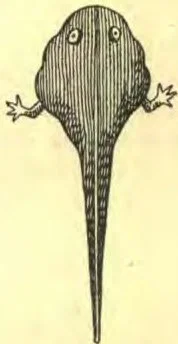
About the time Tad got his first legs, he began to show a disposition to come to the top of the water very often. On examining him, I could see that his gills were growing smaller, and that he liked to get a breath of real air once in a while. Now he would eat bread-crumbs or bits of egg. In about a month his hind legs began to grow, and in another month he had four real legs, as well as his tail. Now he stayed at the top of the water most of the time, unless some one was too near. The pollywogs of some kinds of frogs are to be found at the top of the water, breathing air as soon as they hatch from the egg.
When Tad was five or six months old, he began to use his legs as much as he could, and his tail grew smaller every day. A support for him was not thought of, and of course he could not climb on the glass. He breathed air entirely now. One day he was found dead in one part of the jar, and his tail lay in another. He had become a frog, and lost his tail. Then, as he could not swim enough to keep on top, he had drowned.
Most of my other frogs lived in a pond by the side of the road on my way to school. They were little fellows, and used to make things merry with their songs. In April the frogs would lay their eggs, which looked very much like a bunch of the gum that sometimes runs out of the limbs of peach or apple trees, except that it was in little round drops. Each drop had a spot in it about the size of a pin-head. This was the yolk of the egg. The eggs were stuck fast in bunches to grass and sticks that happened to be in the water. By the last of June they had hatched, and developed into frogs. The only time I ever played truant from school was to watch them crawl out on the bank, try to hop, and finally lose their tails. I have seen many boys get their first pair of trousers; but I have never seen one more pleased than a frog when he loses his tail, and can jump and croak.
Next to losing his tail, the most interesting time in a frog’s life is when he gets a new suit of clothes. On the great day a number of frogs which were ready to shed their skin would hop out on the bank, blink their eyes, and croak a few words in frog language. First one or two would catch a third around the waist, and hold him firmly in their arms. Then another would catch around him just behind the front legs, and several others would begin to nibble and bite at the skin on his back. Soon it would loosen and come off. Then all would scramble for the skin, and those that succeeded in getting it proceeded to eat it. Afterward they would skin another in the same way. They all acted very proud when they got rid of their old skin. Frogs eat any kind of meat that they can get, even their own young. Sometimes, too, they eat the seeds of weeds.
FLOYD BRALLIAR.