The aurora borealis, also called “polar lights” and “northern lights,” is still a mystery to astronomers and scientists. No effort to write a connected history of the phenomena has ever been attempted. The ancients called them chasmata bolides, or trabes, according to their form and colors. In Shetland and Scotland, where they have been frequent, they have been called “the merry dancers.”
The first record of an aurora was made in 688 A. D. This was followed by occasional mention of the phenomenon, until in September, 1621, it was observed all over France. Between 1621 and 1707, eighty-six years, astronomers make no mention of the occurrence of an aurora.
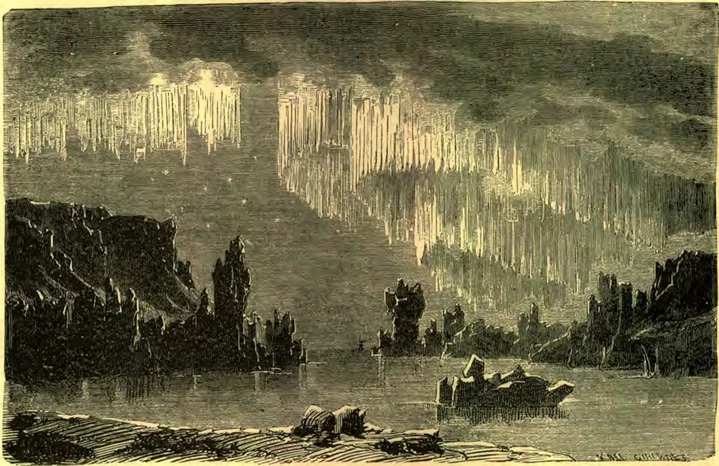
As it has sometimes been visible by daylight, the conclusion has been reached that a light so faint as is the aurora (a light so faint that it does not obscure the stars) could not be visible in sunlight unless it was developed in cloud or mist of some sort. D. Low asserts that all clouds are subject to magnetic influence; that when the lines converge toward the magnetic pole, fine weather follows; when they are at right angles to this position, wet and stormy; and that he has observed as fine auroral motions in the cirrus cloud as he ever beheld in a midnight sky. As clouds have sometimes been observed during the day to assume the forms of aurora, he, with others, is inclined to believe that the aurora is dependent upon the existence of certain clouds for its development.
Lilbermann asserts that aurora are preceded by the same general phenomena as thunder-storms, in which the clouds, instead of bursting in thunder, are drawn into the upper part of the atmosphere, and their vapor crystallized in tiny prisms by the intense cold, the electricity becoming luminous as it flows over these tiny particles.
Early observers believed that the aurora was an electric discharge in the rarefied upper atmosphere, but recent spectroscopic observations do not support this view. Any glowing gas, when analyzed by the prism, is found to consist of a series of colored lines and bands, called its spectrum. The light of the aurora gives a spectrum, “usually consisting of a single line, in greenish-yellow, which does not coincide with a principal line of any known substance,—a spectrum totally different from those of the gases of the atmosphere.”
W. S. CHAPMAN.